













// Comparisons
Atlas vs Vincere (2026): AI-Native Architecture vs AI Added Later
Atlas vs Vincere: which platform fits your agency in 2026
Atlas and Access Vincere Evo (Vincere) both combine ATS, CRM and automation into one system for recruitment agencies, and both market themselves as AI-powered. The difference is how the AI is sold. Vincere licenses the CRM and ATS per user, then adds AI in Smart Packs on top. Atlas includes its AI in the seat price, because there is no version of Atlas without it.
What Vincere actually is
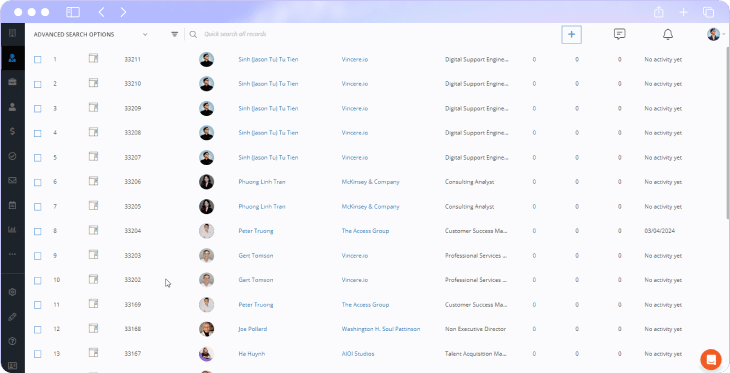
Access Vincere Evo, still widely known as Vincere, is an ATS and CRM for recruitment agencies. It is now part of The Access Group, the enterprise software group, and sits alongside Access Recruitment’s wider product line. Vincere states 22,000+ recruiters on its homepage and 22,000+ agencies on its about page.
The platform covers a combined ATS and CRM, recruitment automation, real-time analytics and reporting, no-code client and candidate portals, video interviewing through Vinneo, a communications hub with embedded chat, and TimeTemp for timesheets, expenses, invoicing and leave tracking. That last component is the deepest back-office coverage of any platform in this comparison set.
Vincere’s AI arrives through Access Evo, described by the company as an intelligence layer built into the tools an agency already uses. Capabilities across the packs include candidate scoring, job description and ad creation, content creation, candidate summaries and speccing, Copilot AI, Evo Docs, LinkedIn content creation, CRM automation and an enrichment agent.
Pricing has two parts, and Vincere sets it out plainly on its homepage: start with the CRM and ATS from £69 per user per month, then “add AI on top of your CRM licence” from £25 per agency per month. The AI Smart Packs are Base from £25, Present from £139, Automate from £235 and Elite from £349, each per agency per month rather than per user. Capabilities are gated across those tiers — candidate summaries and speccing from Present, CRM automation and the enrichment agent from Automate, the full suite at Elite (vincere.io/pricing, verified 1 September 2026).
What Atlas actually is
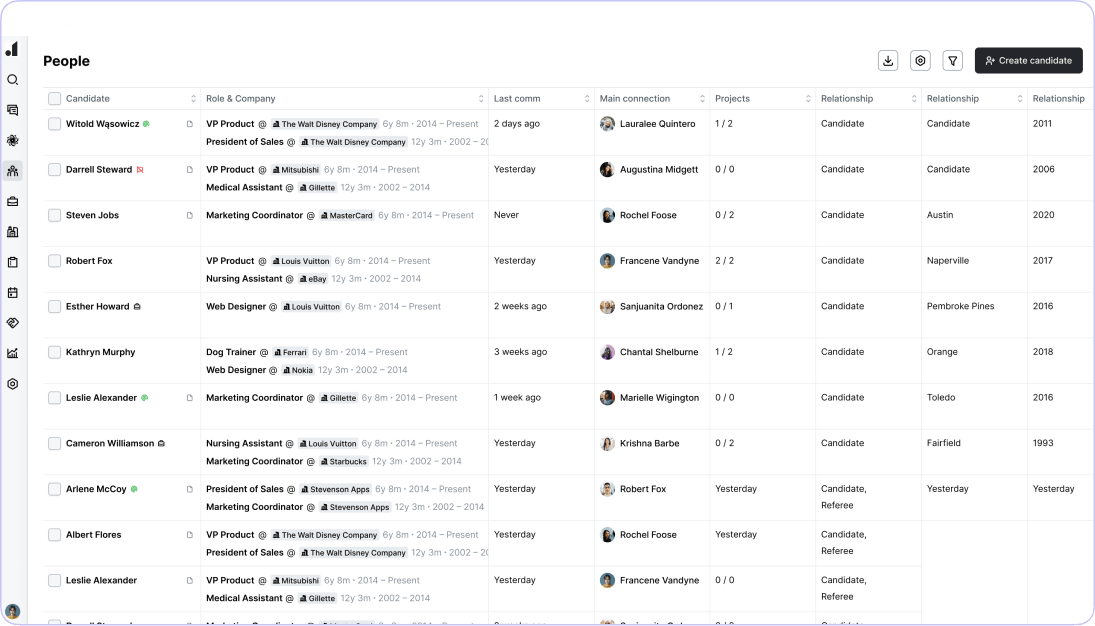
Atlas is an AI-native CRMx — one system combining CRM and ATS — built for agency recruiters and launched in 2023. Its core is Total Memory: a persistent intelligence layer capturing everything a firm’s team says, hears, reads and writes across calls, emails, meetings and notes, made searchable and available to AI agents at every stage of the pipeline. On top sit generative agents that remove recruitment admin, Opportunities for business development, Magic Search for criteria-based candidate assessment, a native AI note-taker, multi-touch outreach campaigns, custom dashboards, an MCP server, a Chrome extension and a mobile app. Atlas serves 500+ agencies, is backed by Smedvig Ventures, and puts around 40% of its team into engineering and product. Pricing starts at $120 per user per month on an annual commitment paid up front.
At a glance
| // Features | Atlas | Vincere |
|---|---|---|
| Category | AI-native CRMx (CRM + ATS) | ATS and CRM with AI sold as add-on Smart Packs |
| Ownership | Independent; backed by Smedvig Ventures | Part of The Access Group |
| Founded | 2023 — AI-native from first commit | Established platform; AI layer added via Access Evo |
| Core intelligence | Total Memory over your firm’s own calls, emails, meetings and notes | Access Evo intelligence layer across Access products |
| Where the AI sits | Included in the seat price | Smart Packs purchased on top of the CRM licence |
| AI agents | Run continuously and ambiently; fully automated BD workflows in build | Copilot AI, enrichment agent, CRM automation — gated by pack tier |
| Search | Magic Search v2, criteria-based fit scoring in plain language, live since March 2026 | Candidate scoring and ranked shortlists; database search field, tag and Boolean based |
| Business development | Opportunities — job leads, target clients and marketable candidates in one workspace, moving toward end-to-end automation | CRM pipelines and automation |
| Temp and contract back office | Contractor management | TimeTemp — timesheets, expenses, invoicing, leave tracking |
| Company shape | Product-led — around 40% of the team in engineering and product, 10% in sales | One product within a large multi-product software group |
| AI consumption model | Magic Credits, unifying AI usage across the platform | Fixed monthly pack price per agency, by tier |
| Pricing | From $120 per user/month, annual, paid up front, AI included | From £69 per user/month for CRM + ATS; AI packs from £25 to £349 per agency/month |
| Scale | 500+ agencies | 22,000+ recruiters |
Vincere figures verified against vincere.io on 10 October 2026.
Where Atlas and Vincere overlap — and where the overlap stops
At feature-name level, the two platforms look similar. Atlas and Vincere both replaced the legacy stack where an agency ran an ATS, a separate CRM and a handful of point tools. Both are single systems of record. Both run recruitment automation. Both produce candidate summaries and scored shortlists. Both offer client-facing presentation, dashboards and reporting, a mobile app and a wide integration set. Both describe themselves as AI-powered. Anyone comparing spec sheets will find a lot of matching rows.
The spec sheet is the wrong instrument. Two platforms can list “candidate scoring” and mean different things, because the question is not whether a capability exists but what it is connected to — and, in this comparison, whether it comes with the platform or is bought separately.
This is where the overlap stops. Atlas built its data model around AI first and the recruitment workflow second: Total Memory exists so that every downstream agent has the full context of what the firm knows, and everything else was added to that layer. Vincere built a recruitment operating system, and Access Evo brings intelligence to it as a layer across the group’s products — which is why the AI has its own price list.
Vincere’s own marketing states that its AI is “built in, not bolted on.” Its own pricing page describes the commercial reality differently: start with the CRM licence, then add AI on top of it. Both sentences are on the same website. The pricing page is the one that determines what an agency actually receives.
The architectural question, stated plainly
Every recruitment platform now claims to be AI-powered. The claim only means something if you ask what it would cost the vendor to be wrong.
A platform built on AI foundations compounds from external progress: when frontier reasoning improves, the whole product improves, because the intelligence sits in the data layer rather than in individually-integrated features. A platform that adds AI as a layer integrates each advance separately, against a schema designed before anyone knew what would be needed.
There is a commercial signature to each. When AI is the foundation, it cannot be priced separately, because no version of the product exists without it. When AI is a layer, it can be — and a four-tier pack structure sold per agency on top of a per-user licence is about as clear a statement of that as a pricing page can make. This is not an accusation. It is how Vincere describes its own commercial model.
Deep dive 1: how the AI is packaged and priced
How Vincere works. Vincere separates the platform from the intelligence. The CRM and ATS licence starts at £69 per user per month. AI then arrives through Smart Packs charged per agency per month: Base from £25, Present from £139, Automate from £235, Elite from £349. Capabilities step up through the tiers — candidate summaries and speccing appear at Present, CRM automation and the enrichment agent at Automate, the full set at Elite . Charging per agency rather than per user is a genuinely buyer-friendly choice at scale, and Vincere deserves credit for publishing the numbers rather than hiding them behind a quote.
Where Atlas is stronger. Atlas has one number. From $120 per user per month on an annual commitment paid up front, with the AI included — not bundled as a promotion, but because Total Memory is what the ATS and CRM are built on top of. There is no pack to choose, no tier at which the enrichment agent switches on, and no separate line item to renegotiate at renewal.
The structural point matters more than the arithmetic. A four-tier AI price list tells you the intelligence is modular: it can be added, removed, downgraded and upsold, because the platform functions without it. That is a legitimate way to build software, and it lets a cost-conscious agency buy only what it needs. It also means the AI a firm gets depends on which pack it bought, so two Vincere customers can be running materially different products — and the capabilities that most change a recruiter’s week, CRM automation and the enrichment agent, sit at Automate and above.
Atlas is also closing the one advantage a separately-priced AI layer can offer, which is visibility into what you are paying for. Magic Credits will unify AI consumption across the entire platform in a single view, so agency leaders can see exactly where the intelligence is being used.
Deep dive 2: scoring candidates vs remembering conversations
How Vincere works. Vincere’s AI centres on assessment and generation. Candidate scoring produces ranked shortlists against open roles, Copilot AI answers questions and drafts content, Evo Docs handles natural-language questions about documents, and the content tools generate job descriptions, ads and LinkedIn posts. Vincere also offers semantic matching through Actonomy as a marketplace integration for firms that want it. These are useful, well-scoped capabilities, and candidate scoring in particular does real work on a live shortlist.
Where Atlas is stronger. Scoring answers a question you already knew to ask: how well does this person fit this role? Atlas answers that too — Magic Searchlets a recruiter define what “great” looks like in plain language and scores every profile against those criteria with a visible fit rating.
The larger difference is what happens to everything that is not a CV. An agency’s real advantage is unstructured: the client who mentioned a hiring plan on a call, the candidate who said in passing they would move for the right package, the feedback a consultant wrote into a note before leaving the firm. Atlas captures all of it into Total Memory, indexed and searchable, and every agent reads from it. A scoring engine cannot use that context, because it was built to evaluate profiles against roles, not to remember conversations.
That is why the two products behave differently on the same query. Ask Vincere for the best fits for a role and it ranks your database against the spec. Ask Atlas and it can also surface the person nobody would have shortlisted on paper, because eighteen months ago they said something that makes them relevant right now.
Deep dive 3: one product versus one product among many
How Vincere works. Vincere is now part of The Access Group, and Access Evo is positioned as an intelligence layer running across the group’s tools rather than a recruitment-only capability. That brings real advantages: group-scale engineering resources, enterprise security and certification, 24/5 support, a large plug-and-play integration catalogue, established migration practice, and the balance-sheet stability that makes procurement teams comfortable. Vincere also publishes a public roadmap through its Innovation Pulse series, which is more transparency than most vendors offer.
Where Atlas is stronger. Inside a multi-product group, recruitment competes for roadmap attention with every other product in the portfolio, and an intelligence layer designed to serve several verticals is optimised for none of them. Group-scale resources are real, but so is group-scale prioritisation.
Atlas has one product and one customer type. Around 40% of the team works in engineering and product and around 10% in sales, and every decision about what to build next is a decision about agency recruitment specifically — not a trade-off against a payroll product or a care-sector system. The observable output is release velocity, and it is the thing Atlas customers volunteer without being asked.
For a buyer signing a multi-year contract, this is the question underneath the feature comparison: whose roadmap are you buying? A group product will be maintained well and improved steadily within the group’s priorities. A single product built for your exact business will move at the speed of your business, because there is nothing else for it to move at.
Where Vincere has genuine advantages
Temp and contract back office. TimeTemp puts timesheets, expenses, invoicing and leave tracking inside the ATS, which is the deepest back-office coverage of any platform in this comparison. For an agency running significant temp or contract volume, having pay-and-bill in the same system as the pipeline removes an entire category of reconciliation work, and Atlas’s contractor management does not go as deep. When it decides the choice: if temp or contract placement with timesheets and invoicing inside the ATS is core to your business, Vincere is a good fit.
Scale, group backing and certification. Vincere states 22,000+ recruiters, is part of The Access Group, holds ISO certification, and offers 24/5 support with an established migration practice. Atlas at 500+ agencies is the newer and smaller company, and its ISO 27001 certification is in progress with completion targeted for the mid of Q4 2026. For a procurement process that weights vendor scale and current certification evidence, that is a real difference today.
Per-agency AI pricing at scale. Charging for AI per agency rather than per user is unusually generous for a large team. A fifty-seat firm on the Elite pack pays £349 per month for the full AI suite across the whole business — a few pounds per user. The trade is that the CRM licence is still per user and the pack tiers gate which capabilities you get, so the effective cost depends heavily on headcount: below roughly ten seats the pack price dominates and Atlas is cheaper all-in, while above that the per-agency model works in Vincere’s favour. Both vendors’ figures are “from” prices, so run the real numbers for your seat count. When it decides the choice: if you have high headcount and modest AI requirements, Vincere’s per-agency packs are the cheaper structure.
What the market is telling us
Atlas talks to agencies evaluating the whole ATS and CRM market every week, including firms that trialled both Atlas and Vincere before deciding. What those buyers say is more useful than either vendor’s marketing, so we publish it as we hear it.
We were one of their first customers, so we’ve been with them a long time and we’ve got a very good deal with them. But since they’ve been taken over by Access, it does feel it’s not as good as it once was.
The price has gone up by 6.5% and they’re saying they can contractually keep us for another 36 months. Our account manager has basically vanished. Everything is through a chatbot.
Our price has increased every year but the product hasn’t got better. So much has changed over the last six to twelve months and our renewal came up. I handed our notice in because I wanted to test the waters.
Based on Atlas evaluation conversations, 2026. Updated as new comparisons come in.
Choose Vincere if
- Temp or contract work is central to your business and you want timesheets, invoicing and pay-and-bill inside the ATS.
- You have high headcount and modest AI requirements, where per-agency pack pricing beats a per-seat model that includes everything.
- You want the backing of a large software group, with 24/5 support and an established migration practice.
- Your requirement is a broad, dependable recruitment operating system rather than AI at the centre of the workflow.
Choose Atlas if
- You want the AI included rather than selected from a pack tier, with no capability gated behind an upgrade.
- Your firm’s knowledge is your product, and the problem is that it sits in inboxes, notebooks and departed employees rather than in a system you can query.
- You want admin to disappear rather than be automated where a pack tier allows it.
- You are buying the roadmap as much as the product, and you want a vendor whose only product is the one you use.
- You want one predictable number: from $120 per user per month, annual, paid up front, with AI included.
-
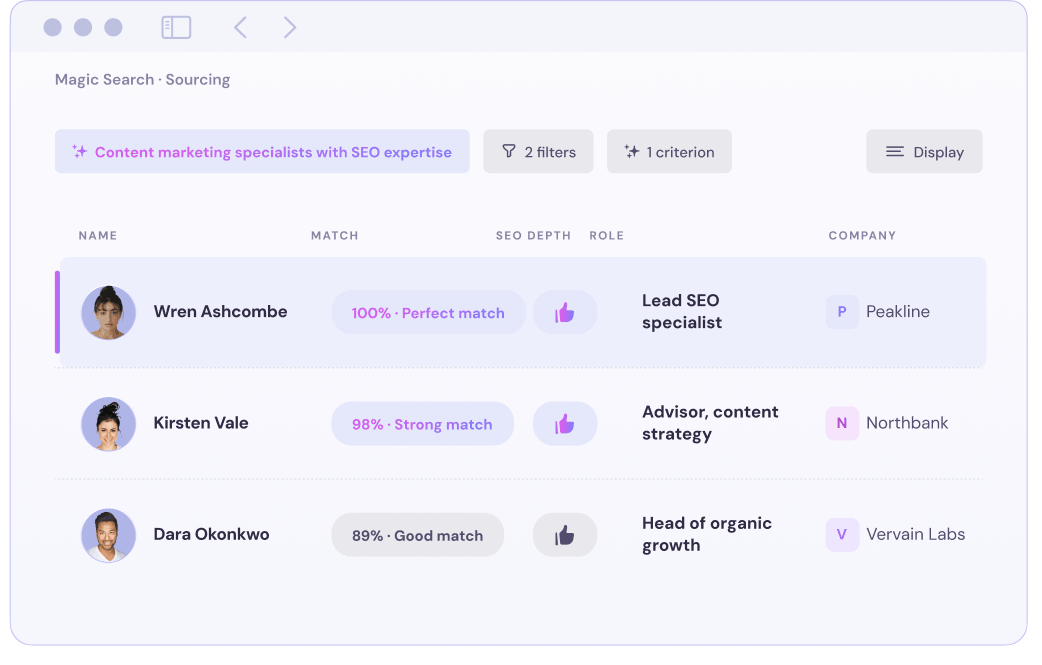
// Magic Search
Find the right people in plain English
Search your entire database using natural language and see exactly why every recommended candidate matches your criteria.
-
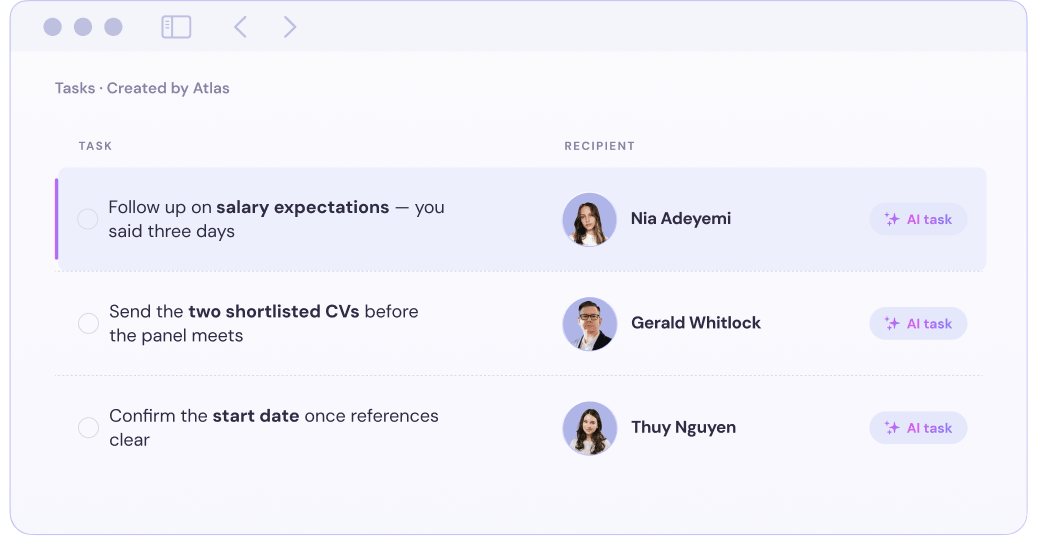
// AI Notetaker + Tasks
Turn conversations into next actions
Capture calls automatically and turn every commitment into a clear, timely follow-up task for your team.
-
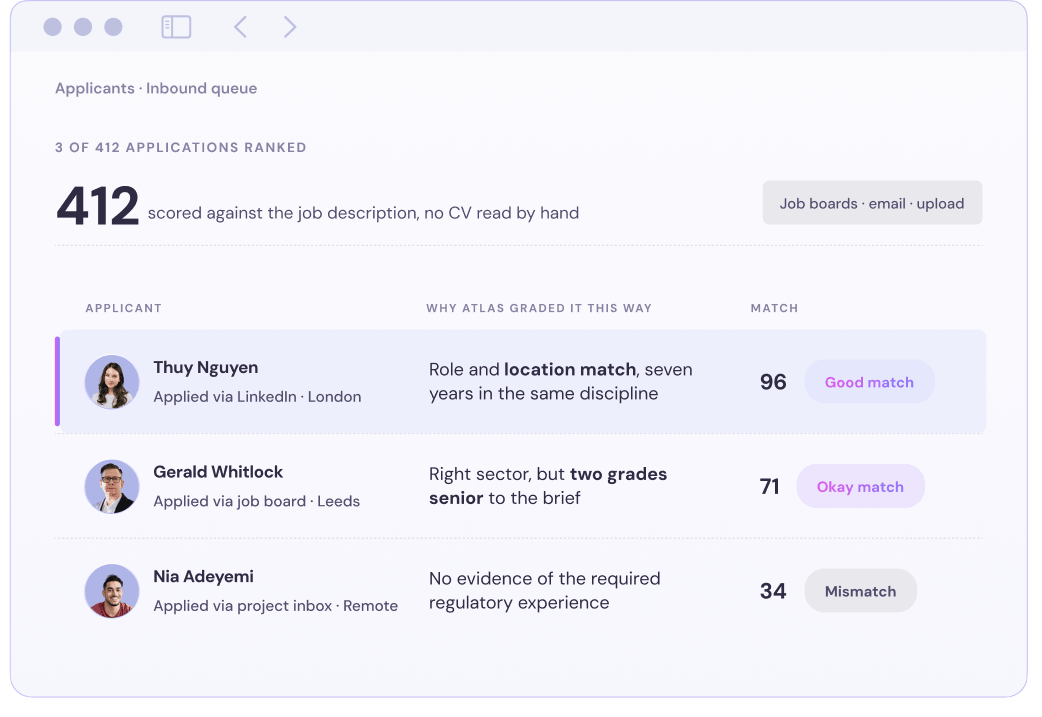
// Applicants
Triage applicants without database clutter
Automatically grade incoming applicants with clear reasoning while keeping unapproved profiles outside your main database.
-
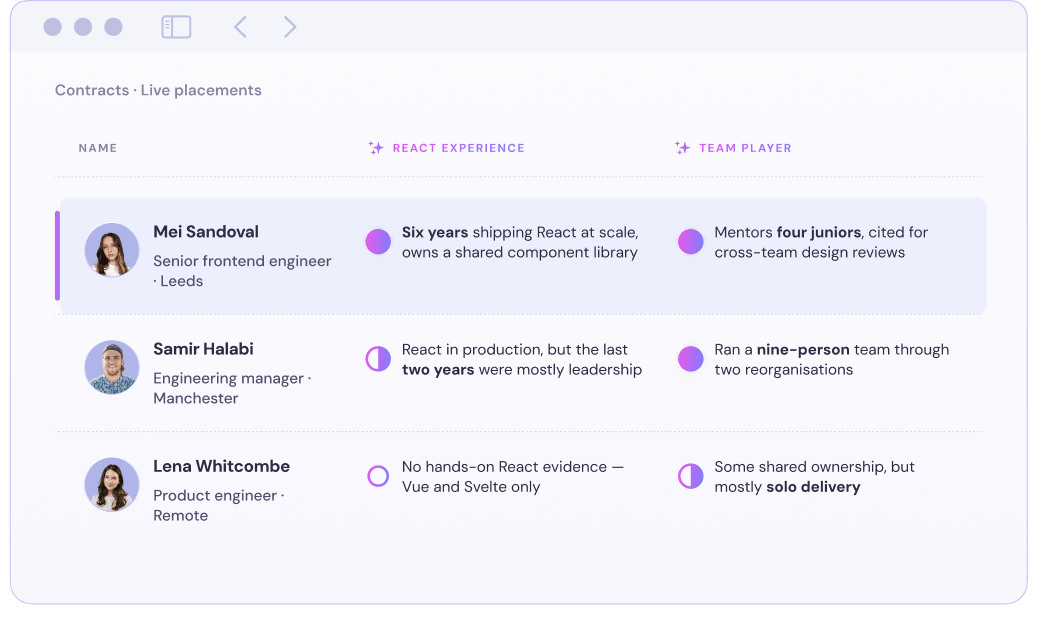
// Magic Columns
Score candidates against your criteria
Evaluate every candidate against your own competencies, instructions and scoring system using flexible AI-powered columns.
-
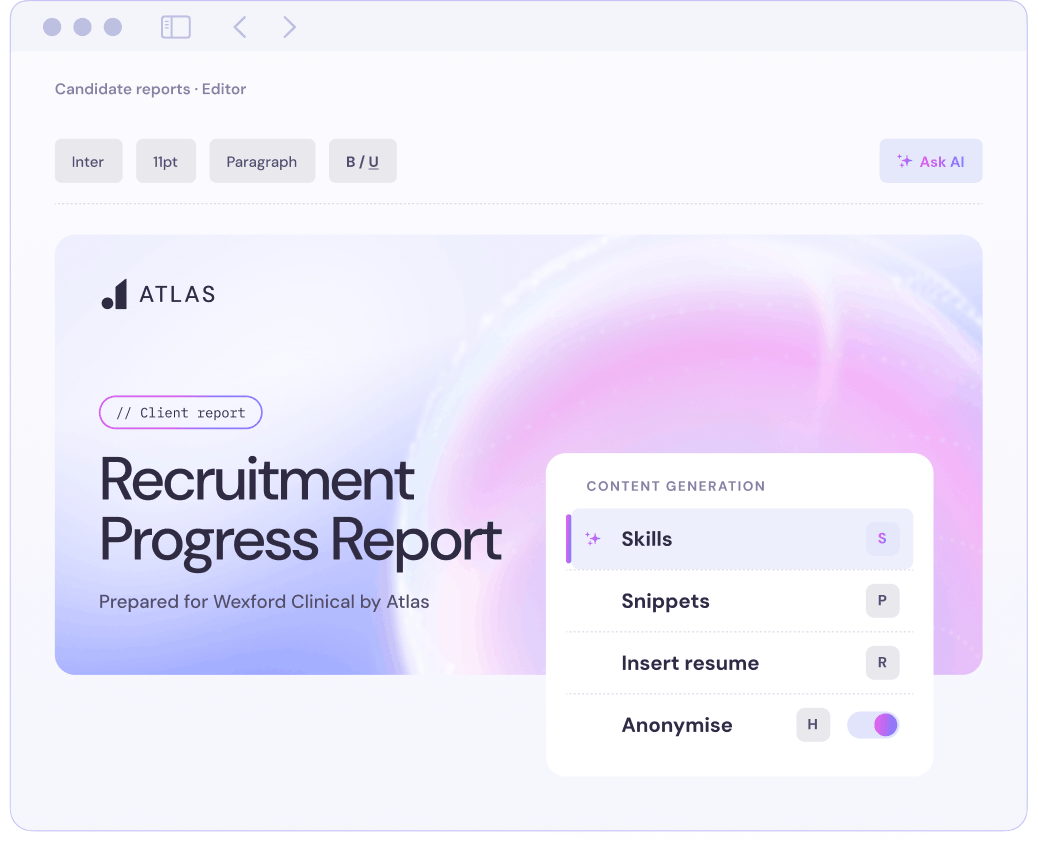
// Candidate Reports
Create polished candidate reports
Turn complete profiles, meeting notes and conversations into polished, client-ready documents.
-
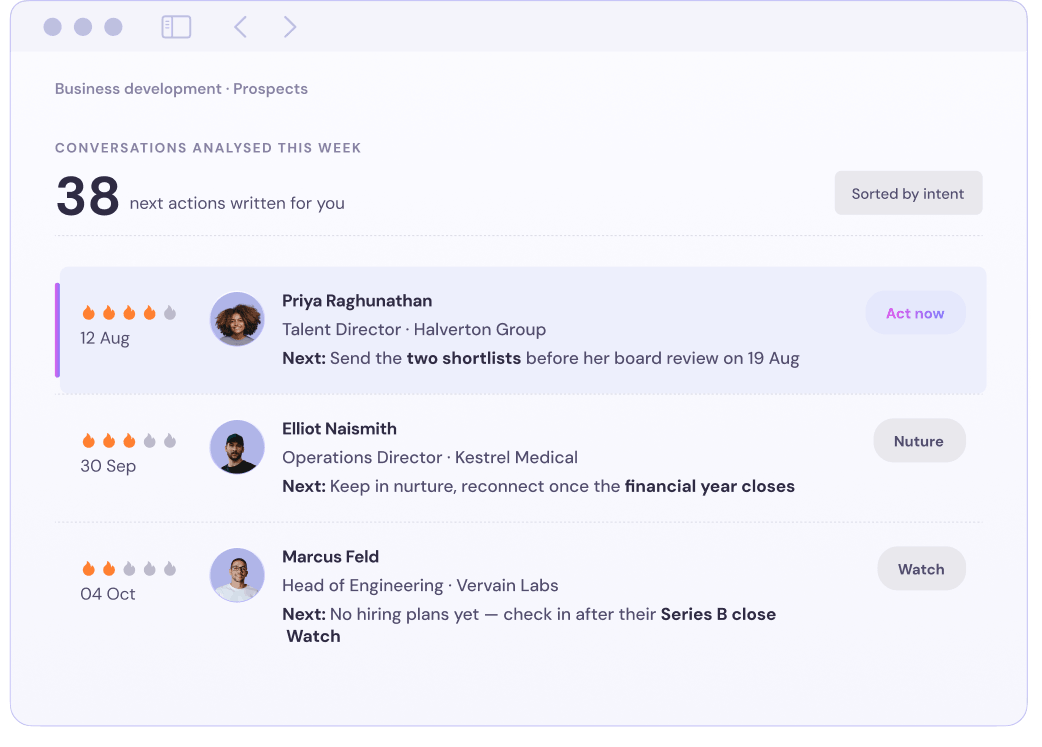
// Opportunities
Focus on opportunities most likely to convert
Track every interaction, assess urgency and prioritise opportunities using an automatically updated likelihood of winning.
-
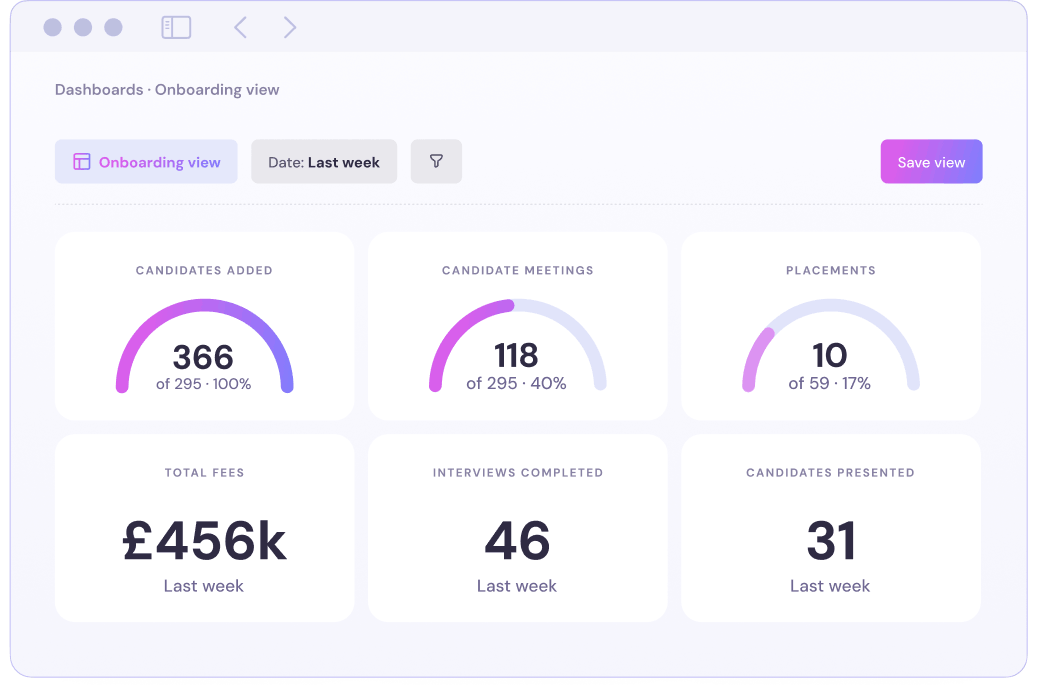
// Dashboards
See performance and pipeline in real time
Track performance, fees, placements and conversion ratios through live dashboards with custom views and filters.
-
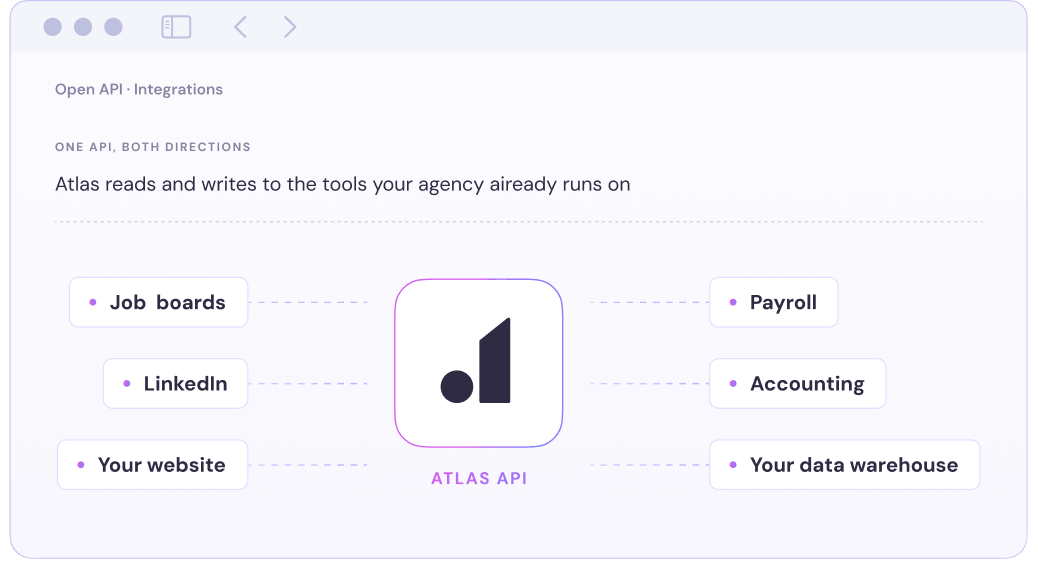
// Open API + Integrations
Connect Atlas to the tools you use
Connect external tools and custom workflows through Atlas’s public API and growing library of native integrations.
-
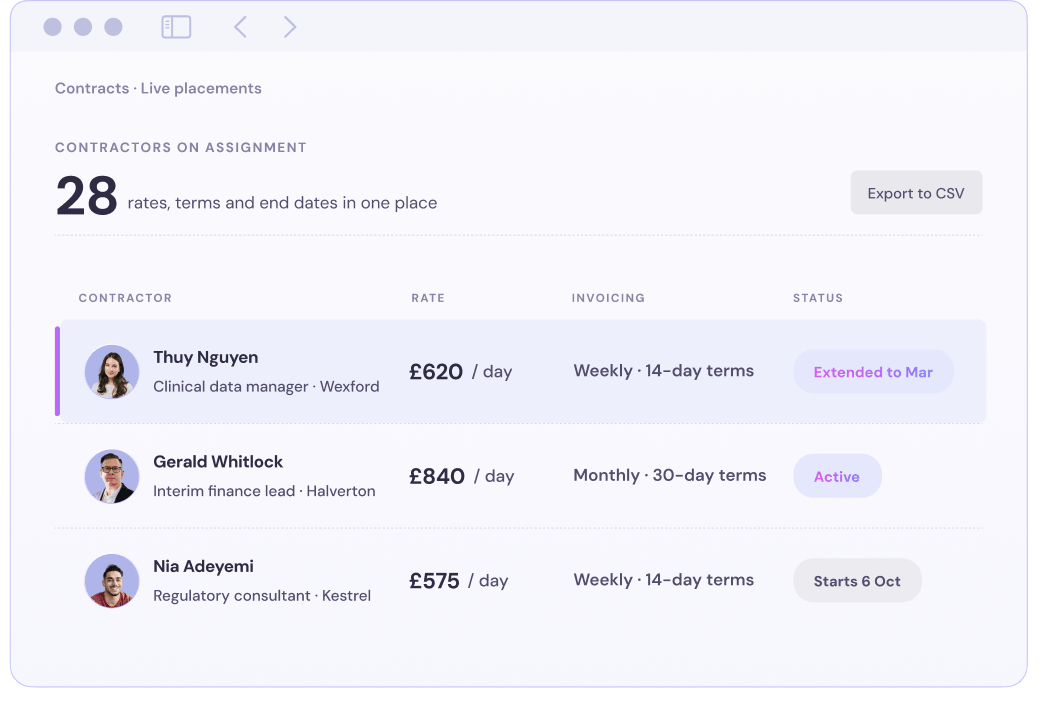
// Contract Management
Manage every placement in one platform
Handle permanent and contract placements with flexible rates, approvals, expenses and automatic status updates.
-
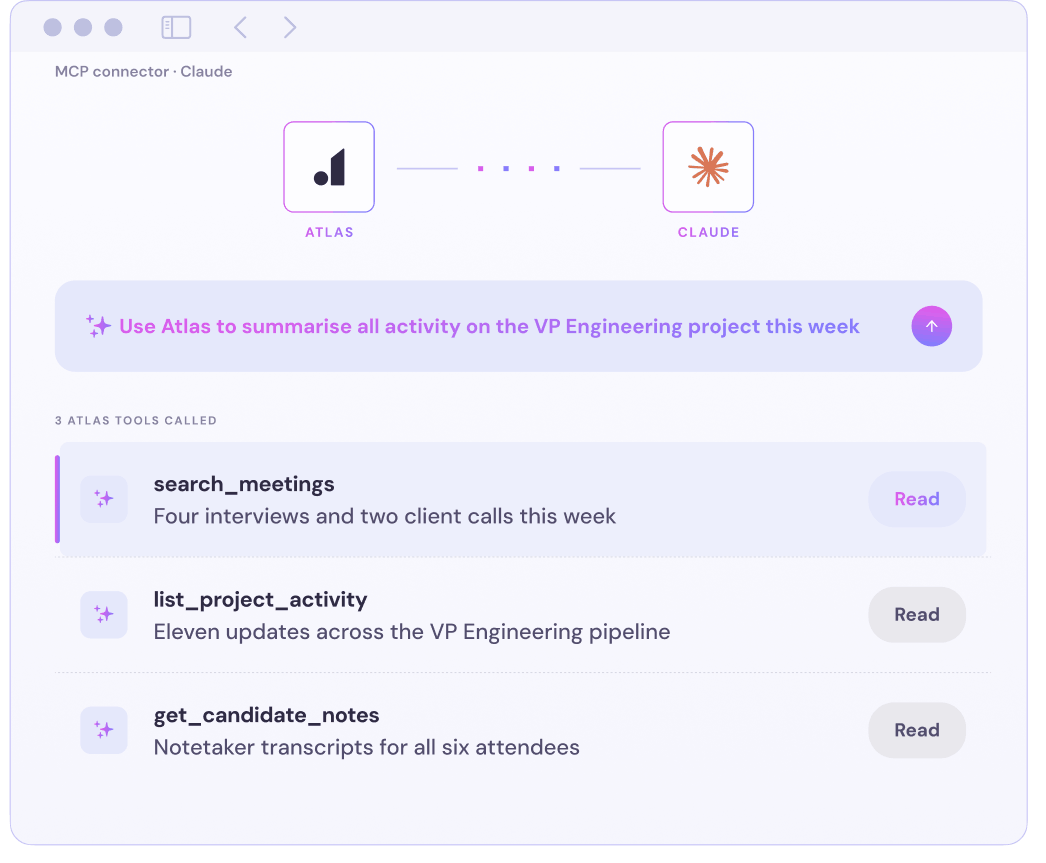
// Claude Connector
Ask Claude anything about your Atlas data
Get answers across candidates, projects, companies, meetings and transcripts without manually searching through records.
Pricing, side by side
Atlas starts at $120 per user per month on an annual commitment paid up front, with AI usage included. Magic Credits will unify visibility of AI consumption across the platform.
Vincere prices in two parts. The CRM and ATS licence starts at £69 per user per month. AI Smart Packs are added on top at £25, £139, £235 or £349 per agency per month depending on tier, with capabilities gated across those tiers.
The structures cross over with headcount, and buyers should do this arithmetic rather than compare headline numbers. At small seat counts, a per-agency pack spread over few users pushes the all-in cost per seat above Atlas. Both vendors quote “from” prices, so the honest advice is to price both at your actual headcount and at the pack tier that contains the capabilities you would actually use — which, for most firms evaluating on AI, means Automate or Elite rather than Base.
Migrating from Vincere to Atlas
Vincere is one of the most common systems our customers move from. We’ve completed well over 50 Vincere migrations, and Atlas’s VP Delivery has completed 300+ large-scale migrations before joining Atlas.
How it works:
- We analyse how you use Vincere. Before anything moves, we look at what’s in your database and how your team actually works: which fields matter, what’s been repurposed and what’s no longer used.
- We map your data into Atlas together. We agree with you where everything should land, so your records make sense in Atlas from day one.
- We test. You check your own data in Atlas before you switch over.
- We train your team. Your recruiters learn Atlas on their own data, not a demo database.
Preserving unstructured history matters more here than in a conventional migration, because that history is exactly what Total Memory operates on afterwards: a migration that carries records but drops notes, call logs and activity context discards the asset the platform is built to exploit. Ask any vendor, including Atlas, for a migration scope that names unstructured data explicitly.
Two things to settle with Vincere before you move: your notice period and renewal date, since three months’ notice is common, and whether any module or marketplace contracts run on separate terms from the core agreement.
The numbers behind the switch
-
// Garfield Stephers
80%less time spent on CV formatting
-
// Pace Global
30% +more candidates and roles handled
-
// Aym Recruitment
150%revenue growth after adopting Atlas
-
// Ethiq
200%of annual billing target achieved
-
// Tech Valley Recruitment
30 minsaved per candidate report
-
// Globus Search
4×faster candidate sourcing and updates
The verdict
Vincere built a broad recruitment operating system, and The Access Group has given it scale, certification and stability. The back-office coverage is above average in this comparison set, the roadmap is published, and per-agency AI pricing is a fairer structure than most vendors offer a large team. For an agency whose business runs on temp and contract volume, it is a good platform.
But Vincere’s own pricing page tells you what its AI is. You license the CRM, then you add intelligence on top, at one of four tiers, and what your recruiters get depends on which one you bought. Atlas cannot offer that choice, because Total Memory is not a pack on the product — it is what the product is built on.
That shows up in three places a buyer feels: one price instead of two, AI that arrives with the platform rather than with a tier, and a memory layer that holds the context a scoring engine was never built to see. Vincere sells AI as an upgrade. Atlas is the upgrade.
// See Atlas in action
Bring a live role. Book a 30-minute demo and we will run it in Atlas against your own data — not a sandbox, not a slide.


