












// Comparisons
Atlas vs Bullhorn (2026): Built on AI vs Assembled Around It
Atlas vs Bullhorn: which platform fits your agency in 2026
Atlas and Bullhorn are both ATS-and-CRM platforms for recruitment agencies, and both now sell AI. The difference is how each one came to exist. Bullhorn is the incumbent — 27 years old, 10,000+ customers, and a platform assembled through sixteen acquisitions. Atlas launched in 2023 with AI as the foundation rather than a product line added to one. That history decides most of what follows.
What Bullhorn actually is
Bullhorn is the largest software vendor in staffing and recruitment. Founded in Boston in 1999, it is founder-led under CEO Art Papas, employs 1,400 people across 14 countries, serves more than 10,000 customers, and has been majority-owned by private equity since 2012 — Vista Equity Partners first, then Insight Partners and Stone Point Capital (bullhorn.com).
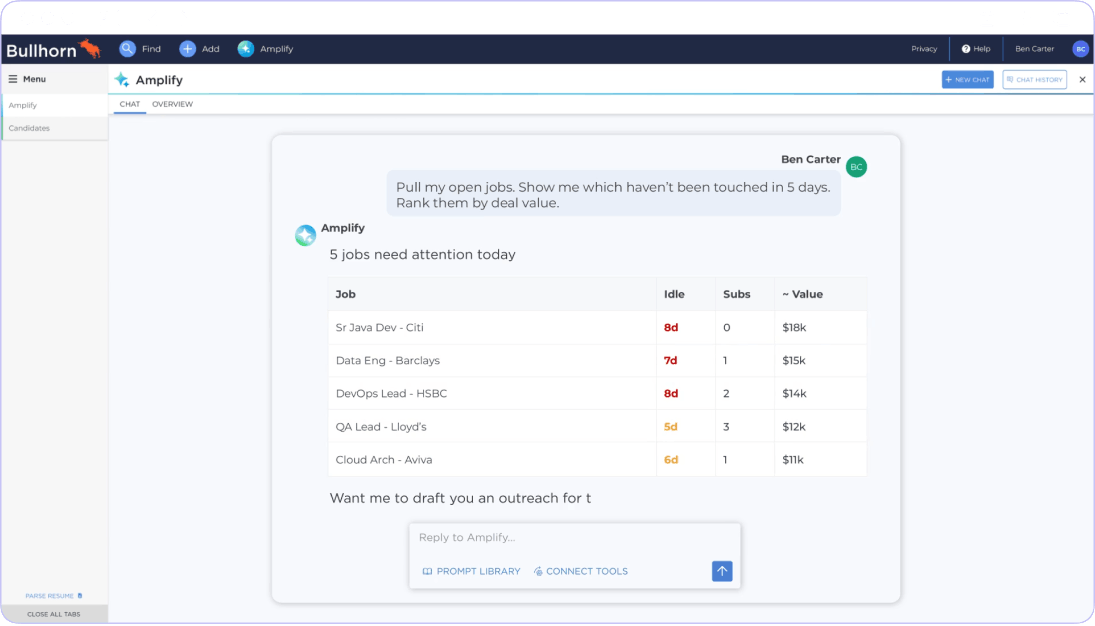
The product line covers ATS and CRM, Bullhorn Automation (the former Herefish), Search & Match, Reporting & Analytics (the former cube19), Middle Office, Onboarding, and Amplify — Bullhorn’s AI layer, which includes Search & Match and a set of “digital workers.” It sits on two platforms: the native Bullhorn Platform, and Bullhorn Recruitment Cloud, built on Salesforce, which serves roughly 150,000 users following the August 2025 acquisition of TargetRecruit. A marketplace of 300+ pre-integrated partners sits around both.
Pricing is a headline number and then a long list of quotes. The core bullhorn platform does not include Advanced Reporting (formerly Cube19), Automation (formerly Herefish), Onboarding (formerly Able) or Amplify. All of these are additional expenses, including implementation costs. The marketplace eco-system has evolved around product gaps, which means another set of suppliers – each with their own cost, implementation and contract to manage.
Bullhorn holds a 4.2 out of 5 on G2 from 1,225 reviews, with just over half of reviewers in the mid-market segment.
What Atlas actually is
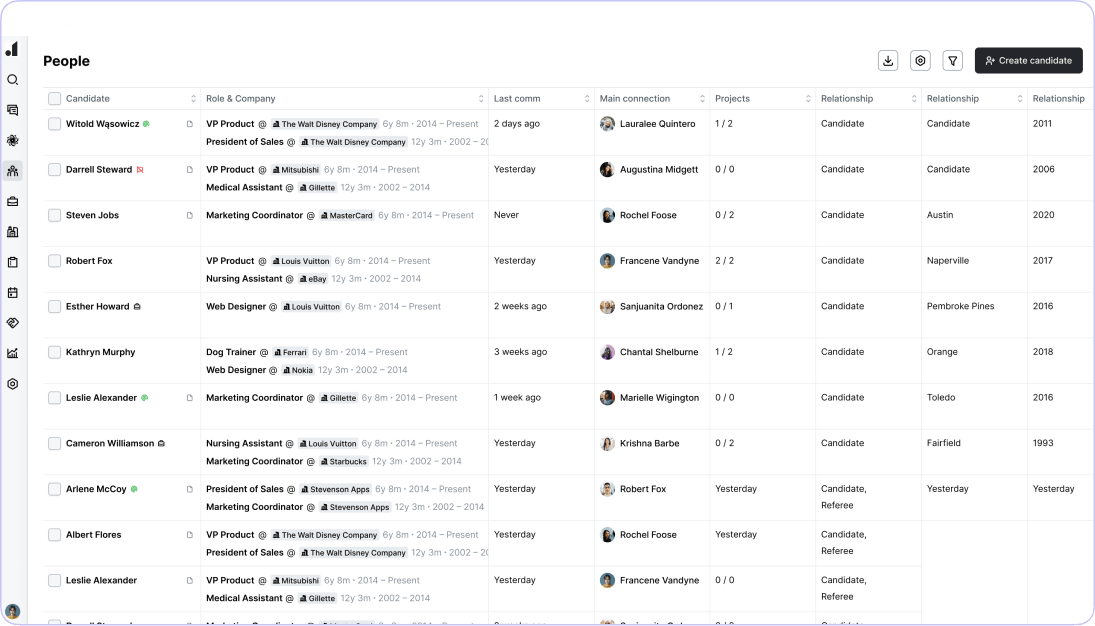
Atlas is an AI-native CRMx — one system combining CRM and ATS — built for agency recruiters and launched in 2023. Its core is Total Memory: a persistent intelligence layer capturing everything a firm’s team says, hears, reads and writes across calls, emails, meetings and notes, made searchable and available to AI agents at every stage of the pipeline. On top sit generative agents that remove recruitment admin, Opportunities for business development, Magic Search for criteria-based candidate assessment, a native AI note-taker, multi-touch outreach campaigns, custom dashboards, an MCP server, a Chrome extension and a mobile app. Atlas serves 500+ agencies, is backed by Smedvig Ventures, and puts around 40% of its team into engineering and product. Pricing starts at $120 per user per month on an annual commitment paid up front.
Side by side
| // Features | Atlas | Bullhorn |
|---|---|---|
|
AI-native architecture — Built around AI from the first commit, or added to an existing core. |
Yes — Total Memory is the substrate | Established core since 1999; Amplify AI layer added on top and requires multiple subscriptions – Automation, Analytics, Amplify. |
|
How the platform was built — One codebase, or assembled. |
One product, one codebase | Built by acquisition; every new major product feature increases your monthly cost. |
|
Agentic execution — Does the AI do the work, or recommend it? |
Agents execute: records, follow-ups, status updates | Amplify digital workers, quote-only |
|
Search across your own data — Plain-language criteria, or keywords and Boolean. |
Magic Search allows you to search across emails, notes, CVs, transcripts. If you hear it, read it or write it, you can search it. | Boolean searching across CVs only. Structured field filters rely on good data being inputted. Emails and notes are not included in search results. |
|
Conversation capture — Do calls and meetings become searchable intelligence? |
Native AI note-taker, feeding Total Memory | No native transcription; marketplace partner required |
|
Business development — A pipeline, or a scored workspace with a next action. |
Opportunities — leads, target clients and marketable candidates, scored on momentum | Sales CRM and pipeline on the Pro tier, quote-only |
|
Outreach campaigns — Multi-step, multi-channel, in the platform. |
Native, context-drawn from notes and job detail | Bullhorn Automation (ex-Herefish), quote-only add-on |
|
Temp, contract and back office — Timesheets, pay and bill, VMS. |
Full contractor management suite | Middle Office, Time & Expense, VMS and onboarding — the deepest in the category |
| Integrations | Core integrations plus MCP server | 300+ marketplace partners |
|
Pricing transparency — Can you cost the 2026 feature set from the website? |
From $120 per user/month, annual, AI included | Starter $99, Core $165; Pro and every AI, automation and analytics module quoted |
| Scale | 500+ agencies | 10,000+ customers; 1,400 staff across 14 countries |
| Review standing | G2 4.9 from a small review base | G2 4.2 from 1,225 reviews |
Bullhorn pricing, product line and company figures verified against bullhorn.com, September 2026. Last verified: 19 September 2026.
Where Atlas and Bullhorn overlap — and where the overlap stops
At feature-name level, the two platforms look similar. Atlas and Bullhorn both combine ATS and CRM in one system. Both cover business development alongside delivery. Both offer candidate search and matching, outreach automation, analytics and dashboards, a mobile app, an API and a wide integration set. Both describe themselves as AI-powered platforms for agencies that want to place more with the same team. Anyone comparing spec sheets will find a lot of matching rows.
The spec sheet is the wrong instrument. Two platforms can list “search and match” and mean different things, because the question is not whether a capability exists but whether it was built into the platform or bought and bolted to it — and, with Bullhorn, whether it is on the plan you can price from the page.
This is where the overlap stops. Atlas built its data model around AI first and the recruitment workflow second: Total Memory exists so that every downstream agent has the full context of what the firm knows, and everything else was added to that layer. Bullhorn built a recruitment platform in 1999 and has extended it for 27 years, largely by acquisition. Its search and matching came from Textkernel and KonaSearch. Its automation came from Herefish. Its analytics came from cube19. Its executive search product is Invenias. Its Salesforce line is Talent Rover, Jobscience, Connexys, Mployee and TargetRecruit.
None of that is hidden — Bullhorn documents all of it. But it produces a particular shape of product, and the shape is visible on Bullhorn’s own login page.
One fact you will not find on other comparison pages
Bullhorn’s login menu on bullhorn.com lists eight separate product logins: Bullhorn ATS & CRM, Bullhorn Automation (“formerly Herefish”), Bullhorn Time & Expense, Bullhorn Connexys Fast Forward, Salesforce Solutions (the former Talent Rover), Bullhorn Jobscience, Bullhorn Connexys, and Bullhorn Talent Platform (the former Able). Tracxn records sixteen acquisitions in total, the three most recent being Mployee (January 2024), Textkernel (2024) and TargetRecruit (August 2025). And for its Salesforce line, Bullhorn’s own press release states that Amplify — its AI — is “delivered via Agentforce,” which is Salesforce’s agent framework rather than Bullhorn’s.
Eight logins is not a criticism of Bullhorn’s engineering. It is an accurate description of what buying-and-integrating produces over 27 years, and it is why “is Bullhorn AI-native?” has a factual answer.
The architectural question, stated plainly
Every recruitment platform now claims to be AI-powered. The claim only means something if you ask what it would cost the vendor to be wrong.
A platform built on AI foundations compounds from external progress: when frontier reasoning improves, the whole product improves, because the intelligence sits in the data layer rather than in individually-integrated modules. A platform assembled from acquisitions integrates each advance against several schemas at once, designed by different companies in different decades, and every integration is a decision about which of the eight products it plugs into first.
There is a commercial signature to each. When AI is the foundation, it cannot be sold separately, because no version of the product exists without it. When AI is a module, it can be — and Bullhorn quotes Amplify, Automation, Analytics and Search & Match separately from a $165 base that covers tracking and email. That is not an accusation. It is how Bullhorn’s pricing page is laid out.
Deep dive 1: what the seat price actually buys
How Bullhorn works. Bullhorn publishes two prices and quotes the rest, and it is worth being precise about what each number contains. Starter at $99 and Core at $165 both cover applicant tracking, the email sidebar, custom fields and workflows, and access to the marketplace. Everything an agency compares on in 2026 sits above that line: the sales CRM and pipeline are on Pro, which is quoted; Bullhorn Automation, Analytics, Amplify Search & Match, SMS, Onboarding and the Amplify digital workers are each quoted on top (bullhorn.com/pricing). Bullhorn’s marketplace then adds a second layer of vendor bills — the outreach tools, note-takers and enrichment providers that Bullhorn customers typically buy from partners.
Where Atlas is stronger. Atlas has one number, on the website: from $120 per user per month on an annual commitment paid up front, with the AI included — not as a bundle, but because Total Memory is what the ATS and CRM are built on. A buyer can cost Atlas from the page. Costing Bullhorn’s 2026 feature set means a Core seat, a Pro upgrade, three or four module quotes and two or three marketplace subscriptions, and the number that comes back is nobody’s list price.
The structural point matters more than the arithmetic. A vendor that can price its AI separately has told you the AI is separable — added to a core that works without it. Atlas cannot do that. And Atlas is closing the one thing modular pricing does offer, which is knowing what you use: Magic Credits will unify AI consumption across the platform in a single view.
Deep dive 2: one memory versus eight databases
How Bullhorn works. Bullhorn’s intelligence is spread across the products it has acquired. Search and matching came in with Textkernel and KonaSearch and now sits inside Amplify. Automation came in with Herefish. Analytics came in with cube19. For firms on the Salesforce line, the AI is Salesforce’s Agentforce. Each is a capable product in its own right, and Bullhorn has done real engineering to make them talk to each other — the marketplace exists precisely because the integration surface is large.
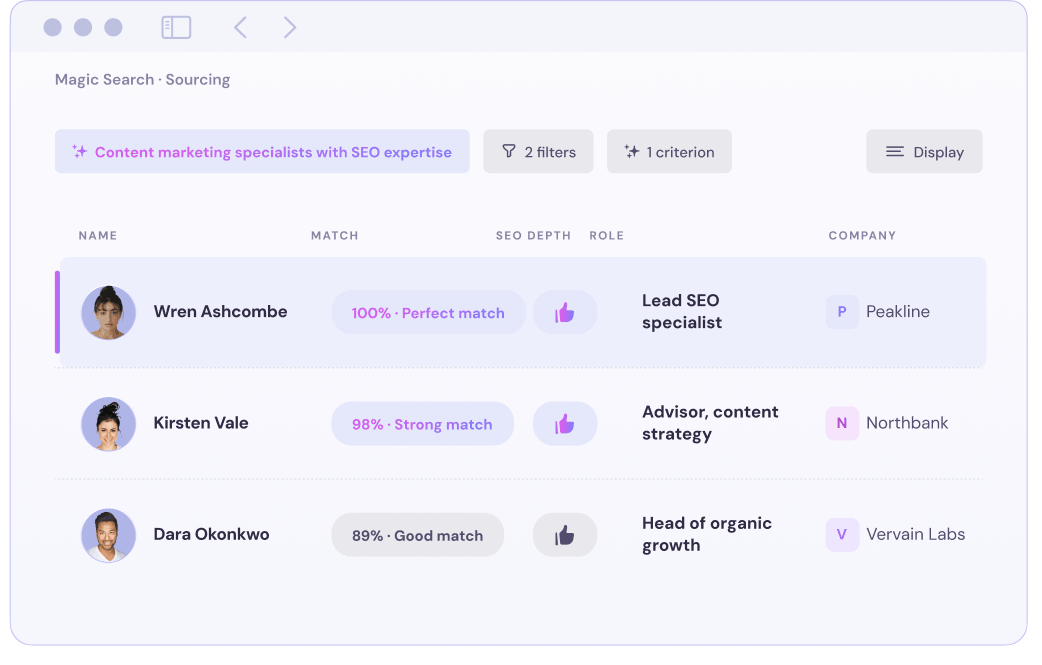
Where Atlas is stronger. Atlas has one memory. Every call, email, meeting and note lands in Total Memory, and every agent reads from the same layer — search, scoring, follow-up, business development. Magic Search lets a recruiter describe what “great” looks like in plain language and scores every profile against it with a visible fit rating, drawing on the CV, the notes and the conversations at once.
The practical consequence is what happens to a fact. In Atlas, a candidate saying on a call that they would move for the right package becomes something the search finds, the BD agent uses and the follow-up references — automatically, because it entered one layer. In an assembled platform, that fact has to be captured by one product, stored in a schema another product understands, and surfaced by a third, and the marketplace partner that recorded the call is a fourth. It can be done. It is not the default.
Deep dive 3: admin load, and the cost of leaving
How Bullhorn works. Bullhorn is a configurable system, and configurable systems generate admin. Custom fields, workflows and picklists are set up per agency; some changes go through Bullhorn support rather than an admin screen; and the platform’s reputation for a long learning curve is one Bullhorn itself addresses with a dedicated learning product. Contracts are typically multi-year with notice periods, which suits a vendor whose customers stay for a decade and is the norm at enterprise scale.
Where Atlas is stronger. Atlas is built on the premise that admin should disappear rather than be delegated. Agents update records, log calls, chase silent candidates and write notes as the system’s default behaviour — no queue, no support ticket to add a picklist value. Recruiters coming from Bullhorn describe the same thing in the same words: the platform is labour-intensive even when it is set up correctly, and the labour is the point of leaving.
On migration specifically, Atlas has an unusual credential. The person leading Atlas’s onboarding and migration ran the delivery team at Bullhorn’s largest systems-integration partner and completed around 250 Bullhorn migrations before joining Atlas. Bullhorn data models are not a mystery here.
The thing to settle before you move is contractual, not technical. Bullhorn agreements commonly carry a three-month notice period, and multi-year terms are standard, so the practical question is usually when you can leave rather than how. Atlas can run a migration in parallel with a live Bullhorn instance so that the switch happens at contract end rather than before it.
Where Bullhorn has genuine advantages
Middle office, back office and temp at scale. Bullhorn’s Middle Office, Time & Expense, onboarding and VMS coverage are the deepest in the category, and for large temp and contract operations there is no platform in this comparison that matches them, Atlas included. This is where 27 years and sixteen acquisitions pay off without qualification. When it decides the choice: if you run high-volume temp or contract with pay-and-bill inside the platform, Bullhorn is the better fit.
Scale, ecosystem and procurement comfort. Ten thousand customers, 1,400 staff across 14 countries, a 300-partner marketplace, an established developer API and a brand every procurement team recognises. For an agency that has to justify a vendor internally, or that needs a specific marketplace integration that only exists for Bullhorn, that is a real advantage today. Atlas at 500+ agencies is the newer and smaller company, and its ISO 27001 certification is in progress with completion targeted for mid Q4 2026. When it decides the choice: if vendor scale, a named marketplace partner or current certification evidence is a procurement requirement, Bullhorn clears it now.
What the market is telling us
Atlas talks to agencies evaluating the whole ATS and CRM market every week, and Bullhorn is the platform prospects most often arrive from. What those buyers say is more useful than either vendor’s marketing, so we publish it as we hear it.
Bullhorn is still very labour intensive. We’ve got it all coded up correctly… I’m sick of doing some of the mundane tasks. I feel like I’m spending a lot of time navigating so many different platforms.
Every time I wanted to add an industry I had to email Bullhorn to get them to do it from their side. It was about four weeks for every single one. It seemed like they just weren’t built for what I wanted to do.
Bullhorn do a good job and they charge you for it. But I’d prefer to take this opportunity to look at something like Atlas.
Based on Atlas evaluation conversations. Updated as new comparisons come in.
Choose Bullhorn if
- Temp or contract work is central to your business and you need middle office, time and expense, VMS and onboarding inside the platform.
- Your company runs on Salesforce and you want a recruitment platform native to it.
- A specific marketplace integration exists only for Bullhorn and your workflow depends on it.
- Vendor scale and a 27-year track record are hard requirements in your procurement process.
Choose Atlas if
- Your firm’s knowledge is your product, and you want one memory layer rather than several products stitched together.
- You want admin to disappear rather than be configured, ticketed and delegated.
- You are buying the roadmap as much as the product, and want a vendor whose only product is the one you use.
- You are perm, exec search or professional contract and do not need enterprise back office.
-
// Magic Search
Find the right people in plain English
Search your entire database using natural language and see exactly why every recommended candidate matches your criteria.
-
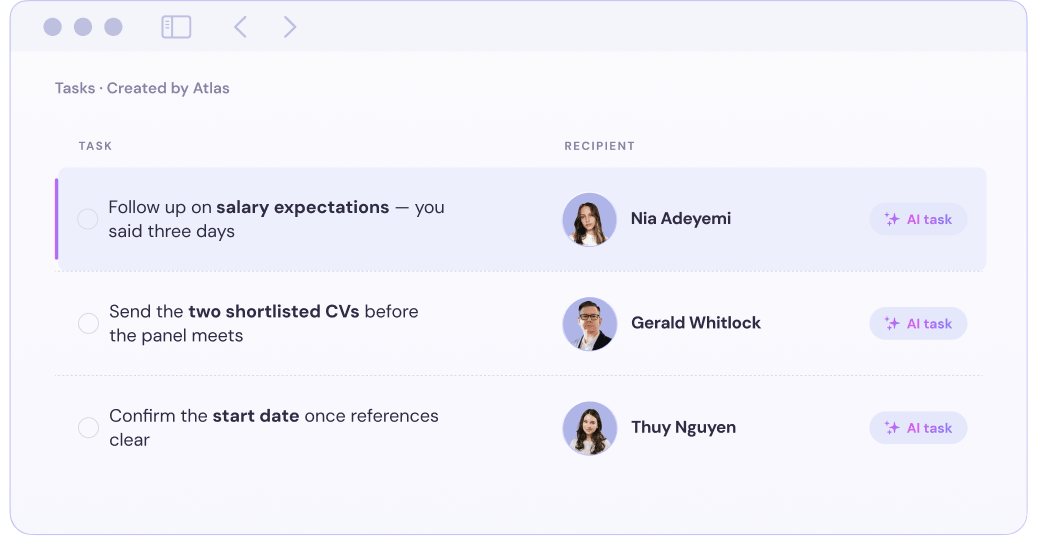
// AI Notetaker + Tasks
Turn conversations into next actions
Capture calls automatically and turn every commitment into a clear, timely follow-up task for your team.
-
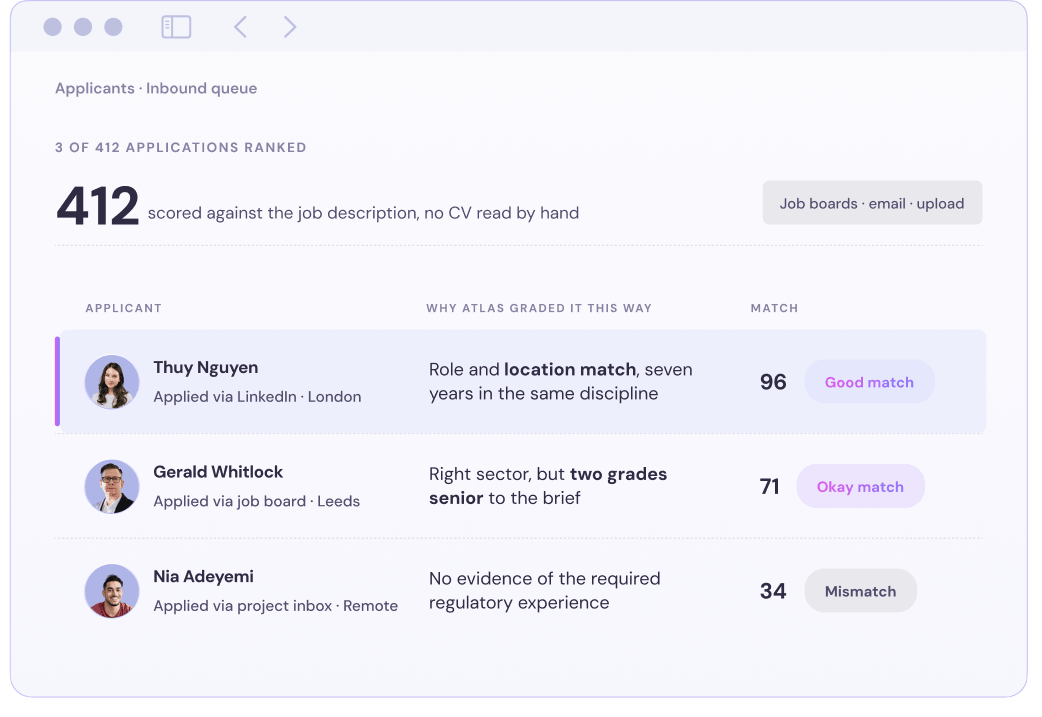
// Applicants
Triage applicants without database clutter
Automatically grade incoming applicants with clear reasoning while keeping unapproved profiles outside your main database.
-
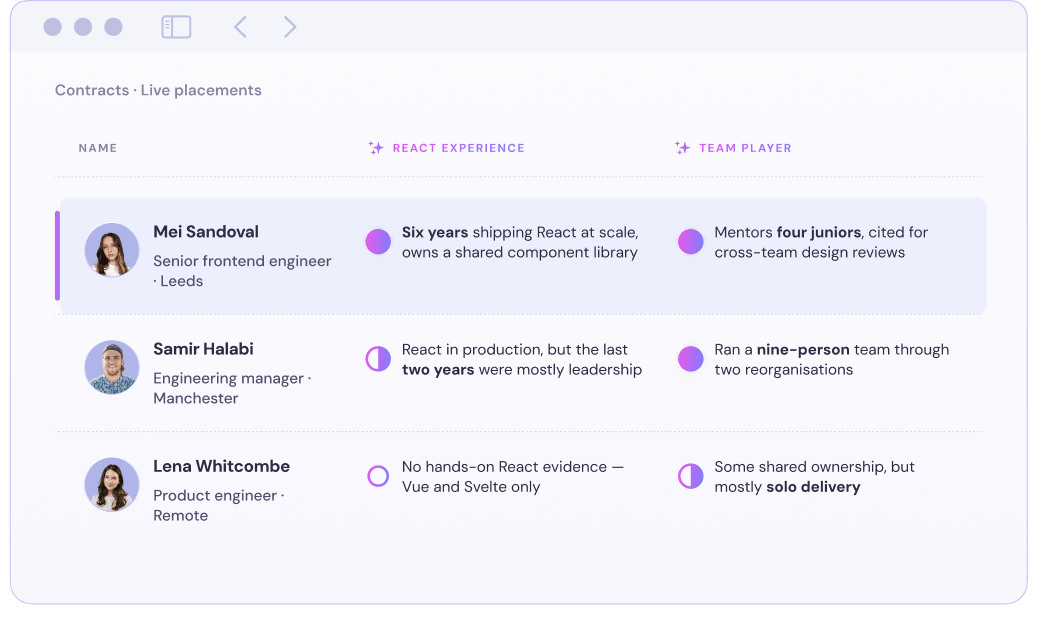
// Magic Columns
Score candidates against your criteria
Evaluate every candidate against your own competencies, instructions and scoring system using flexible AI-powered columns.
-
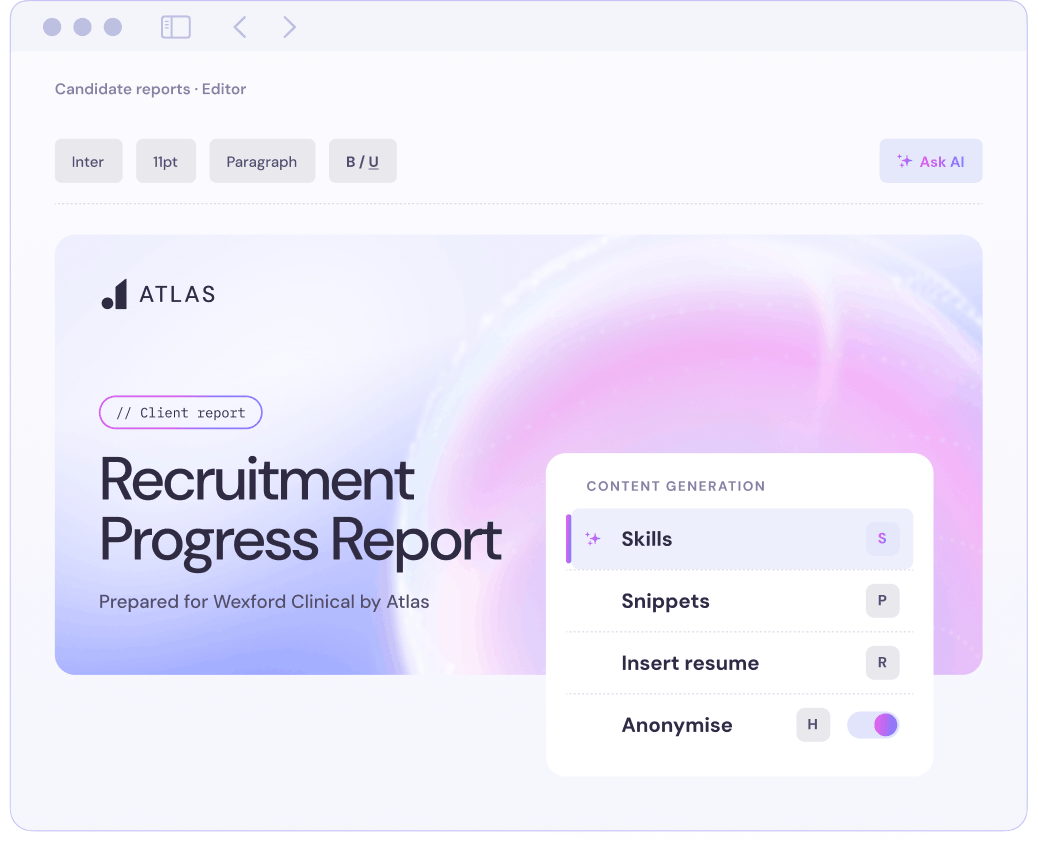
// Candidate Reports
Create polished candidate reports
Turn complete profiles, meeting notes and conversations into polished, client-ready documents.
-
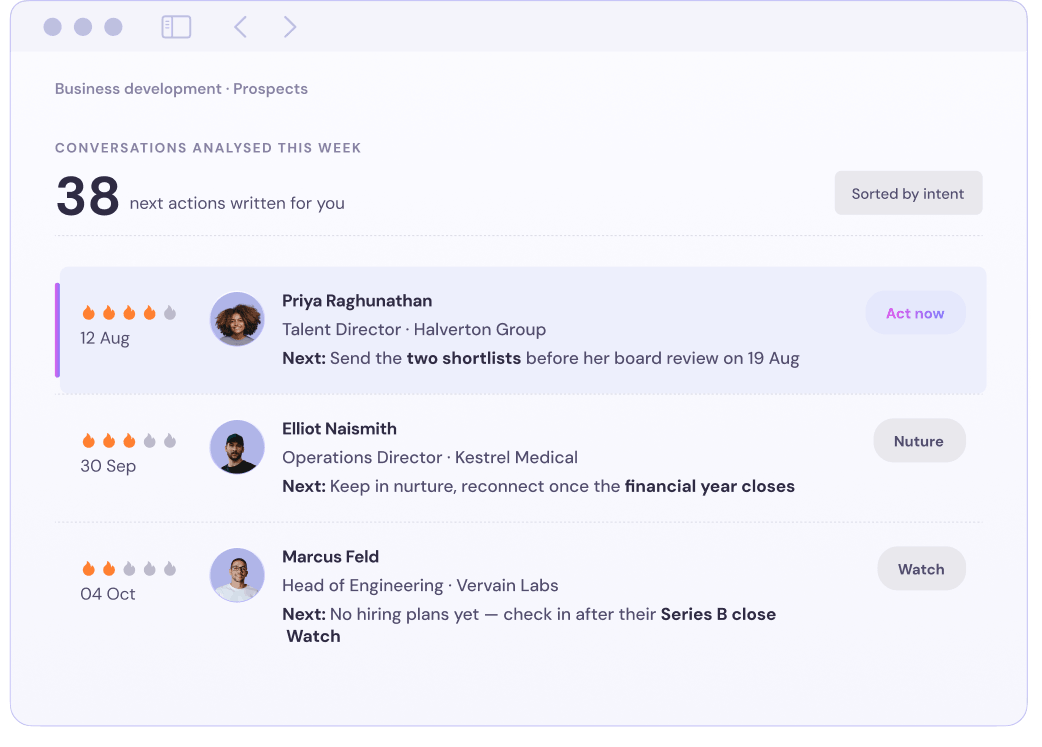
// Opportunities
Focus on opportunities most likely to convert
Track every interaction, assess urgency and prioritise opportunities using an automatically updated likelihood of winning.
-
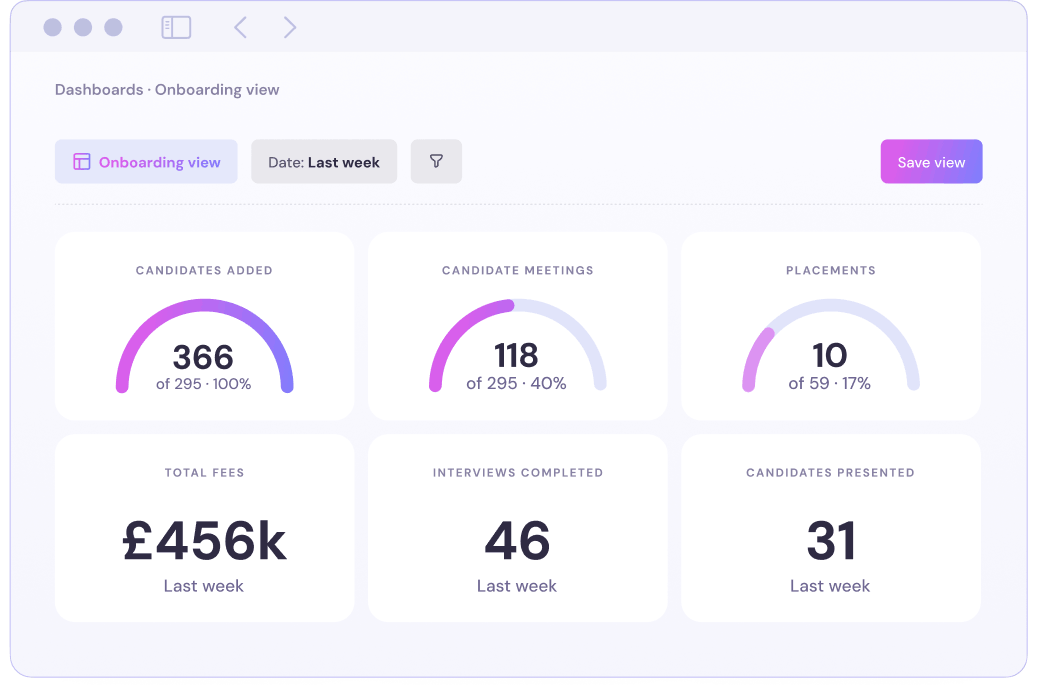
// Dashboards
See performance and pipeline in real time
Track performance, fees, placements and conversion ratios through live dashboards with custom views and filters.
-
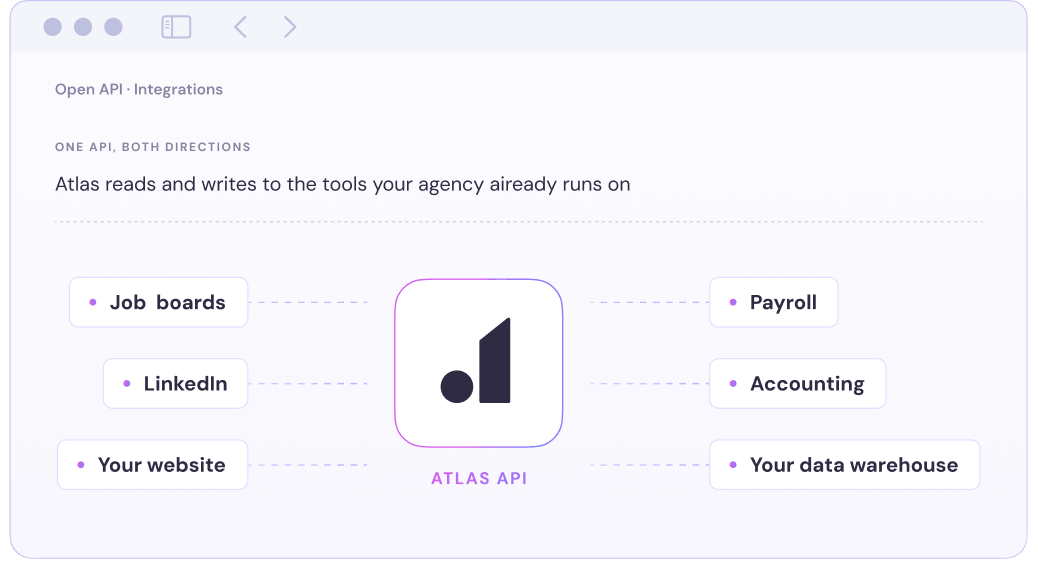
// Open API + Integrations
Connect Atlas to the tools you use
Connect external tools and custom workflows through Atlas’s public API and growing library of native integrations.
-
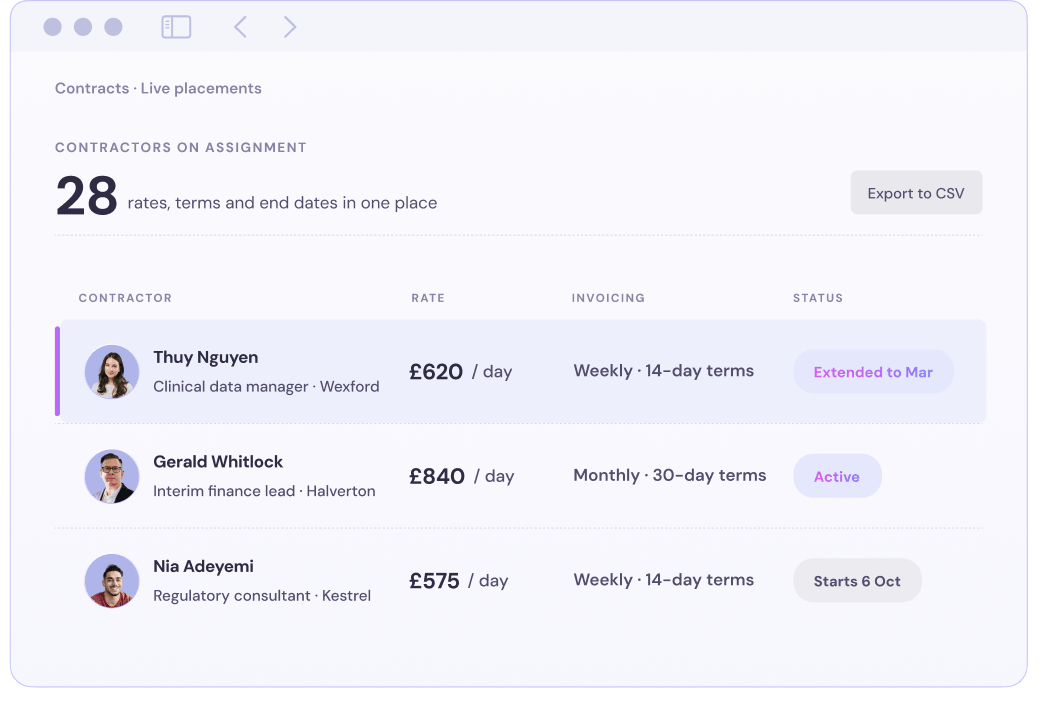
// Contract Management
Manage every placement in one platform
Handle permanent and contract placements with flexible rates, approvals, expenses and automatic status updates.
-
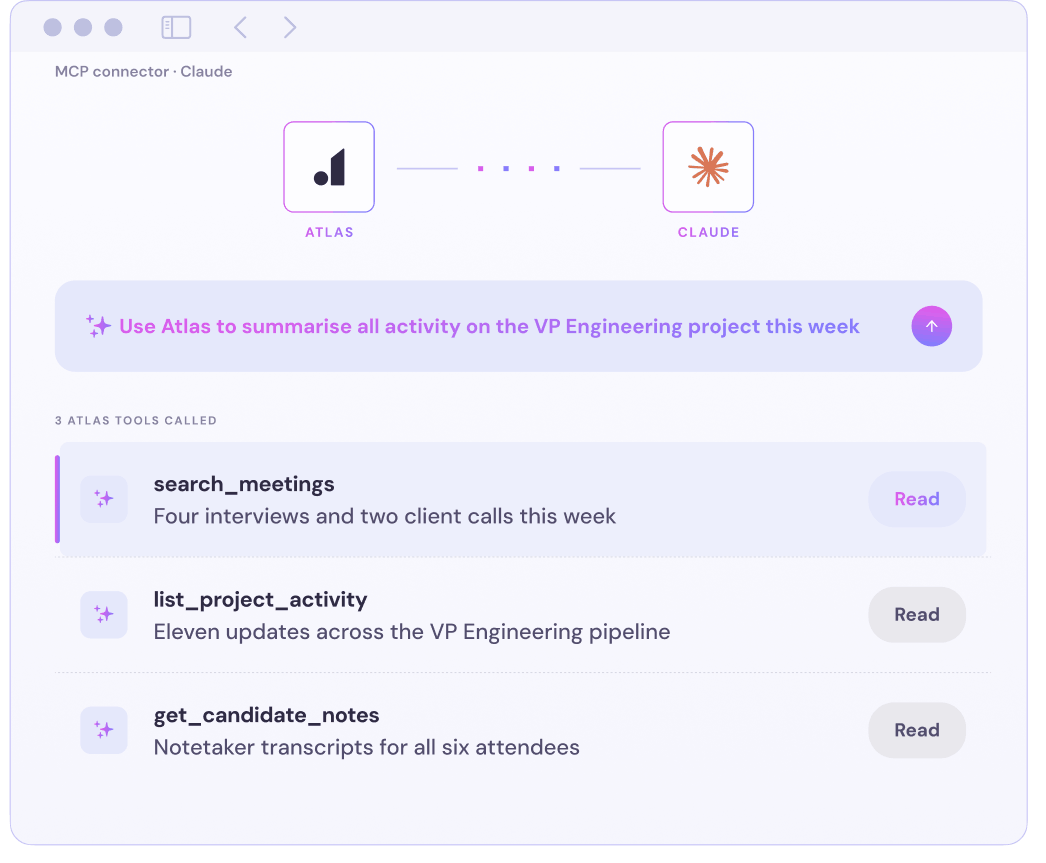
// Claude Connector
Ask Claude anything about your Atlas data
Get answers across candidates, projects, companies, meetings and transcripts without manually searching through records.
Pricing, side by side
Atlas starts at $120 per user per month on an annual commitment paid up front, with AI usage included. Magic Credits will unify visibility of AI consumption across the platform at no additional cost over that price.
Bullhorn publishes Starter at $99 and Core at $165 per user per month, excluding VAT. Core covers applicant tracking, the email sidebar, custom fields and workflows and marketplace access. The sales CRM and pipeline require Pro, which is quoted. Bullhorn Automation, Analytics, Amplify Search & Match, SMS, Onboarding and the Amplify digital workers are each quoted separately (bullhorn.com/pricing, verified September 2026).
So the comparison is not $120 against $165. It is $120 with AI, CRM, search, outreach and analytics included, against $165 plus a Pro upgrade plus three to five module quotes plus marketplace subscriptions for whatever Bullhorn does not do natively. Ask Bullhorn for a single all-in figure at your seat count for the capabilities you would actually use, and compare that.
Migrating from Bullhorn to Atlas
Bullhorn is the most common system our customers move from. We’ve completed well over 100 Bullhorn migrations, and the person leading them knows Bullhorn from the inside. Atlas’s VP Delivery ran the delivery team at Bullhorn’s largest systems-integration partner and completed around 250 Bullhorn migrations before joining Atlas. Bullhorn data models are not a mystery here.
That experience matters, because no two Bullhorn databases look the same. A decade of workarounds, custom fields and bespoke integrations leaves its mark, and we’re well versed in untangling it.
How it works:
- We analyse how you use Bullhorn. Before anything moves, we look at what’s in your database and how your team actually works: which fields matter, what’s been repurposed and what’s no longer used.
- We map your data into Atlas together. We agree with you where everything should land, so your records make sense in Atlas from day one.
- We test. You check your own data in Atlas before you switch over.
- We train your team. Your recruiters learn Atlas on their own data, not a demo database.
Preserving unstructured history matters more here than in a conventional migration, because that history is exactly what Total Memory operates on afterwards: a migration that carries records but drops notes, call logs and activity context discards the asset the platform is built to exploit. Ask any vendor, including Atlas, for a migration scope that names unstructured data explicitly.
Two things to settle with Bullhorn before you move: your notice period and renewal date, since three months’ notice is common, and whether any module or marketplace contracts run on separate terms from the core agreement.
The numbers behind the switch
-
// Garfield Stephers
80%less time spent on CV formatting
-
// Pace Global
30% +more candidates and roles handled
-
// Aym Recruitment
150%revenue growth after adopting Atlas
-
// Ethiq
200%of annual billing target achieved
-
// Tech Valley Recruitment
30 minsaved per candidate report
-
// Globus Search
4×faster candidate sourcing and updates
The verdict
Bullhorn earned its position. Twenty-seven years, ten thousand customers, the deepest back office in the category and a marketplace that covers almost every gap — for large temp operations and Salesforce-native firms, it is the better platform, and no comparison page changes that.
But Bullhorn has also told you what it is, on its own login page. Eight products, sixteen acquisitions, and an AI layer that on one of its two platforms belongs to Salesforce. That is what buying-and-integrating produces over three decades, and it is why every modern capability arrives as a separately-quoted module on top of a base that covers tracking and email.
Atlas was built the other way. One product, one memory, one price with the AI in it — because Total Memory is not a module on the platform, it is what the platform is built on. Bullhorn assembled a recruitment platform around AI. Atlas built one on it.
// See Atlas in action
Bring a live role. Book a 30-minute demo and we will run it in Atlas against your own data — not a sandbox, not a slide.


