












// Comparisons
Atlas vs JobAdder (2026): Assistive AI vs Agents That Act
Atlas vs JobAdder: which platform fits your agency in 2026
Atlas and JobAdder both combine ATS and CRM into one platform for recruitment agencies, and both now ship AI. The difference is what the AI is for. JobAdder’s Adder Intelligence summarises, drafts and suggests, and JobAdder is explicit that it keeps the recruiter in control. Atlas’s agents execute — record maintenance, follow-up and status updates happen without being asked.
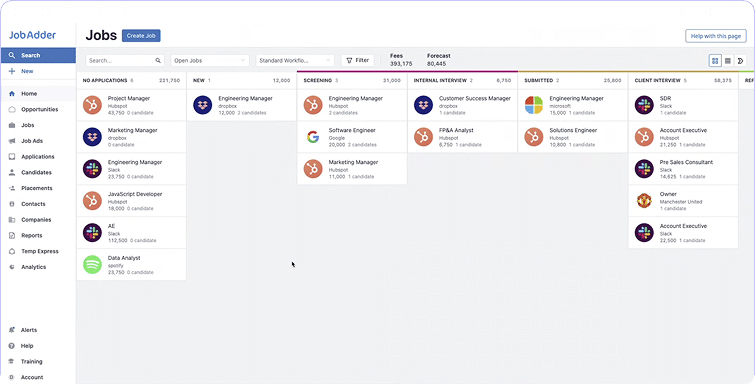
What JobAdder actually is
JobAdder is an ATS and CRM for recruitment agencies and in-house talent teams, operated by JobAdder Operations Pty Ltd and strongest in Australia and New Zealand, with a UK and North American presence. It positions itself as the intelligent recruitment platform for growing agencies, and its long-standing reputation is for usability rather than depth.
Its genuine distinguishing asset is distribution. JobAdder connects to 200+ job boards globally and 100+ integrations, with native job posting that writes an ad once and syndicates it. That is the widest advertising reach of any platform in this comparison set. The platform also covers applicant tracking, a recruitment CRM with business development tools, recruitment marketing, placement management, analytics with competitive benchmarking, forms, hiring-manager portals and a mobile app. It is ISO 27001 certified, offers support 24/6, and runs JobAdder Academy for in-app training and certification.
JobAdder’s AI layer, Adder Intelligence, launched in November 2025. Its published capabilities are Smart Summary, which produces an instant summary and relevancy rating on every applicant from resumes, notes and job descriptions; Smart Floats, which generates client-ready candidate overviews; Smart Job Descriptions; and Smart Sync, which prompts recruiters to update candidate records after scanning notes and activities. Smart Skills, an AI skill-coding capability, shipped in March 2026, and a Campaigns email sequencer is in beta. Independent assessment as of mid-2026 indicates Adder Intelligence starts on the Essential plan, so customers on the entry-level Lite plan receive no AI, and there is no native call transcription.
JobAdder’s own framing of the design intent is that its AI amplifies human expertise and keeps the recruiter in control, integrated into existing workflows. That is a coherent philosophy, and it is the central difference between the two platforms.
JobAdder does not publish pricing. It offers four plans — Lite, Essential, Pro and an in-house Business edition — quoted after a demo based on geography and team size.
What Atlas actually is
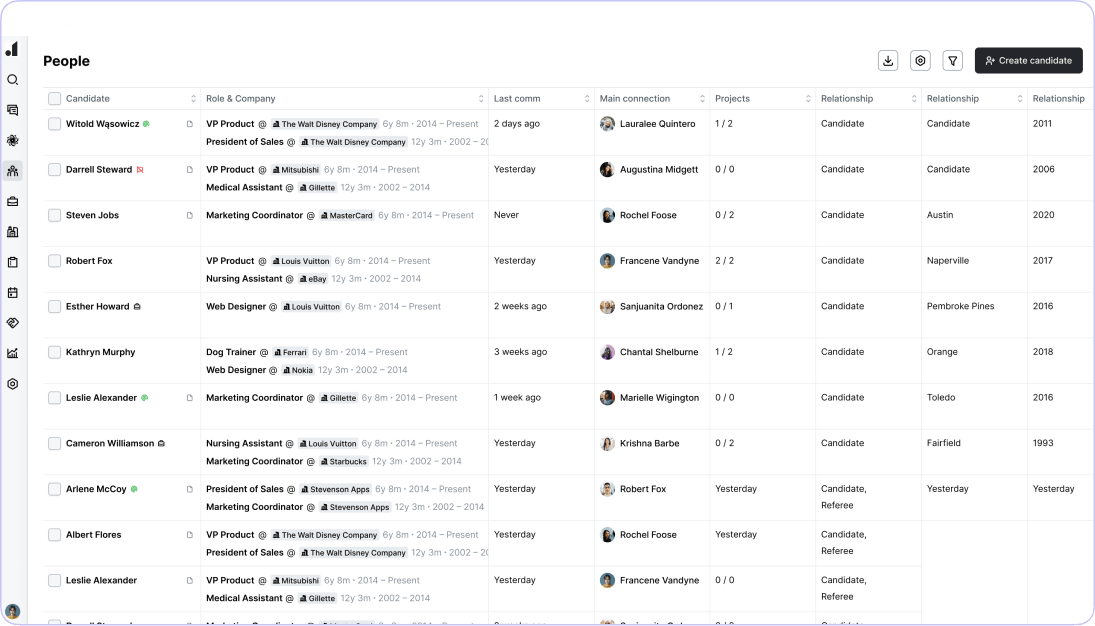
Atlas is an AI-native CRMx — one system combining CRM and ATS — built for agency recruiters and launched in 2023. Its core is Total Memory: a persistent intelligence layer capturing everything a firm’s team says, hears, reads and writes across calls, emails, meetings and notes, made searchable and available to AI agents at every stage of the pipeline. On top sit generative agents that remove recruitment admin, Opportunities for business development, Magic Search for criteria-based candidate assessment, a native AI note-taker, multi-touch outreach campaigns, custom dashboards, an MCP server, a Chrome extension and a mobile app. Atlas serves 500+ agencies, is backed by Smedvig Ventures, and puts around 40% of its team into engineering and product. Pricing starts at $120 per user per month on an annual commitment paid up front.
Side by side
| // Features | Atlas | JobAdder |
|---|---|---|
|
AI-native architecture — Built around AI from the first commit, or added to an existing core. |
Yes — Total Memory is the substrate | Established core; Adder Intelligence added Nov 2025 |
|
Agentic execution — Does the AI do the work, or recommend it? |
Agents execute: records, follow-ups, status updates | Assistive by design — summarises, drafts, prompts |
|
Search across your own data — Plain-language criteria, or keywords and tags. |
Magic Search v2 — criteria-based fit scoring, live since Mar 2026 | Keyword, tag and skill matching; Smart Skills coding since Mar 2026 |
|
Conversation capture — Do calls and meetings become searchable intelligence? |
Native AI note-taker, feeding Total Memory | No native call transcription; third-party integration |
|
Business development — A pipeline, or a scored workspace with a next action. |
Opportunities — leads, target clients and marketable candidates, scored on momentum | Purpose-built BD tools within the CRM |
|
Outreach campaigns — Multi-step, multi-channel, in the platform. |
Native, context-drawn from notes and job detail | Campaigns email sequencer in beta |
|
Job board distribution — How many boards you can post to. |
Core boards and integrations | 200+ job boards, 100+ integrations |
|
Benchmarking — How you compare to the wider market. |
Custom native dashboards | Competitive benchmarking against market data |
|
Pricing transparency — Can you cost it from the website? |
From $120 per user/month, annual, AI included | Not published — four tiers quoted after a demo |
|
AI on the entry plan — Does the cheapest plan include the AI? |
Yes — no tier without it | No — AI starts at Essential; Lite has none |
| Security | ISO 27001 in progress, targeted mid Q4 2026 | ISO 27001 certified |
| Mobile app | Yes | Yes |
JobAdder pricing structure, integration counts and certification verified against jobadder.com, 10 October 2026. AI capability scope and plan gating per independent assessment, June–July 2026. Last verified: 10 October 2026.
Where Atlas and JobAdder overlap — and where the overlap stops
At feature-name level, the two platforms look similar. Atlas and JobAdder both combine ATS and CRM in one system. Both cover business development alongside delivery. Both parse resumes, summarise candidates and produce client-ready overviews. Both offer analytics and dashboards, a mobile app, workflow automation and a wide integration catalogue. Both describe themselves as AI-powered platforms for growing agencies. Anyone comparing spec sheets will find a lot of matching rows.
The spec sheet is the wrong instrument. Two platforms can list “candidate summaries” and mean different things, because the question is not whether a capability exists but what it does with the output.
This is where the overlap stops, and JobAdder states the difference plainly enough that we do not need to characterise it. JobAdder’s design principle is AI that amplifies human expertise and keeps the recruiter in control. Smart Sync scans notes and activities and then prompts a recruiter to update the record. Smart Summary produces a relevancy rating for a human to act on. The intelligence advises; the recruiter still does the work.
Atlas was built on the opposite premise: that the work itself should move. Total Memory is not a feature layered onto the ATS — it is what the ATS and CRM run on, which is why Atlas’s agents can act rather than recommend. An agent updating a record without confirmation needs the full context of what the firm knows, and that only exists when every call, email, note and meeting feeds one layer.
Both philosophies are defensible. Only one of them takes work off a recruiter’s desk.
The architectural question, stated plainly
Every recruitment platform now claims to be AI-powered. The claim only means something if you ask what the AI is allowed to do.
A platform built on AI foundations compounds from external progress: when frontier reasoning improves, the whole product improves, because the intelligence sits in the data layer rather than in individually-integrated features. A platform that adds AI to an established core integrates each advance separately, against a schema designed before anyone knew what would be needed — which is why the earliest capabilities to ship tend to be the ones that need no architectural change. Summarising a resume requires no new data model. Acting on eighteen months of unlogged conversation does.
That ordering is visible in Adder Intelligence’s roster. Summaries, drafts, floats and prompts arrived first, in November 2025. They are the capabilities that fit an existing structure.
Deep dive 1: AI that suggests vs agents that act
How JobAdder works. Adder Intelligence is assistive by design, and JobAdder is open about that: the AI amplifies human expertise and keeps the recruiter in control. Smart Summary gives every applicant a summary and a relevancy rating drawn from their resume, recruiter notes and the job description. Smart Floats turns that into a client-ready overview. Smart Sync watches notes and activities and prompts the recruiter to update the record. For a high-volume applicant desk, a relevancy rating on every application is real triage value, and the human-in-the-loop stance is a legitimate answer to firms nervous about AI touching client data unsupervised.
Where Atlas is stronger. The admin that actually costs recruiters their week is not the judgement call — it is the several hundred small acts of maintenance nobody assigns. Updating a status. Logging a call. Chasing a candidate who went quiet. Writing the note and connecting it to the record.
A prompt to update a record is still a task on a recruiter’s list. It has moved from “remember to do this” to “respond to this”, which is progress, but the work has not left the desk. Atlas’s agents run against Total Memory continuously and do it — no queue, no confirmation step, no prompt to action.
The honest framing of the trade is control versus load. JobAdder gives you more oversight of what the AI touches. Atlas gives you less to do. For agencies whose problem is that consultants are drowning in admin rather than that they distrust automation, the second is worth more — and a recruiter who ignores a suggestion queue when busy ends up exactly where they started.
Deep dive 2: what your database can actually be asked
How JobAdder works. JobAdder’s matching is skill and keyword based, with AI and Skill Matching surfacing candidates against open roles, and Smart Skills adding AI skill coding from March 2026 to make that taxonomy more consistent. Independent assessment as of mid-2026 indicates database search itself remains keyword, tag and filter driven rather than plain-language, and that JobAdder has no native call transcription. Within its own model this works well: JobAdder customers report filling a high share of roles from their own database, and skill coding at scale genuinely improves match consistency.
Where Atlas is stronger. Two gaps compound here. The first is how you ask. Atlas’s Magic Search takes a plain-language description of what “great” looks like for a search and scores every profile against those criteria with a visible fit rating — six months of daily production use across 500+ agencies, hardened continuously since launch. Keywords and tags can only return what someone remembered to tag.
The second gap is larger. Without native call capture, conversations never enter the searchable layer at all. Everything a candidate said on a screening call, every hiring plan a client mentioned in passing, every piece of context a consultant carried in their head — none of it is in the database to be searched by any method. Atlas’s note-taker feeds all of it into Total Memory, where it is indexed alongside CVs and available to every agent.
That is why the same query behaves differently. Ask JobAdder for matches and it ranks your tagged, coded database against the spec. Ask Atlas and it can also surface the person nobody would have shortlisted on paper, because of something they said in a call last year.
Deep dive 3: what it costs, and which plan the AI is on
How JobAdder works. JobAdder publishes no pricing. Its stated rationale is that every business is different and it prefers to build a tailored proposal, which it does across four plans — Lite, Essential, Pro and an in-house Business edition — quoted by geography and team size after a demo. There is a real customer benefit in that: a small team can start on a light plan and pay for less platform than a one-size seat price would charge, and the tiering means you are not buying capability you will not use.
Where Atlas is stronger. Atlas has one number, on the website: from $120 per user per month on an annual commitment paid up front, with AI included. A buyer can cost Atlas before speaking to anyone.
The structural point sits underneath the transparency point. Adder Intelligence starts on the Essential plan, which means a JobAdder customer on Lite is running an ATS with no AI at all, and the AI a customer receives depends on which tier they were quoted into. Two JobAdder agencies can be using materially different products. Atlas has no tier without Total Memory, because the platform is built on it — there is no version to sell.
Atlas is also closing the one advantage tiered AI pricing offers, which is only paying for what you use. Magic Credits will unify AI consumption across the entire platform in a single view, so agency leaders can see exactly where the intelligence is going.
Where JobAdder has genuine advantages
Job board distribution and the integration marketplace. JobAdder connects to 200+ job boards globally and 100+ integrations, with native posting that writes an ad once and syndicates it everywhere. This is the widest advertising reach in this comparison set and Atlas does not match it. For an agency whose model depends on volume advertising across many boards and regions, that is a decisive capability rather than a nice-to-have. When it decides the choice: if multi-board advertising volume drives your applicant flow, JobAdder is a good platform.
Market position, enablement and certification. JobAdder is deeply established in Australia and New Zealand with local support, offers support 24/6, runs JobAdder Academy for in-app training and certification, and is ISO 27001 certified. Atlas’s ISO 27001 certification is in progress with completion targeted for the mid of Q4 2026, and Atlas is the newer and smaller company. JobAdder also offers competitive benchmarking against market data, which no other platform in this set provides. When it decides the choice: if you are ANZ-based, or if current certification evidence and formal enablement programmes are procurement requirements, JobAdder clears those bars today.
Tiering and dual-desk workflow flexibility. JobAdder offers unlimited custom workflows configured for perm, temp or dual desks, and its plan ladder lets a small or cost-sensitive team buy an ATS without paying for AI. Not every agency wants agentic AI right now, and JobAdder’s structure serves that buyer better than a single seat price that includes everything. When it decides the choice: if you run high-volume temp or dual desks, or want a proven ATS without an AI layer, JobAdder’s tiering fits well.
What the market is telling us
Atlas talks to agencies evaluating the whole ATS and CRM market every week, including firms that trialled both Atlas and JobAdder before deciding. What those buyers say is more useful than either vendor’s marketing, so we publish it as we hear it.
We use JobAdder at the moment. It’s okay. I find it quite basic. The main thing for me is there’s quite a few in my coaching group who’ve switched to Atlas and they all said it’s the best CRM they’ve ever used — and they actually want to use it. With us it still feels like a bit of a chore.
I’ve been on JobAdder. I’m just finding that I’m spending so much time on administration.
Based on Atlas evaluation conversations, 2026. Updated as new comparisons come in.
Choose JobAdder if
- Multi-board job advertising is central to how you generate applicants, and 200+ boards with native posting is the capability you are buying.
- You are ANZ-based and want local support and a vendor with deep roots in your market.
- You want AI that recommends rather than acts, with a recruiter approving every change.
- You run high-volume temp or dual desks, or want a proven ATS on a light plan without paying for an AI layer.
Choose Atlas if
- You want the admin to actually leave your recruiters’ desks, not arrive as a queue of prompts to approve.
- Your firm’s knowledge is your product, and the problem is that conversations never make it into the system to be searched at all.
- You want to search your database in plain language against criteria you define, rather than by keywords and tags someone remembered to apply.
- You want to know what it costs from the website, with the AI included on every plan.
- You are buying the roadmap as much as the product, and want a vendor whose only product is the one you use.
-
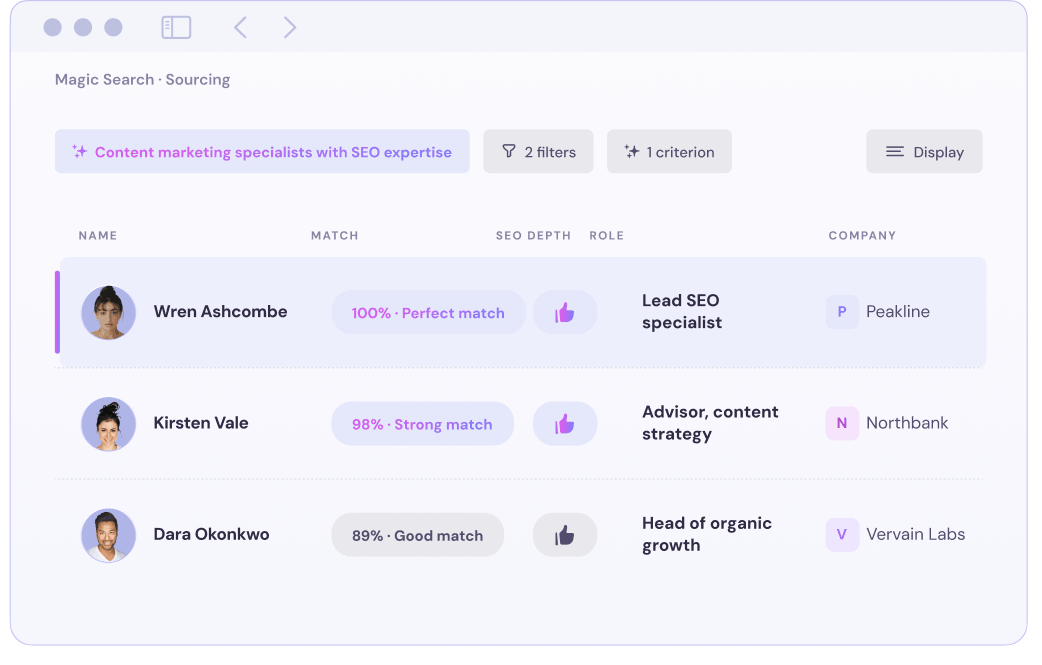
// Magic Search
Find the right people in plain English
Search your entire database using natural language and see exactly why every recommended candidate matches your criteria.
-
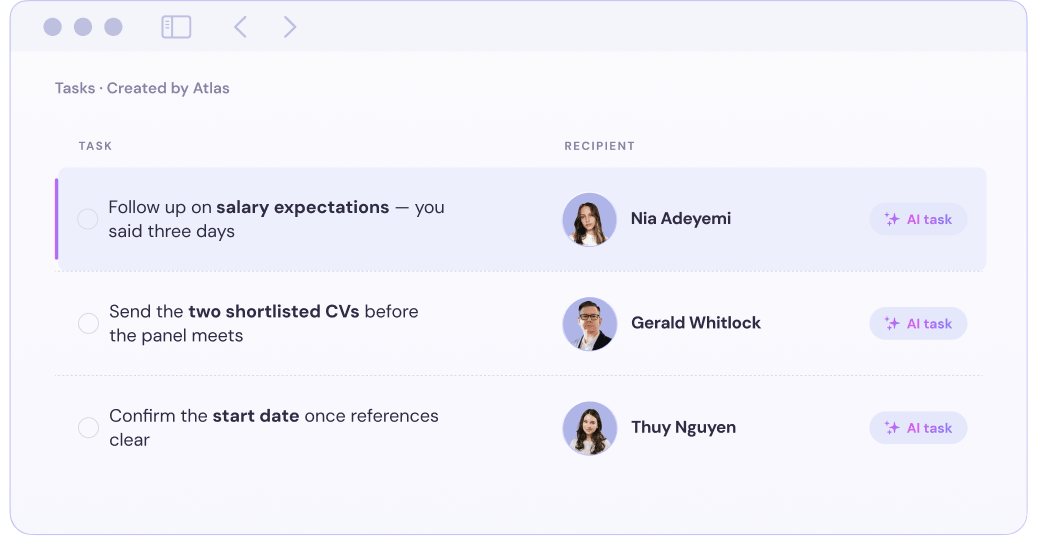
// AI Notetaker + Tasks
Turn conversations into next actions
Capture calls automatically and turn every commitment into a clear, timely follow-up task for your team.
-
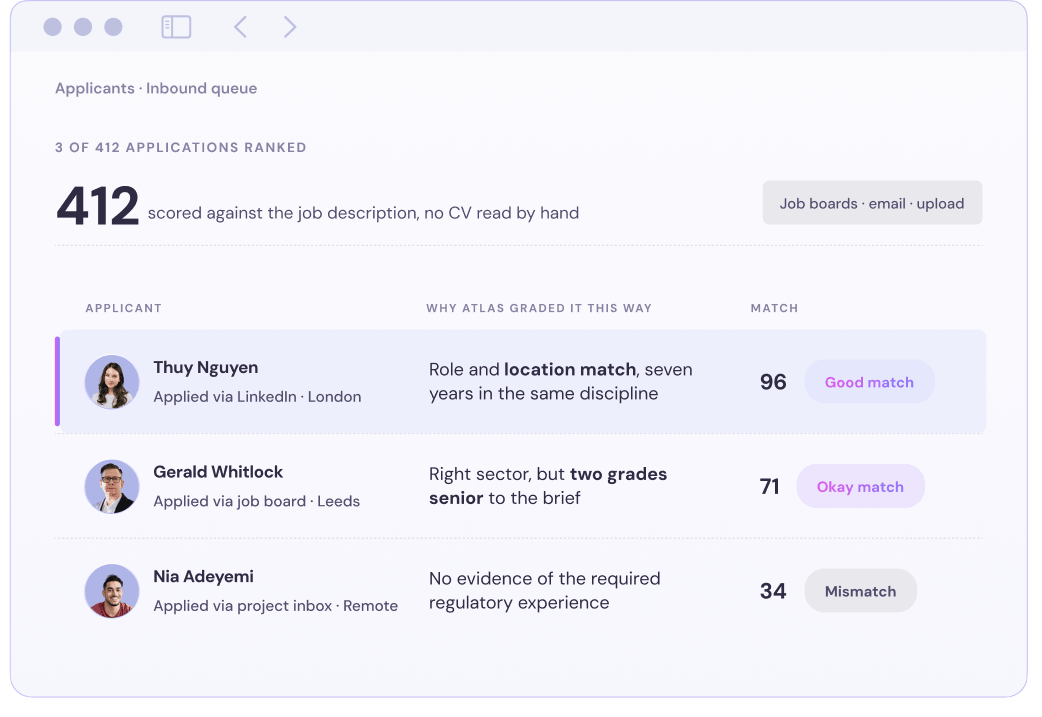
// Applicants
Triage applicants without database clutter
Automatically grade incoming applicants with clear reasoning while keeping unapproved profiles outside your main database.
-
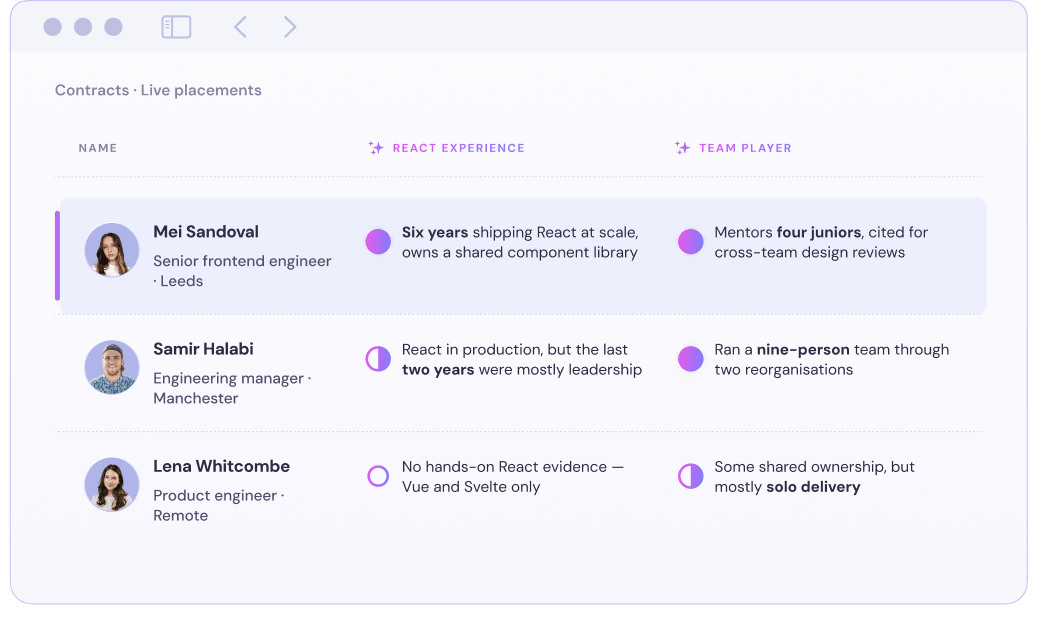
// Magic Columns
Score candidates against your criteria
Evaluate every candidate against your own competencies, instructions and scoring system using flexible AI-powered columns.
-
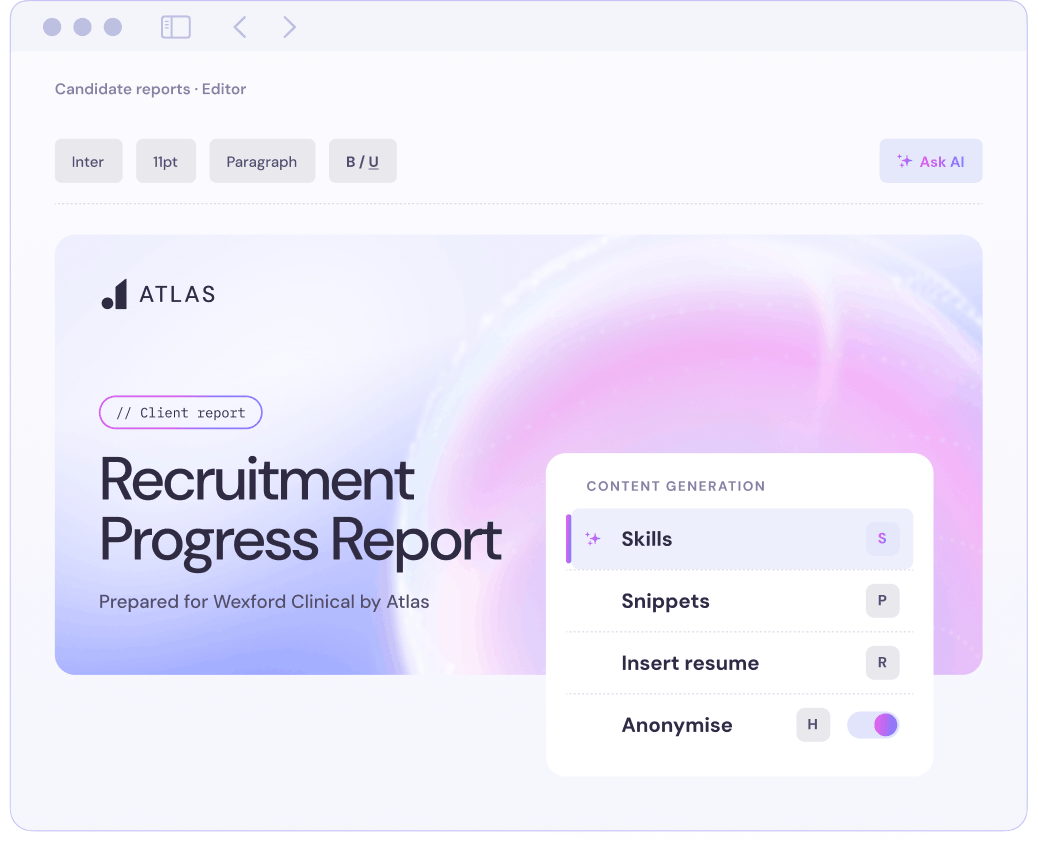
// Candidate Reports
Create polished candidate reports
Turn complete profiles, meeting notes and conversations into polished, client-ready documents.
-
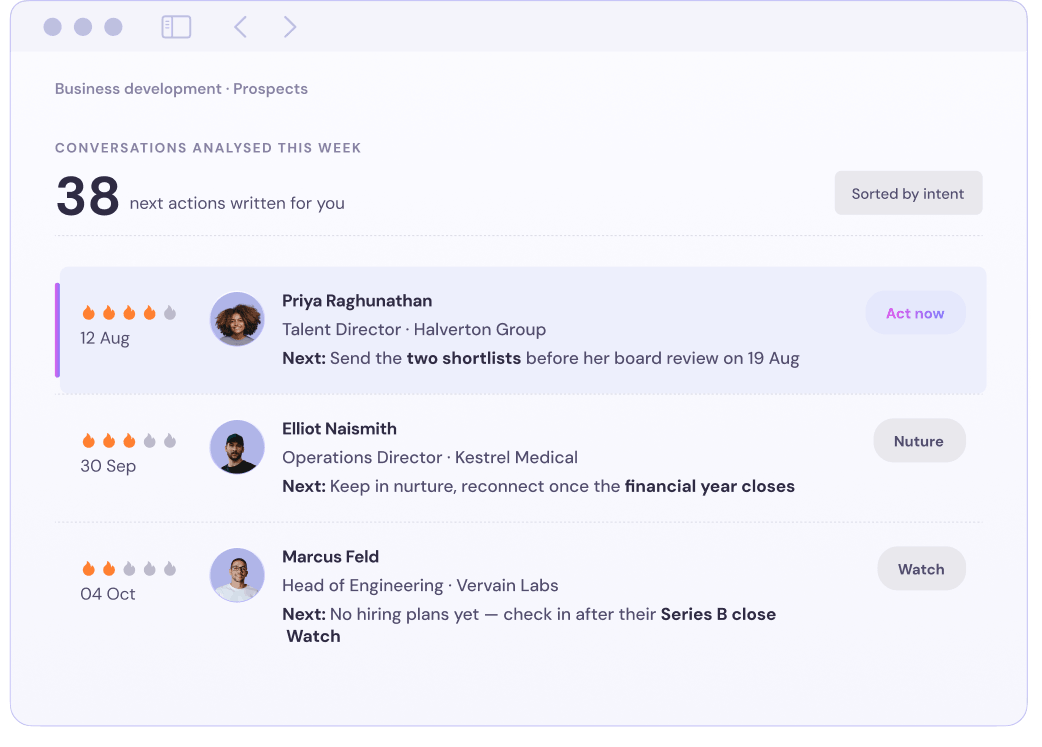
// Opportunities
Focus on opportunities most likely to convert
Track every interaction, assess urgency and prioritise opportunities using an automatically updated likelihood of winning.
-
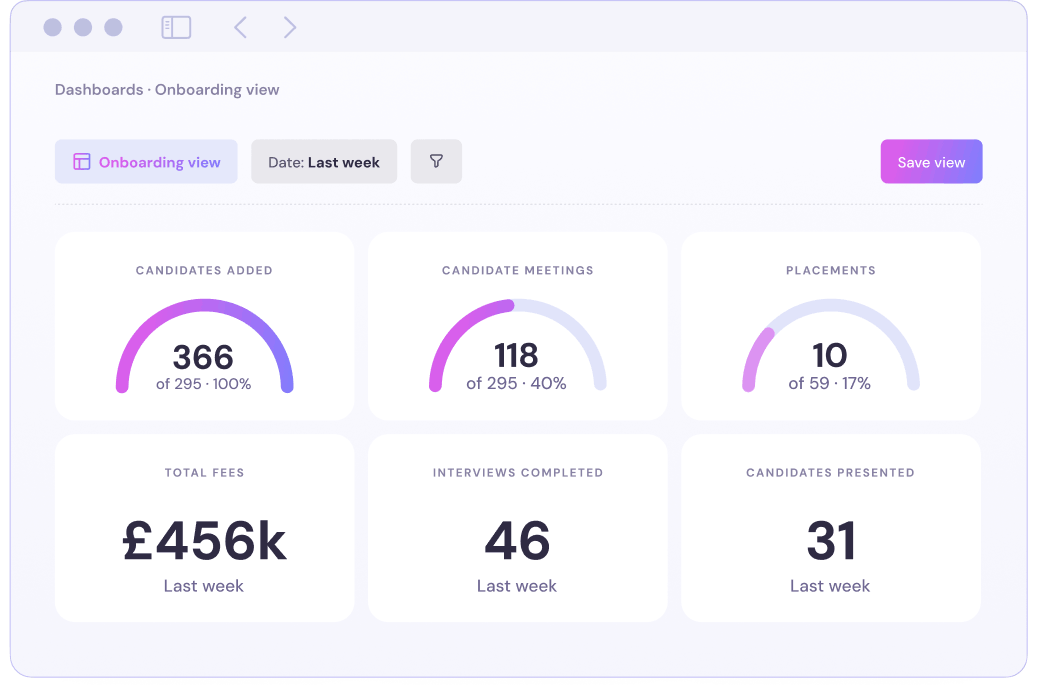
// Dashboards
See performance and pipeline in real time
Track performance, fees, placements and conversion ratios through live dashboards with custom views and filters.
-
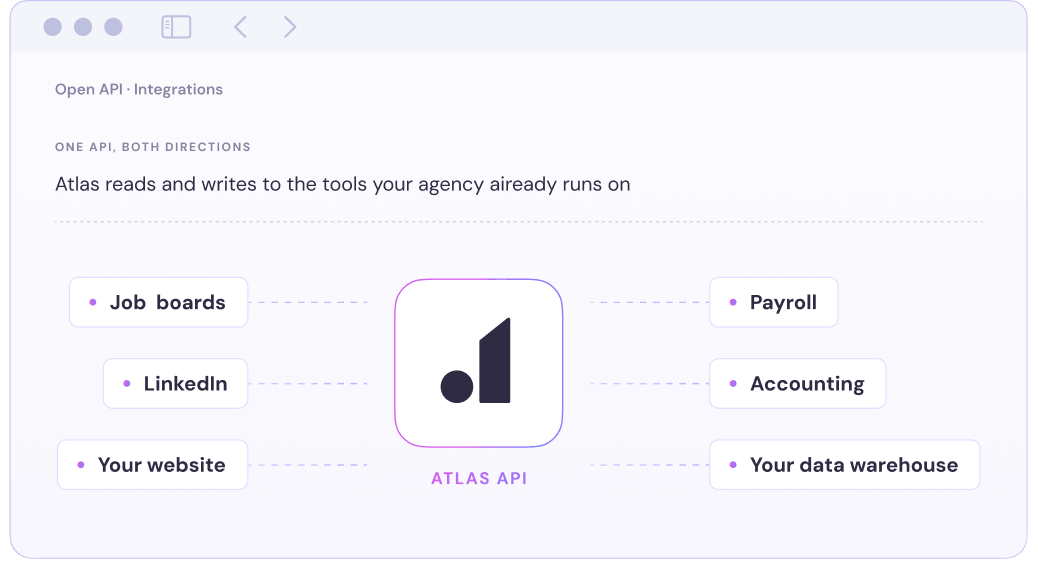
// Open API + Integrations
Connect Atlas to the tools you use
Connect external tools and custom workflows through Atlas’s public API and growing library of native integrations.
-
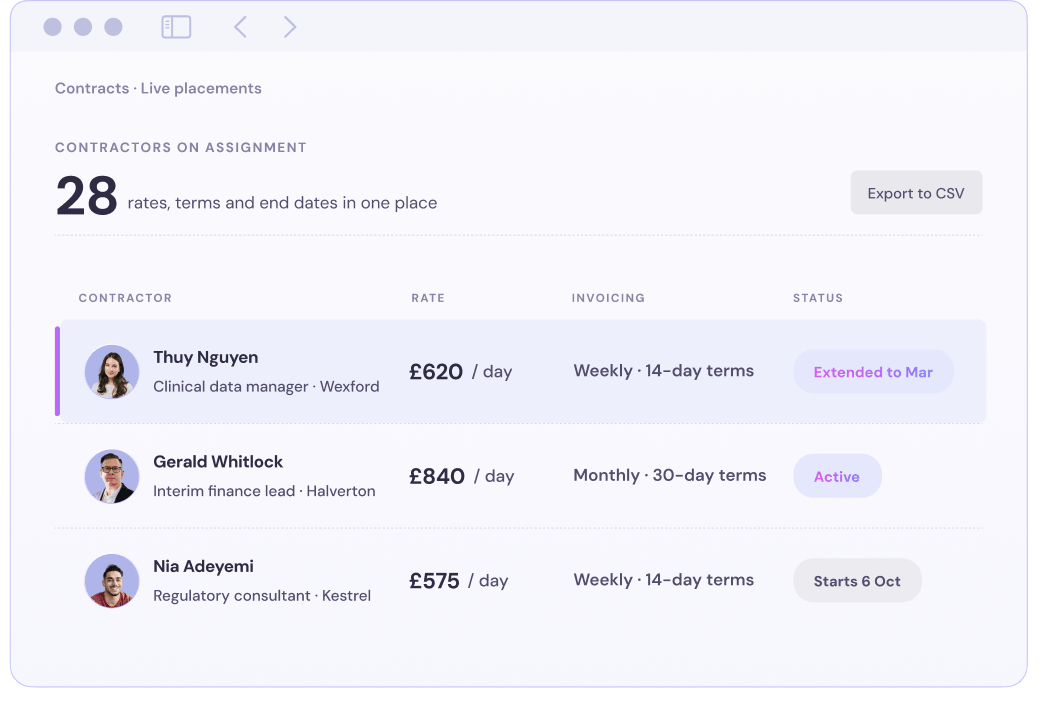
// Contract Management
Manage every placement in one platform
Handle permanent and contract placements with flexible rates, approvals, expenses and automatic status updates.
-
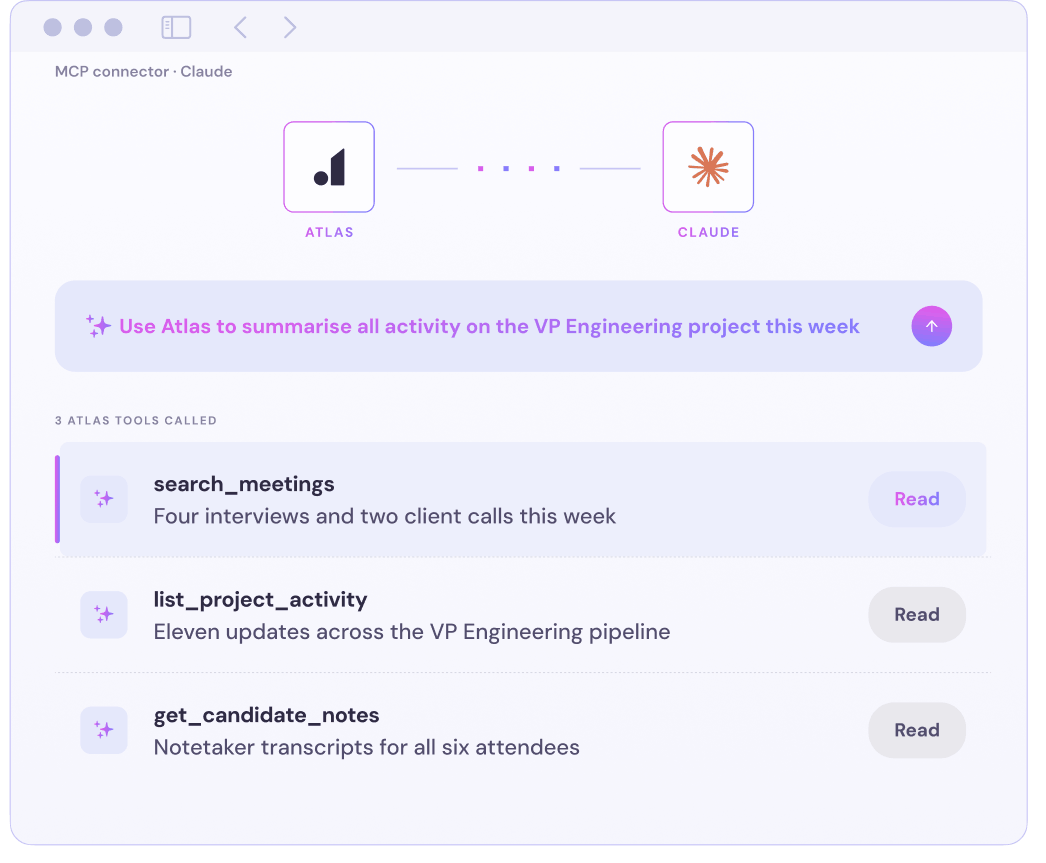
// Claude Connector
Ask Claude anything about your Atlas data
Get answers across candidates, projects, companies, meetings and transcripts without manually searching through records.
Pricing, side by side
Atlas starts at $120 per user per month on an annual commitment paid up front, with AI usage included. Magic Credits will unify visibility of AI consumption across the platform at no additional cost over that price.
JobAdder does not publish pricing. Four plans — Lite, Essential, Pro and an in-house Business edition — are quoted after a demo based on geography and team size. Third-party directories estimate the entry point in the low-to-mid three figures per user per month, but those are estimates rather than JobAdder’s figures and should be treated as such.
Two things to establish in a JobAdder quote. First, which plan you are being quoted, since Adder Intelligence starts at Essential and Lite includes no AI. Second, whether managed data migration is inside the quote or priced separately, as it is quoted separately by default.
Migrating from JobAdder to Atlas
JobAdder is one of the most common systems our customers move from. Our Atlas’s VP Delivery has completed 300+ large-scale migrations before joining Atlas.
How it works:
- We analyse how you use JobAdder. Before anything moves, we look at what’s in your database and how your team actually works: which fields matter, what’s been repurposed and what’s no longer used.
- We map your data into Atlas together. We agree with you where everything should land, so your records make sense in Atlas from day one.
- We test. You check your own data in Atlas before you switch over.
- We train your team. Your recruiters learn Atlas on their own data, not a demo database.
Preserving unstructured history matters more here than in a conventional migration, because that history is exactly what Total Memory operates on afterwards: a migration that carries records but drops notes, call logs and activity context discards the asset the platform is built to exploit. Ask any vendor, including Atlas, for a migration scope that names unstructured data explicitly.
The numbers behind the switch
-
// Garfield Stephers
80%less time spent on CV formatting
-
// Pace Global
30% +more candidates and roles handled
-
// Aym Recruitment
150%revenue growth after adopting Atlas
-
// Ethiq
200%of annual billing target achieved
-
// Tech Valley Recruitment
30 minsaved per candidate report
-
// Globus Search
4×faster candidate sourcing and updates
The verdict
JobAdder earned its reputation honestly. It is easy to use, deeply established in its home market, ISO 27001 certified, well supported, and it has the best job board distribution in the category. For an agency whose applicant flow runs on volume advertising, it is a good platform.
But JobAdder has told you what its AI is for, and we take it at its word: it amplifies human expertise and keeps the recruiter in control. Smart Summary rates a candidate for a human to judge. Smart Sync prompts a human to update a record. The intelligence advises, and the recruiter still does the work — including the several hundred small acts of maintenance that are the actual problem.
Atlas was built the other way. Total Memory is the substrate rather than a layer, which is why Atlas’s agents can act instead of recommend, and why conversations become searchable rather than lost. JobAdder made its AI a better assistant. Atlas made the admin go away.
// See Atlas in action
Bring a live role. Book a 30-minute demo and we will run it in Atlas against your own data — not a sandbox, not a slide.


