













// Comparisons
Atlas vs Recruiterflow (2026): AI Included vs AI Quoted Separately
Atlas vs Recruiterflow: which platform fits your agency in 2026
Atlas and Recruiterflow both combine ATS, CRM, outreach and automation into one system for recruitment agencies, and both now market themselves as AI-native. The difference is where the AI sits on the price list. Recruiterflow’s published plan carries the ATS, CRM, sequences and automation; every AIRA agent sits on a second plan with no public price. Atlas includes its AI in the seat price.
What Recruiterflow actually is
Recruiterflow is an ATS and CRM for recruiting and staffing agencies, and a bootstrapped US company. Its own account of its build history is that it shipped multichannel sequences in 2019, workflow automation in 2021 and agentic intelligence in 2023. It states 1,700+ agencies on its pricing page, and 2,100+ search firms elsewhere on the same page. It holds ISO 27001 and SOC 2, both displayed in its site footer.
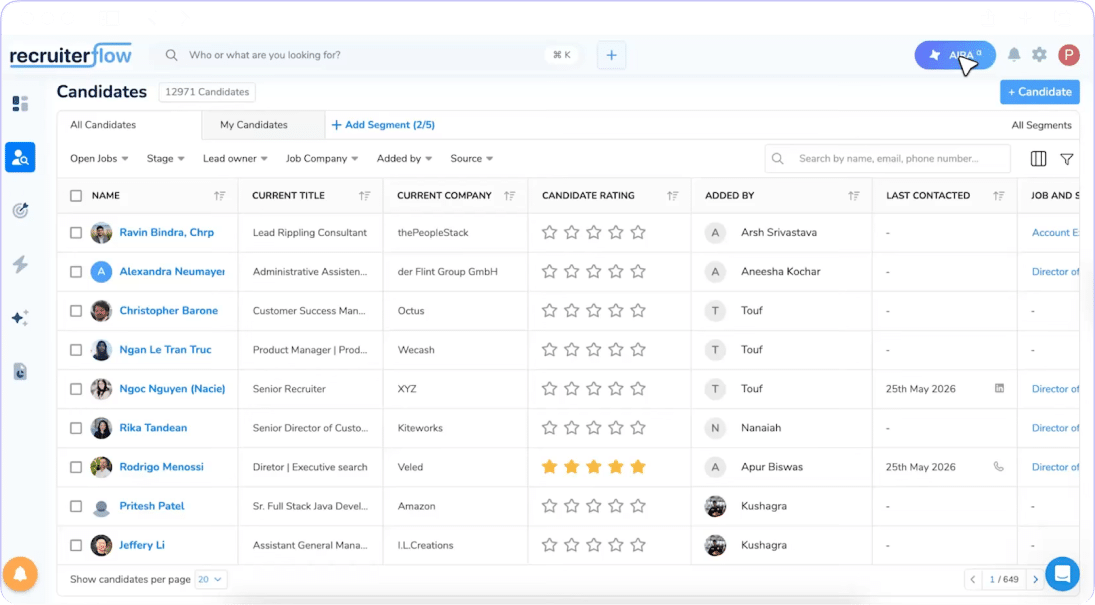
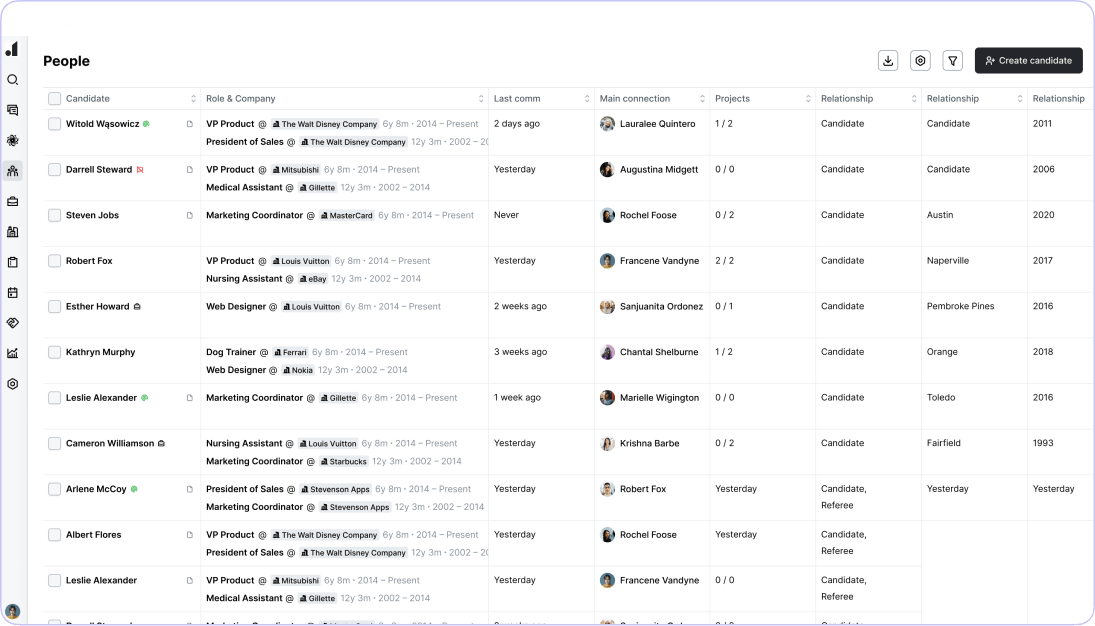
The platform’s core is a recruiting operations system: unlimited jobs, candidates, contacts and companies, LinkedIn imports and Chrome-extension sourcing, a custom ATS and CRM, a branded careers page, multichannel sequences, recruitment and sales automation, reporting and API access.
On top of that sits AIRA, Recruiterflow’s AI layer. AIRA covers the Notetaker, Matchmaker, Source (across 850M+ profiles), Field Updates Agent, Submission Agent, Task Agent, Research Agent, Job Change Alerts, Ask AIRA, AIRA Search natural-language search, a verified phone and email finder, omnichannel communication sync and custom BI dashboards. Recruiterflow describes AIRA as a suite of agents that “augment key parts of the recruiting workflow, one task at a time”.
What Atlas actually is
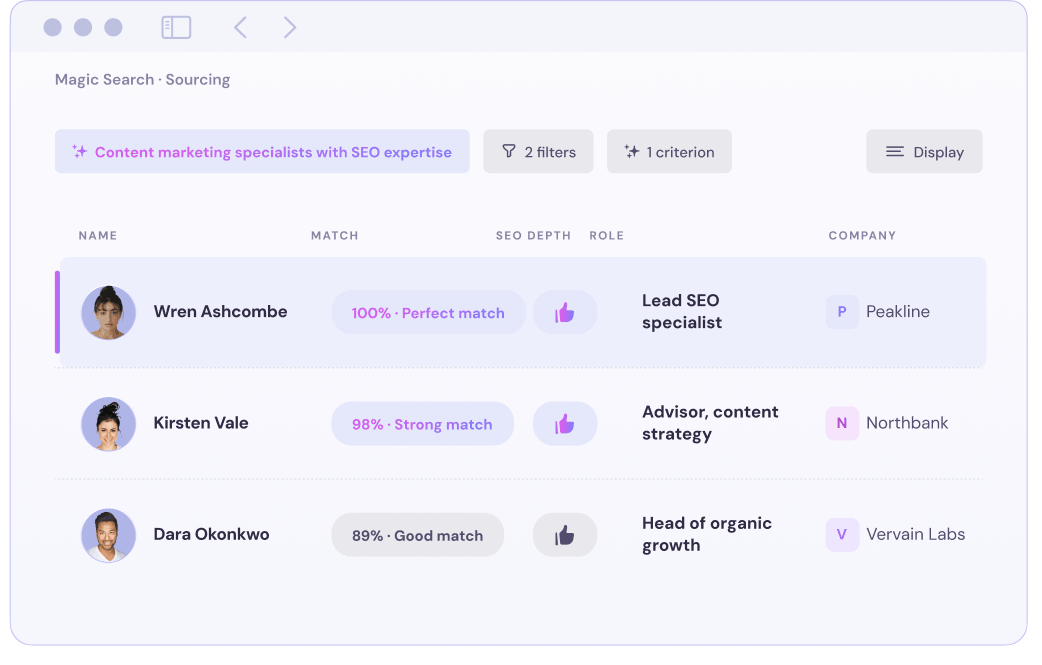
Atlas is an AI-native CRMx — one system combining CRM and ATS — built for agency recruiters and launched in 2023. Its core is Total Memory: a persistent intelligence layer capturing everything a firm’s team says, hears, reads and writes across calls, emails, meetings and notes, made searchable and available to AI agents at every stage of the pipeline. On top sit generative agents that remove recruitment admin, Opportunities for business development, Magic Search for criteria-based candidate assessment, a native AI note-taker, multi-touch outreach campaigns, custom dashboards, an MCP server, a Chrome extension and a mobile app. Atlas serves 500+ agencies, is backed by Smedvig Ventures, and puts around 40% of its team into engineering and product. Pricing starts at $120 per user per month on an annual commitment paid up front.
Side by side
| // Features | Atlas | Recruiterflow |
|---|---|---|
| Category | AI-native CRMx (CRM + ATS) | Recruiting operations platform with a separately-priced AI layer |
| Founded | 2023 — AI-native from first commit | Bootstrapped US company; agentic layer added from 2023 |
| Core intelligence | Total Memory over your firm’s own calls, emails, meetings and notes | AIRA agents, scoped one task at a time |
| Where the AI sits | Included in the seat price | AIRA Plan — quote-only, no published price |
| AI agents | Run continuously and ambiently; fully automated BD workflows in build | Task-scoped agents; Field Updates Agent suggests changes for approval |
| Search | Magic Search v2, criteria-based fit scoring, live since March 2026 | Keyword and filters on Platform; AIRA Search and Matchmaker on the quote-only plan |
| Communication channels | Calls, email, meetings and notes into one memory layer | Email, calls, text on Platform; LinkedIn steps and conditional branching on AIRA |
| Business development | Opportunities — job leads, target clients and marketable candidates in one workspace, moving toward end-to-end automation | Sales pipelines and sales automation on the CRM side |
| Reporting | Custom native dashboards | “Basic” on Platform; custom BI dashboards on AIRA |
| Company shape | Product-led — around 40% of the team in engineering and product, 10% in sales | Bootstrapped; named account managers and SLA-backed support |
| AI consumption model | Magic Credits, unifying AI usage across the platform | All agents included once on the AIRA plan; the plan itself is quoted |
| Pricing | From $120 per user/month, annual, paid up front, AI included | Platform $119/user/month annual ($149 monthly); AIRA plan custom-quoted |
| Security | ISO 27001 certification in progress, targeted mid Q4 2026 | ISO 27001 and SOC 2 held today |
| Migration | Scoped implementation plan after reviewing your export | Free self-serve CSV; paid white-glove quoted at 6–8 weeks |
Recruiterflow figures verified against recruiterflow.com/pricing on 10 October 2026.
Where Atlas and Recruiterflow overlap — and where the overlap stops
At feature-name level, the two platforms look similar. Atlas and Recruiterflow both replaced the legacy stack where an agency ran an ATS, a separate CRM and a handful of point tools. Both are single systems of record. Both keep business development and delivery in one platform. Both run multichannel outreach with AI-drafted messaging. Both capture calls and write notes back to records. Both ship a Chrome extension, an API and an MCP connector. Both publish an agent roster. Anyone comparing spec sheets will find a lot of matching rows.
The spec sheet is the wrong instrument. Two platforms can list “AI note-taker” and mean different things, because the question is not whether a capability exists but what it is connected to — and, in this comparison, whether it is on the plan you can actually buy from the page.
This is where the overlap stops. Atlas built its data model around AI first and the recruitment workflow second: Total Memory exists so that every downstream agent has the full context of what the firm knows, and everything else was added to that layer. Recruiterflow built a recruiting operations platform first — sequences in 2019, automation in 2021 — and added agents from 2023 onward. Recruiterflow’s own description of AIRA is the tell: agents that augment the workflow “one task at a time.”
That phrase is not a criticism, it is an accurate description of a design. Task-scoped agents work well when each task is self-contained. They are a different thing from a shared memory layer that every agent reads from and writes to, and the difference shows up whenever a task depends on something said somewhere else — in a call last quarter, in an email thread nobody logged, in a note a departed consultant wrote.
The architectural question, stated plainly
Every recruitment platform now claims to be AI-native. The claim only means something if you ask what it would cost the vendor to be wrong.
A platform built on AI foundations compounds from external progress: when frontier reasoning improves, the whole product improves, because the intelligence sits in the data layer rather than in individually-integrated features. A platform that added AI to an existing core integrates each advance separately, against a schema designed before anyone knew what would be needed.
There is a commercial signature to each. When AI is the foundation, it cannot be sold separately, because there is no version of the product without it. When AI is a layer, it can be — and Recruiterflow’s two-plan structure is the clearest evidence in this market of which model a vendor is running. That is not an accusation; it is what the pricing page says.
Deep dive 1: whether the AI is on the price list
How Recruiterflow works. Recruiterflow sells the platform and the intelligence as two products. The Platform Plan at $119 per user per month annually covers the ATS, CRM, multichannel sequences, recruitment and sales automation, Chrome sourcing, reports and API access, with no add-ons inside that plan. Everything the company now leads with in its marketing — the Notetaker, Matchmaker, AIRA Source, Field Updates, Submission and Task agents, Job Change Alerts, the verified phone and email finder, omnichannel sync and custom BI dashboards — sits on the AIRA Plan, which is quote-only. Recruiterflow’s feature table marks each of those with a cross against Platform. To Recruiterflow’s credit, once a firm is on AIRA, every current and future agent is included with no per-agent charges.
Where Atlas is stronger. Atlas has one number. From $120 per user per month on an annual commitment paid up front, with the AI included — not as a bundle discount, but because there is no Atlas without it. A buyer can cost Atlas from the page. Costing Recruiterflow’s 2026 feature set requires a sales conversation, and the number that comes back is the Platform price plus an unquoted second figure.
This matters beyond budgeting. A vendor that can price its AI separately has told you something structural: the AI is separable. Atlas cannot sell a version without Total Memory, because Total Memory is what the ATS and CRM are built on top of.
Atlas is also closing the one advantage a separate AI plan can offer, which is visibility into what the AI actually does. Magic Credits will unify AI consumption across the entire platform in a single view, so agency leaders can see exactly where the intelligence is being used.
Deep dive 2: task-scoped agents vs a shared memory layer
How Recruiterflow works. AIRA is a roster of agents, each mapped to a discrete job: the Notetaker summarises a call, the Matchmaker scores candidates against a role, the Research Agent preps for a conversation, the Submission Agent drafts a branded submittal, Job Change Alerts flags a move, the Field Updates Agent proposes changes to ATS and CRM fields. Recruiterflow describes the design in its own FAQ as augmenting the workflow one task at a time, with each agent working behind the scenes on its own remit. It is a clean, legible architecture, and the individual agents are well specified.
Where Atlas is stronger. Recruiterflow published the right test for this, in its own words: “Does AI execute or just suggest? Suggesting actions isn’t agentic.” It is a good standard. Recruiterflow’s own pricing page describes the Field Updates Agent as producing “automatic suggestions of field updates” for the ATS and CRM — which is to say, a recruiter still confirms them.
Atlas’s agents do not present a queue. They run against Total Memory continuously, and record maintenance, follow-up and status updates happen as the system’s default behaviour. The reason Atlas can do that with confidence is the same reason the architecture matters: an agent acting without confirmation needs the full context of what the firm knows, not the fragment relevant to one task. When every call, email, note and meeting feeds one layer, an update is grounded in everything rather than inferred from one input.
The practical difference shows up on the work nobody assigns. A task-scoped agent handles the task you gave it. It does not surface that a client mentioned a hiring plan in passing eighteen months ago, or that a candidate said in a call that they would move for the right package — because no single task owns that. A memory layer does, because remembering is not a task. It is the substrate.
Deep dive 3: business development as a workflow, not a pipeline
How Recruiterflow works. Recruiterflow handles the client side through its CRM: sales pipelines, sales automation, multichannel sequences and the automation recipe engine that is one of the most mature parts of the product. On the Platform Plan, sequences run email, text and task steps; LinkedIn connection and message steps and conditional branching require the AIRA Plan. It is a solid, well-iterated BD toolkit, and firms running high-volume email outbound get real value from it.
Where Atlas is stronger. Atlas treats business development as a single connected workflow rather than a pipeline plus a sequencer. Opportunities holds job leads, target clients and marketable candidates in one workspace, scored on engagement, momentum and conversion likelihood, with a recommended next move attached. Because Opportunities sits on the same memory layer as delivery, a BD signal picked up in a candidate call reaches the client side automatically — the two halves of an agency’s business stop being separate systems that a consultant manually reconciles.
Atlas is now extending its agents to run that arc end to end: identification, outreach and follow-up executed without a recruiter driving each step. That is a materially harder problem than sequencing, and it is only tractable when the agents already hold the firm’s full context.
Sequencing and BD pipelines are well-solved problems, and Recruiterflow solves them. The difference is what sits underneath: a sequencer executes the steps you configured, while an agent working off a shared memory layer can tell you which client to approach this week and why.
Where Recruiterflow has genuine advantages
A mature automation engine on the published plan. Recruiterflow shipped multichannel sequences in 2019 and workflow automation in 2021, and years of iteration show in the recipe engine. Recruitment and sales automation are included in the $119 Platform Plan with no add-ons inside it. For a firm that wants dependable workflow automation rather than agentic AI, that is a well-proven capability at a published price. When it decides the choice: if your requirement is automation rather than AI, Recruiterflow’s Platform Plan covers it cheaply and reliably.
Install base and service model. Recruiterflow runs 1,700+ agencies and markets named account managers and SLA-backed support, with support the theme its own customer testimonials lead with. That is a real service infrastructure and a real body of production experience, and Atlas at 500+ agencies is the newer company. When it decides the choice: if a named account manager and a formal SLA are procurement requirements, Recruiterflow is built around that model.
What the market is telling us
Atlas talks to agencies evaluating the whole ATS and CRM market every week, including firms that trialled both Atlas and Recruiterflow before deciding. What those buyers say is more useful than either vendor’s marketing, so we publish it as we hear it.
I like the functionality and the look of Atlas more than Recruiterflow, but I think Recruiterflow has got more functions — AIRA Source, the external search. Though that might not last if they get told off by LinkedIn.
Recruiterflow is not bad, but comparing both AIs there is no doubt that Atlas goes deeper – you can tell the difference that it’s at the core.
Based on Atlas evaluation conversations, 2026. Updated as new comparisons come in.
Choose Recruiterflow if
- Your requirement is workflow automation rather than agentic AI, and the published Platform Plan covers it.
- A named account manager and an SLA are central to how you buy software.
- Your outbound runs primarily on email and text cadences, which the Platform Plan handles without an upgrade.
Choose Atlas if
- Your firm’s knowledge is your product, and the problem is that it sits in inboxes, notebooks and departed employees rather than in a system you can query.
- You want admin to disappear rather than arrive as a queue of suggestions to approve.
- You want business development and delivery running on one memory layer rather than two reconciled systems.
- You want one predictable number: from $120 per user per month, annual, paid up front, with AI included.
-
// Magic Search
Find the right people in plain English
Search your entire database using natural language and see exactly why every recommended candidate matches your criteria.
-
// AI Notetaker + Tasks
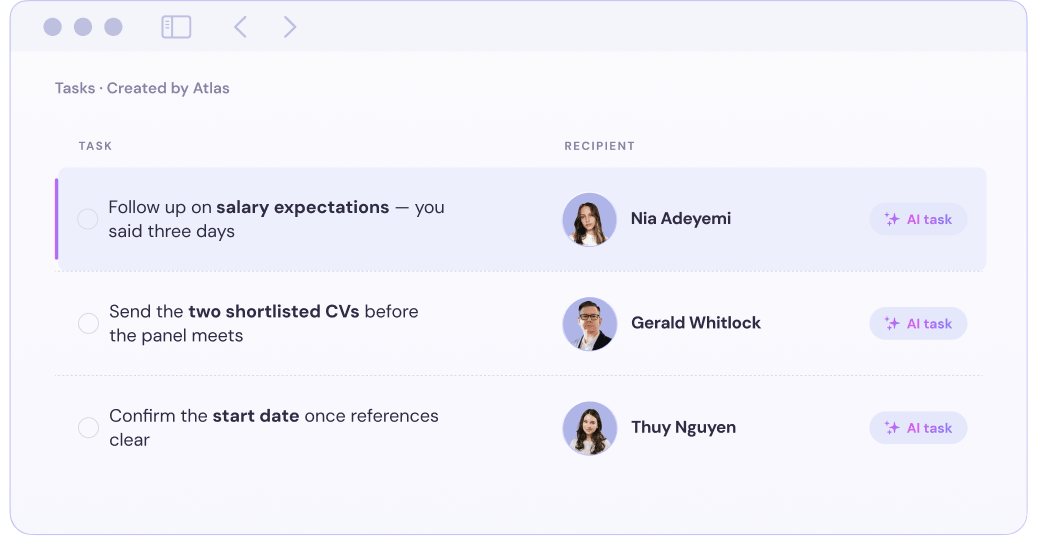
Turn conversations into next actions
Capture calls automatically and turn every commitment into a clear, timely follow-up task for your team.
-
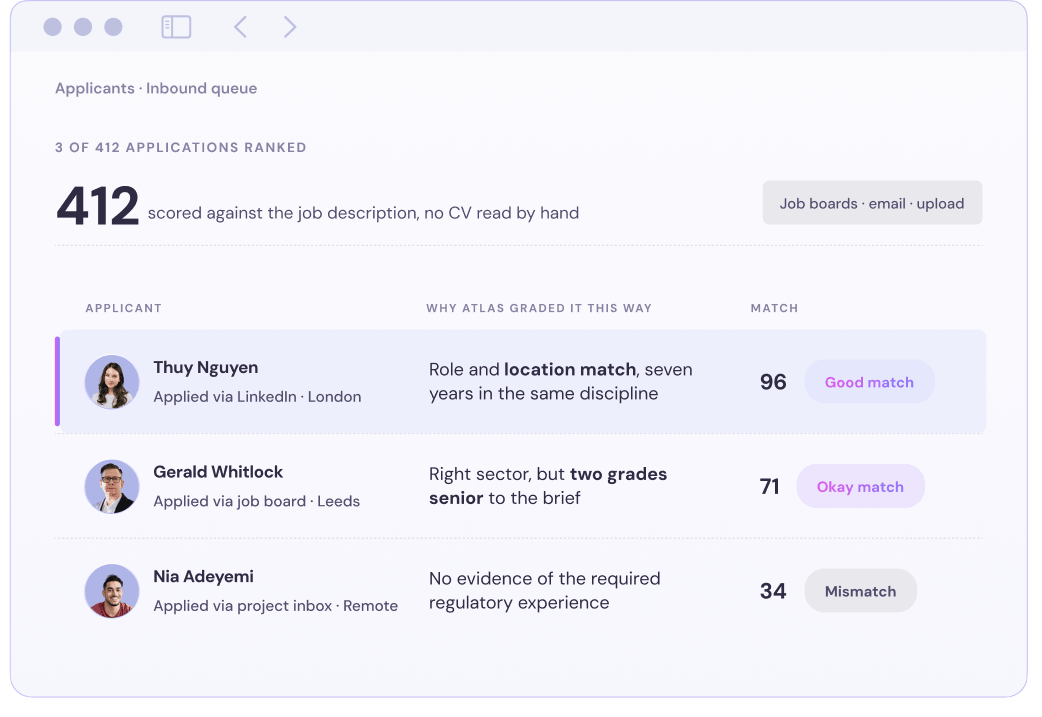
// Applicants
Triage applicants without database clutter
Automatically grade incoming applicants with clear reasoning while keeping unapproved profiles outside your main database.
-
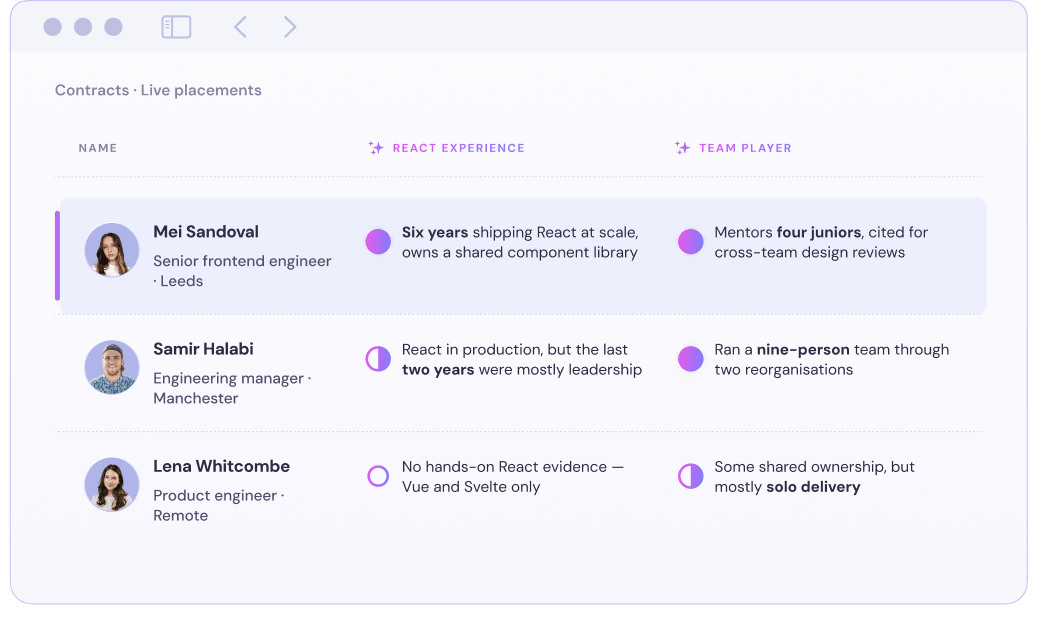
// Magic Columns
Score candidates against your criteria
Evaluate every candidate against your own competencies, instructions and scoring system using flexible AI-powered columns.
-
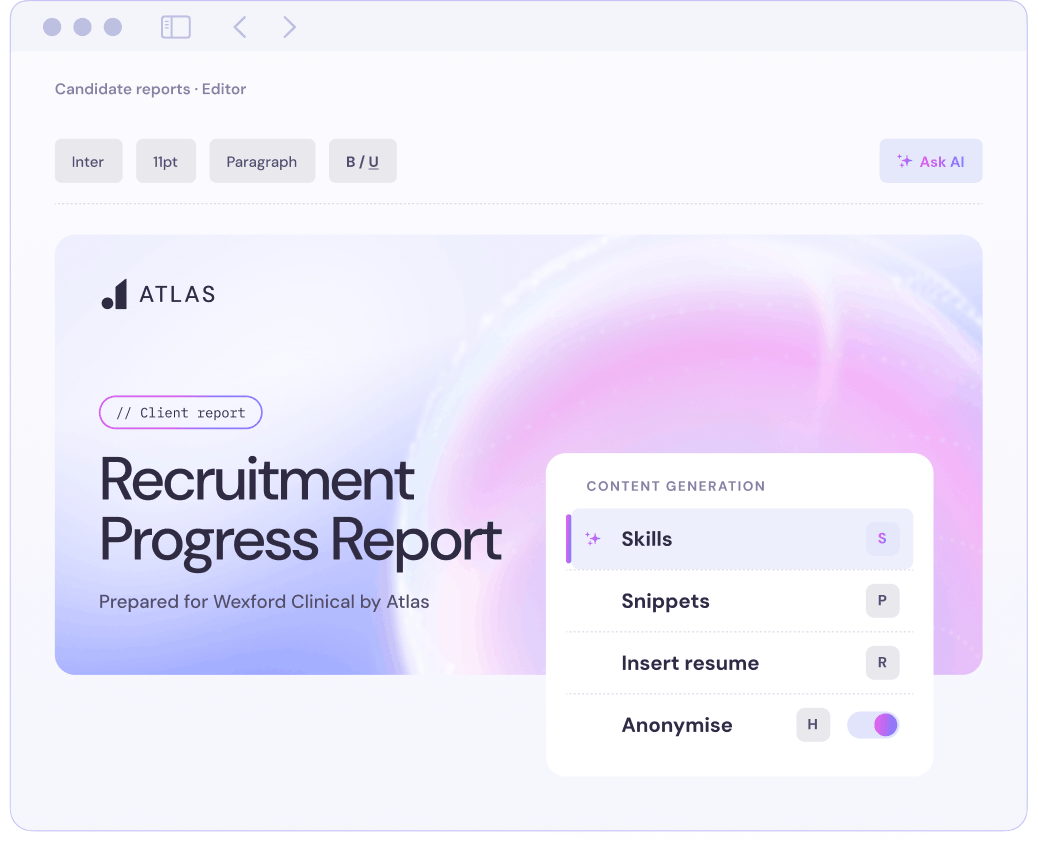
// Candidate Reports
Create polished candidate reports
Turn complete profiles, meeting notes and conversations into polished, client-ready documents.
-
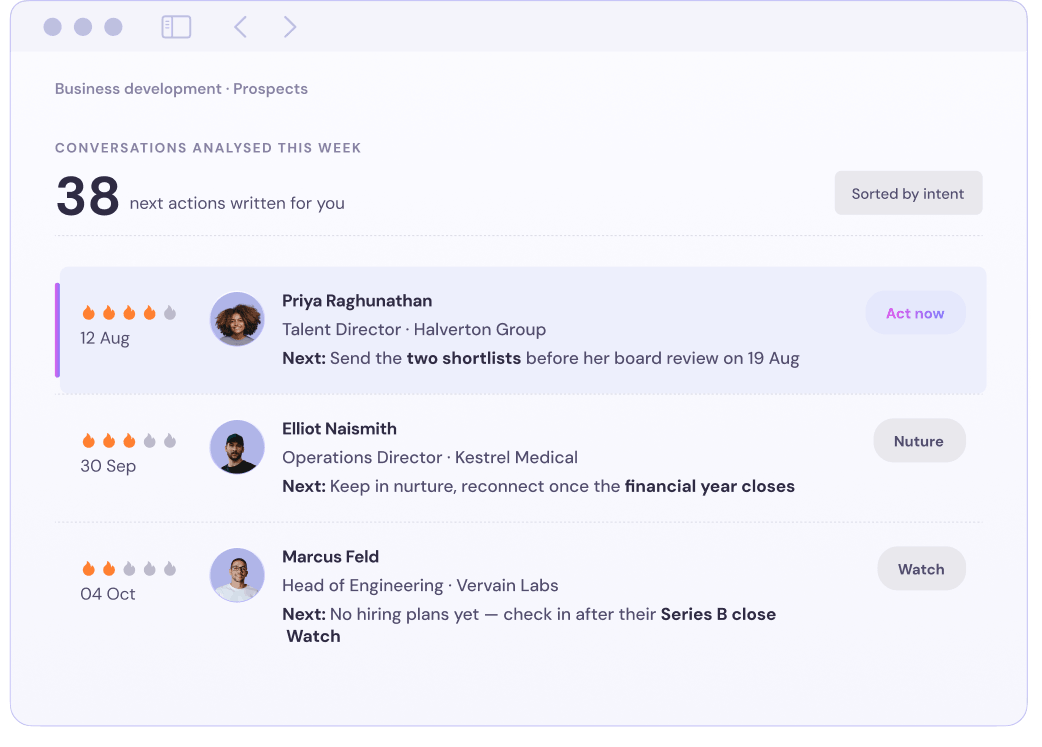
// Opportunities
Focus on opportunities most likely to convert
Track every interaction, assess urgency and prioritise opportunities using an automatically updated likelihood of winning.
-
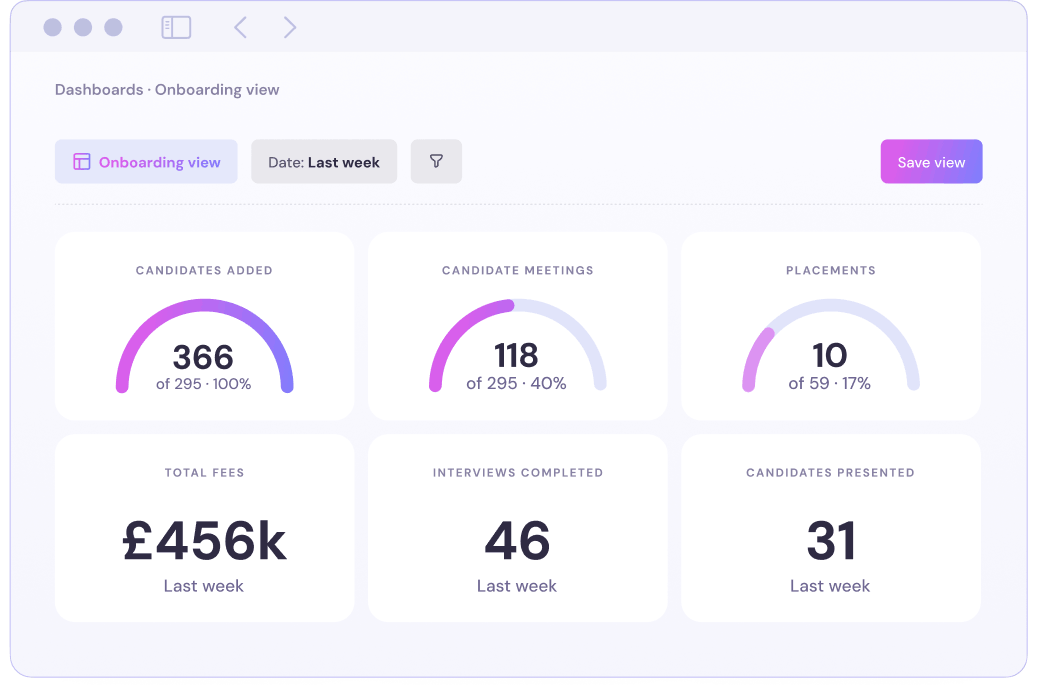
// Dashboards
See performance and pipeline in real time
Track performance, fees, placements and conversion ratios through live dashboards with custom views and filters.
-
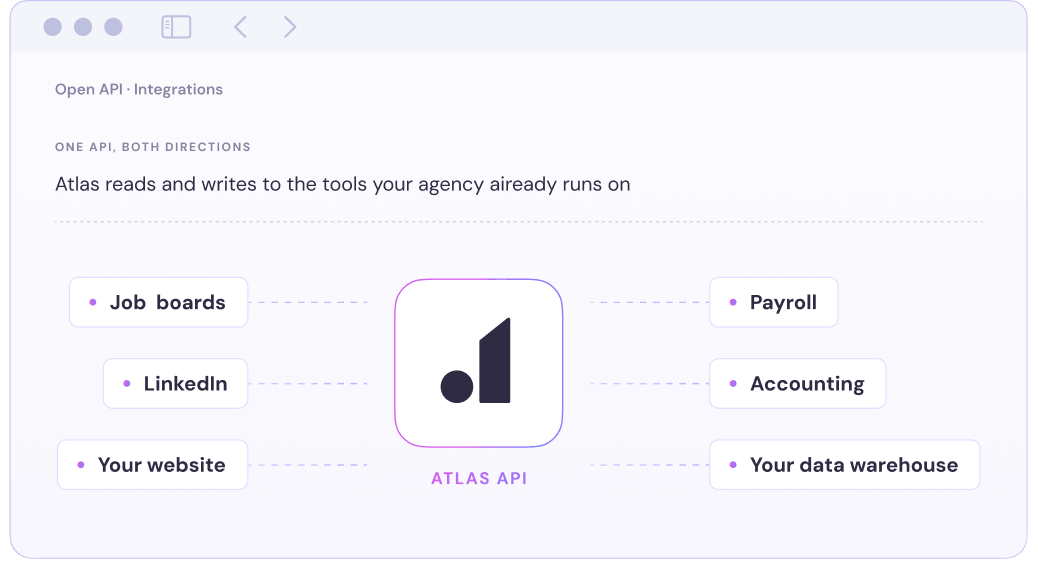
// Open API + Integrations
Connect Atlas to the tools you use
Connect external tools and custom workflows through Atlas’s public API and growing library of native integrations.
-
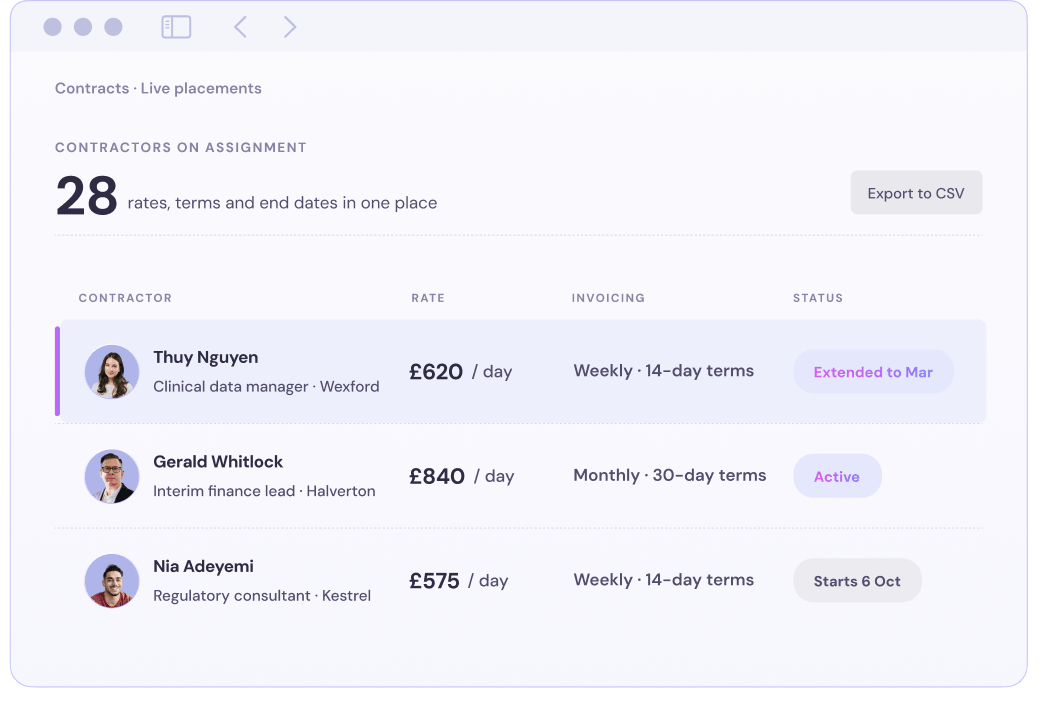
// Contract Management
Manage every placement in one platform
Handle permanent and contract placements with flexible rates, approvals, expenses and automatic status updates.
-
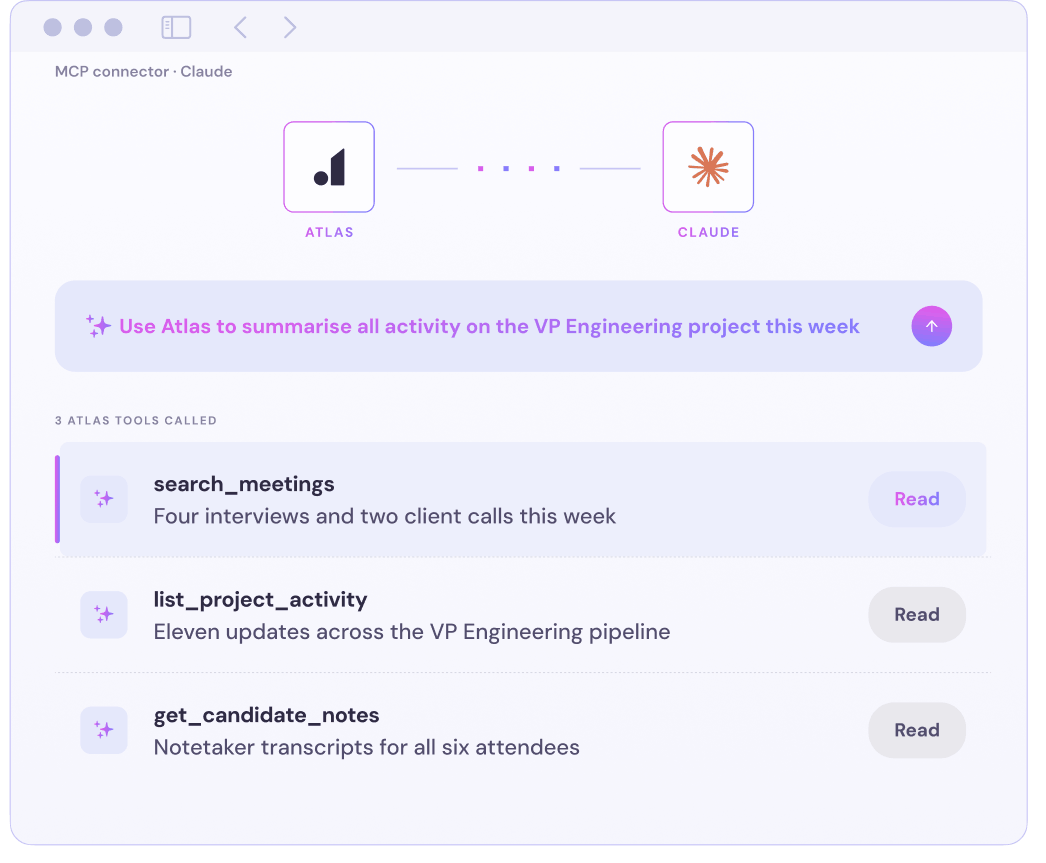
// Claude Connector
Ask Claude anything about your Atlas data
Get answers across candidates, projects, companies, meetings and transcripts without manually searching through records.
Pricing, side by side
Atlas starts at $120 per user per month on an annual commitment paid up front, with AI usage included. Magic Credits will unify visibility of AI consumption across the platform at no additional cost over that price.
Recruiterflow publishes the Platform Plan at $119 per user per month billed annually, $149 monthly. That plan carries the ATS, CRM, multichannel sequences, recruitment and sales automation, Chrome sourcing, reports and API access, with no add-ons within it. The AIRA Plan, which carries every AI agent, LinkedIn sequence steps, conditional branching and the BI dashboards, is quote-only.
So the two published numbers are near-identical — $120 against $119 — but they buy different things. Atlas’s $120 includes the AI. Recruiterflow’s $119 explicitly excludes it, and the price that includes it is not on the page.
Migrating from Recruiterflow to Atlas
Migration begins with a full export from Recruiterflow — candidates, companies, jobs, activities and notes. Atlas handles the structured import, field mapping and configuration, then testing and training before go-live.
Preserving unstructured history matters more here than in a conventional migration. Recruiterflow makes this point well in its own content, and it is right: call notes, email threads and activity logs are where years of relationship context live, and most migrations quietly exclude them. For Atlas the stakes are higher still, because that history is exactly what Total Memory operates on afterwards — a migration that drops it discards the asset the platform is built to exploit. Ask any vendor, including Atlas, for a migration scope that names unstructured data explicitly.
Atlas scopes the implementation plan after reviewing your export, so the go-live date is agreed before work begins.
The numbers behind the switch
-
// Garfield Stephers
80%less time spent on CV formatting
-
// Pace Global
30% +more candidates and roles handled
-
// Aym Recruitment
150%revenue growth after adopting Atlas
-
// Ethiq
200%of annual billing target achieved
-
// Tech Valley Recruitment
30 minsaved per candidate report
-
// Globus Search
4×faster candidate sourcing and updates
The verdict
Recruiterflow built a good recruiting operations platform and has been iterating on it for years. The automation engine is mature, the agent roster is well specified, the certifications are in place today, and the service model is real. For a firm that wants proven automation at a published price, it is a sound choice.
But Recruiterflow’s structure tells you what it is. A platform that can sell its intelligence as a separate plan is a platform where the intelligence is separable — added to a core that works without it, priced accordingly, and quoted rather than published. Atlas cannot do that, because Total Memory is not a layer on the product; it is what the product is built on.
That shows up in three places a buyer feels: one price instead of two, agents that act rather than suggest, and a memory layer that holds the context no single task owns. Recruiterflow sells AI as an upgrade. Atlas is the upgrade.
// See Atlas in action
Bring a live role. Book a 30-minute demo and we will run it in Atlas against your own data — not a sandbox, not a slide.


