










// Recruitment Technology, Recruitment Strategies
Skill Tagging Candidate Records Was Always Cover for Bad CRM Search
Published: 11 August 2026,
9 min to read
The bottom line
Skill-coding taxonomies were never a data strategy at recruitment agencies. They were compensation for a search engine that could only match the characters you typed. They failed the moment a consultant left a field blank. Once candidate database search can interpret meaning on its own, the taxonomy stops being an asset. It becomes a cost you can remove.
Where skill-coding taxonomies actually came from
No agency set out to build a skills taxonomy. It arrived as a patch.
The pattern repeats across mid-market and enterprise firms. Candidate database search returned noise, so someone built a controlled vocabulary to compensate. It listed skills, sectors, seniority bands, and specializations, and every candidate record got coded by hand. The list started at 40 entries and reached 400.
The taxonomy was usually designed by one person who has since left the business. Nobody in particular has maintained it since.
Dozens of agency operations leads have described the same arc to us on recorded calls. Coding discipline holds while a researcher owns it. Then billing pressure arrives. Fields go blank, and every search built on those fields quietly stops returning the right people. Nobody notices, because a search with 12 results looks exactly like a search with 40.
Why did keyword search push agencies into skill coding?
Because string matching cannot read a resume. It finds the characters you typed and stops there.
A cv search for FP&A misses the controller whose resume spells out financial planning and analysis. A search for VP Sales misses the Commercial Director doing the identical job. Boolean narrows the gap at the cost of a 200-character string only its author can maintain.
The same limitation shows up on job boards. A keyword pass over a CV database returns volume, not fit.
So agencies encoded the meaning by hand. Tags carried what the record could not express on its own. They named the sector the candidate really worked in, and the specialization hiding behind a generic title.
Some of that gap can be closed inside the system. Expanding a search across similar job titles catches the COO when you asked for an Executive. Nobody has to code either record first.
That was sound engineering in 2012. It is an expensive habit now.
What happens when tagging fields go blank across a candidate database?
The search breaks silently, which is the worst way for a search to break. A candidate with an empty skill field does not rank as a weak match. They are absent from the result set entirely.
Consultants worked out early that a mandatory field will accept a single space. Nobody has ever been paid a bonus for a well-coded record.
This is not specific to recruitment. Across 602 CRM users and administrators, 76% said less than half of their organization’s CRM data is accurate and complete.
At scale, four failure modes do most of the damage:
The result is a recruitment team that loses track of qualified candidates it already owns. It then pays to source them a second time. Training does not fix this. CRM adoption fails at recruitment agencies for structural reasons. Meanwhile, data decay works against the tidiest vocabulary on a schedule of its own.
- Two consultants code the same candidate differently, so one search finds them and the next does not.
- A tag is correct on the day it is applied and wrong 18 months later, after a promotion nobody logged.
- Records arriving by bulk import or resume parse land untagged, and stay that way.
- The vocabulary drifts as new sectors are added, leaving older candidate records filed under labels nobody searches anymore.
How much is the tagging habit costing your desk?
More than the coding time, which is the smallest line on the invoice.
McKinsey’s measure of knowledge work still applies here. Interaction workers spend nearly 20 percent of the workweek looking for internal information or tracking down colleagues who can help. On a recruitment desk, that is time not spent on BD calls or the shortlist a client is waiting on.
The bigger number is the placement nobody made. Atlas surveyed more than 1,000 agency recruiters. It found that 36.99% name candidate sourcing as the biggest factor slowing placements. No other bottleneck ranked higher. A dormant database that cannot be searched properly is a sourcing problem wearing a different label.
Set the ledger out honestly and the cost side includes:
The asset side carries one entry: searches that work, provided everyone filled everything in. An AI-powered CRM that enriches candidate information for you changes which side of that ledger the work sits on.
- Recruiter hours spent coding records instead of working live roles
- Operations hours spent auditing, merging, and re-mapping the vocabulary
- Placements missed because a strong candidate sat behind an empty field
- Job board and external sourcing spend to re-find people the agency already had on file
Can candidate database search read meaning without tags?
Yes, and that is what makes the taxonomy redundant rather than merely irritating. Semantic search reads the record as written, so meaning no longer has to be encoded into a field in advance.
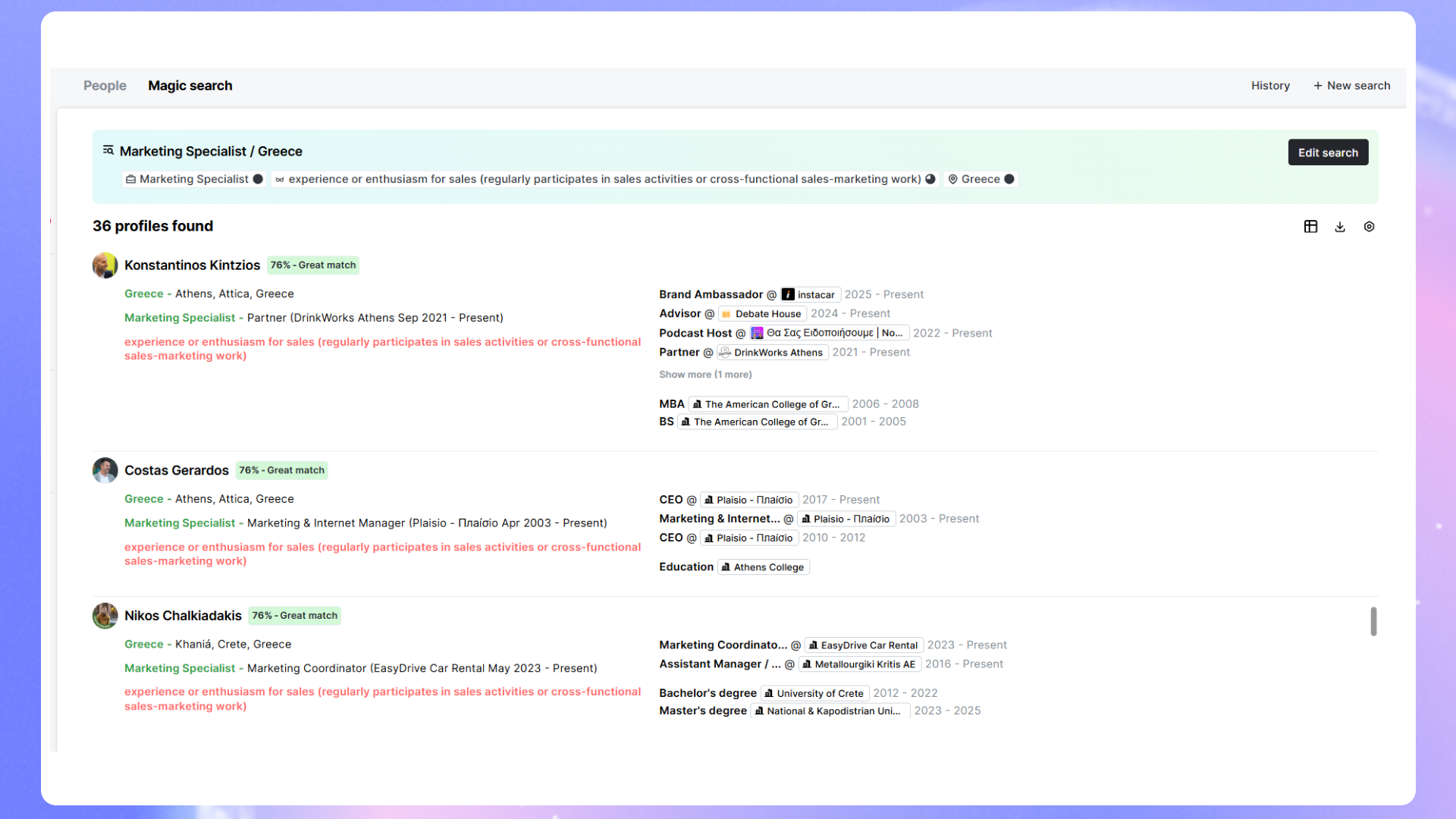
The shift is from matching strings to interpreting intent. Describe the person you need the way you would explain it to a colleague. The system resolves the seniority and the career stage itself. That capability is what Magic Search was built around. It sits inside Atlas, an AI-powered CRM and recruitment platform built on agentic AI. The platform exists to take admin out of recruitment workflows.
Magic Search reads everything your company has said, heard, read, or written about a candidate. Results come back as a short list with match percentages and the evidence behind each one.
The search runs over everything the team has captured, not the fields someone remembered to complete. An untidy record is no longer an invisible one. Notes, calls, emails, and messages all become searchable candidate data.
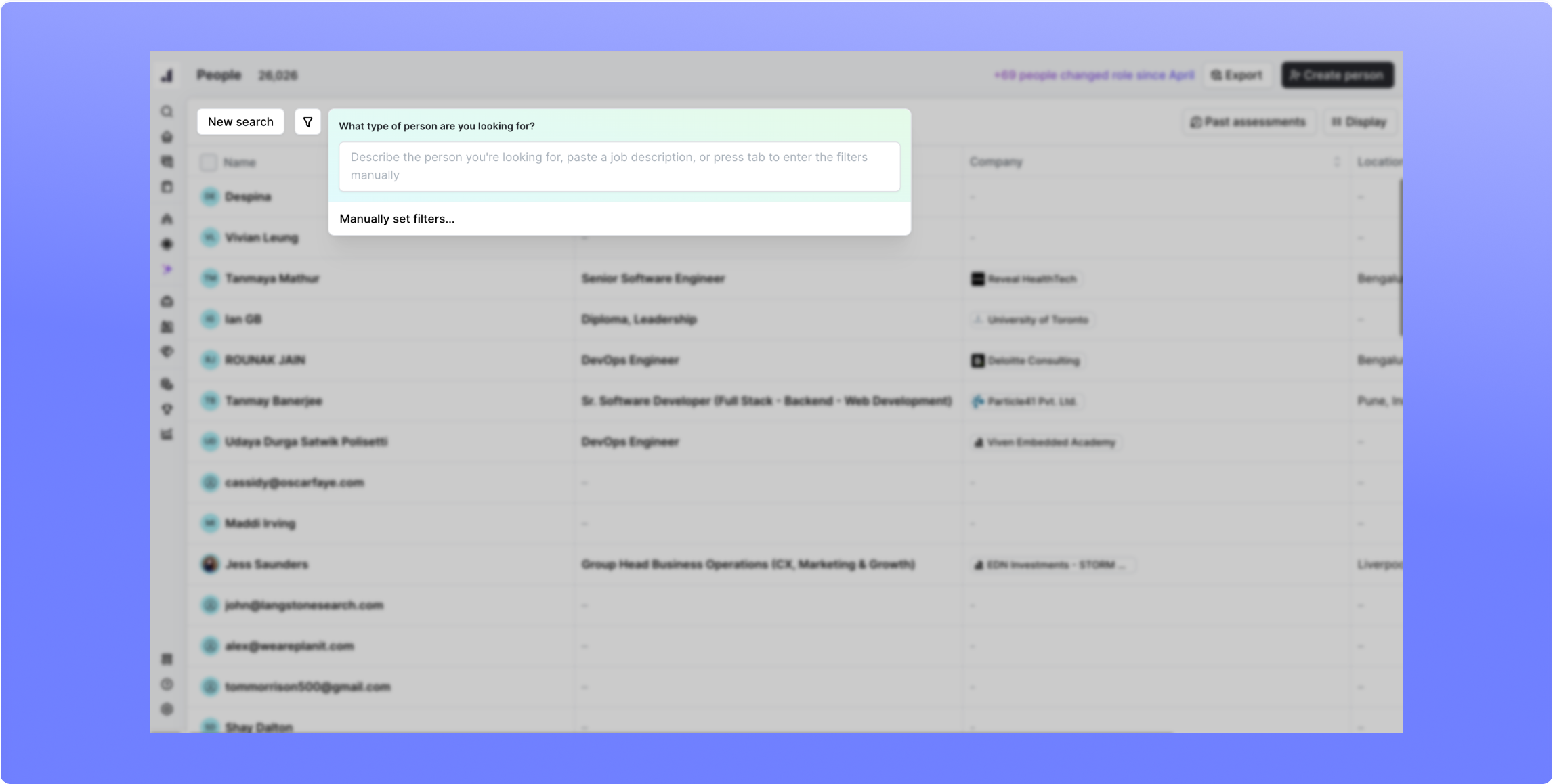
Recruitment database software built this way also inverts the old order of operations. You no longer need to know which filters to set before you start. Phrase match is still there when you want to require or exclude specific experience.
Tags do not disappear. They stop being load-bearing.
Teams that want them keep them. Globus Search tailors attributes, tags, filters, and search criteria to each project. The firm reports sourcing and updating candidates 4x faster since moving to Atlas.
The practical test is re-engagement. Ask your system for people you spoke to two years ago who would now suit a live role. If that returns active candidates you had forgotten, you own a talent pool. If it returns nothing, you were searching your tags rather than your data.
Frequently asked questions (FAQs) on candidate database search and skill tagging
Not immediately, and not all of it. Keep the tags that record a fact, such as right to represent or compliance requirements. Those are contractual records rather than search aids. Retire the descriptive skill and sector coding that exists only to make search functionality work. That layer is redundant once your search can read the record.
Boolean matches the exact characters you specify, using operators to widen or narrow the result set. Semantic search interprets what you asked for. It can recognize that a Commercial Director and a VP of Sales may be doing the same job. Boolean rewards whoever writes the best string. Semantic search rewards a clear description of the requirement.
That is the main reason to adopt it. Semantic search reads resumes, notes, emails, and call transcripts rather than structured tag fields. A record with an empty skills field remains fully searchable. Agencies with a large dormant existing database tend to see the biggest gain, because those candidates were unreachable under the old method.
Map it rather than rebuild it. Existing tags can be carried across as attributes and stay available as manual filters. That protects the searches your team relies on today. What changes is that new records no longer depend on being coded to be found, so the vocabulary stops growing.
Track time-to-send alongside the share of shortlisted candidates that came from your own database rather than external sourcing. If internally sourced placements rise while job board spend holds flat, the search is doing work the taxonomy did badly. Submission-to-interview ratio is a useful second check. It shows whether the people surfacing are genuinely relevant candidates.
Reporting suffers most when fields are technically complete but unreliable, which is the usual state of a mandatory taxonomy field. Derive reports from what the system captures automatically, such as communication and pipeline movement. That gives a more accurate picture than a field a consultant completed under protest. Keep mandatory fields where the value is contractual.
Put the taxonomy on the cost side, where it belongs
Skill coding solved a real problem with the tools available at the time. It stopped earning its place the moment candidate database search could interpret meaning on its own. Every hour spent maintaining it now buys something the platform should already provide.
What replaces it is a search that reads the record as written. Describe the person you need, and the right candidates surface from the database you already own, with the evidence attached. That is the specific job Atlas does for agency search, and it removes the coding step rather than automating it.
Worth a look before your next taxonomy review comes around.