










// Recruitment Technology, Recruitment Strategies
Data Decay is Costing Your Agency Its Easiest Placements
Published: 30 June 2026,
8 min to read
The bottom line
Your database is the cheapest source of placements your agency owns, and it loses value every month as candidates and contacts move roles. Data decay is the reason most recruiters abandon their own records and fall back on slower, more expensive sourcing. Keep the data current automatically, and that dormant asset turns back into a live pipeline.
The asset your agency quietly writes off
Every agency sits on a database it paid years to build, and most of it is wrong by now. Data decay is the slow process by which accurate records turn inaccurate as the people inside them move on. The records were right once. Time made them wrong.
A placed candidate is worth far more than a cold name. They know your service, they trust your team, and two years later, they may be the ones doing the hiring. Yet the record that should make that reconnection effortless has quietly gone out of date, and nobody noticed until the email bounced.
What is data decay, and why does it hit agency databases hardest?
Data decay is the rate at which the information in your records becomes inaccurate over time, and recruitment feels it harder than almost any other industry. Your data is tied to where people work, so when someone moves, their title, employer, email, and reporting line can all change at once. That is the whole problem with treating a candidate database as a one-time build rather than a living thing.
The labor market sets the pace. Median US employee tenure has fallen to 3.9 years, with more than one in five workers holding a year or less with their current employer as of January 2024.
In plain terms, a meaningful slice of your database ages out every single year, through no fault of whoever entered it. The result is a system layered with dirty data: dead numbers, old job titles, former employers, and stale notes that no longer reflect reality.
Why does your own database deliver the easiest placements?
Because the people already in it are warmer than anyone you can reach cold. A candidate you placed remembers your name. A client you billed has bought from you before. Re-engaging that talent pool is faster and cheaper than starting from a blank search, which is the case for data-driven recruitment.
This is where the cost of decay bites hardest.
When records are current, one search surfaces people you already have a relationship with, and a job move becomes a reason to reconnect rather than a fact you missed. Career moves signal new budgets, new teams, new priorities, and fresh vacancies, the natural openings for a spec CV or a business development call.
They also make passive candidate sourcing productive, since a warm name beats a cold one every time. Lose the accuracy, and you lose the signal, so those moments pass unnoticed while a competitor with fresher data makes the call.
Why do recruiters stop trusting the data they already own?
They stop because every stale record costs time they do not have, and after enough dead ends, the database starts to feel like a liability. Trust tends to erode in a predictable sequence:
- You place or speak with a candidate, and the record is complete and accurate.
- Months pass, they move roles, and the title, employer, and contact details on file fall out of date.
- A recruiter pulls that record for a live role, finds it wrong, and loses an hour chasing a dead end.
- After enough of those, the team quietly stops searching the database and sources everything fresh instead.
Manual upkeep is meant to prevent all this, and it almost never does. In Atlas’s 2026 benchmark research, 36.99% of agency recruiters named too much manual work as their single biggest operational challenge. Updating records by hand loses to live billing work every time, so the data ages while everyone is busy. That same dynamic explains why CRM adoption fails at so many agencies: a system only stays useful if keeping it current costs nobody any effort.
How can agencies keep a candidate database accurate without the admin?
The answer is infrastructure that updates itself, so accuracy stops depending on whether a busy recruiter remembers to log a change. This is where agentic AI shifts the economics of data quality management. Software that watches your network and rewrites records the moment something changes keeps the data clean without adding a task to anyone’s day.
Job change tracking sits at the heart of it.
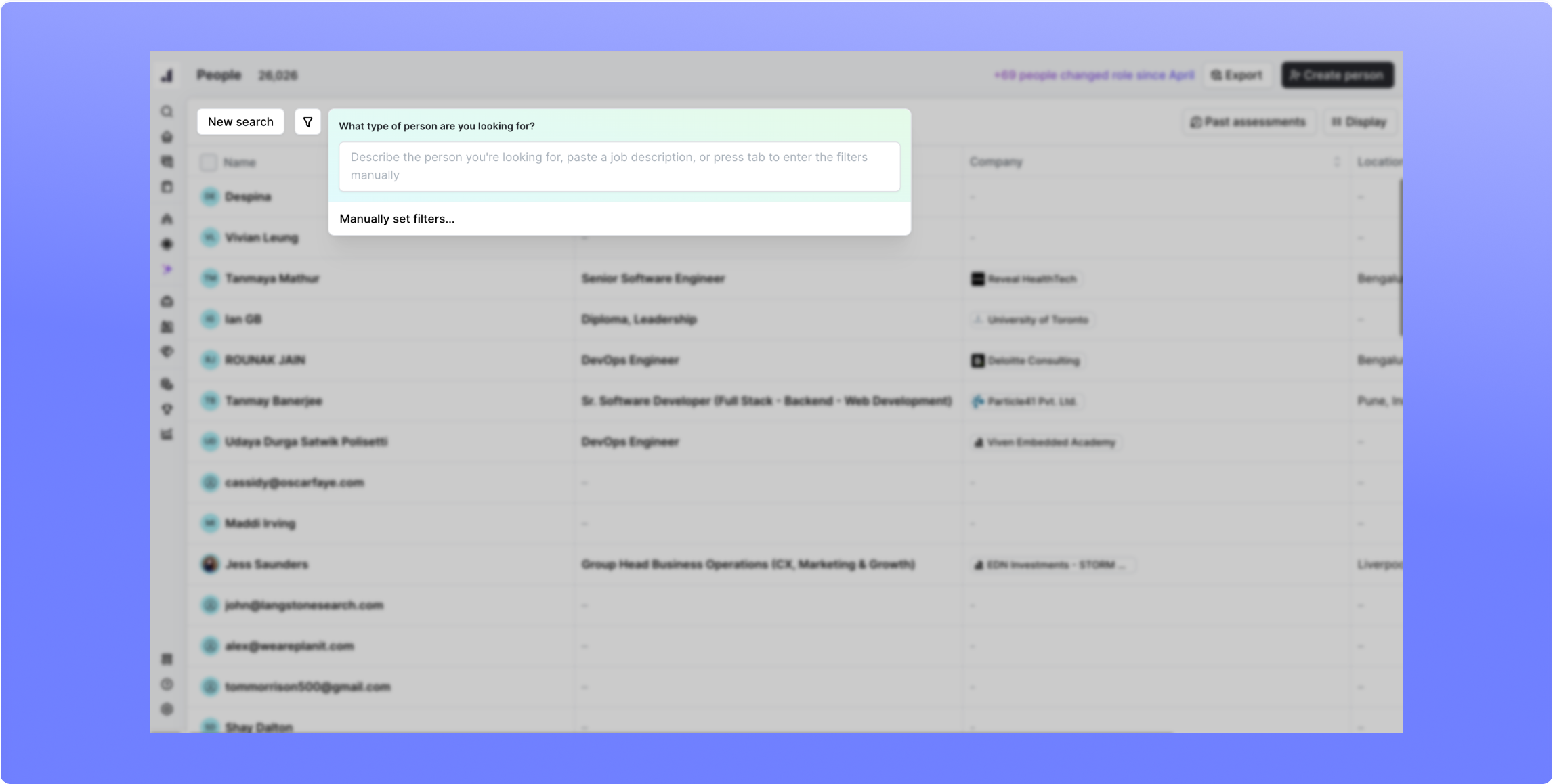
The capability behind an always-current database is what shapes Atlas, an AI-powered recruitment platform that uses agentic AI to take admin out of agency workflows. It tracks role and company changes across your network in real time and updates each candidate record automatically, then flags the moment someone moves so you can reach out while the timing is good.
The payoff shows up in the work that follows.
Once the data maintains itself, recruiters spend their hours on relationships instead of records. Ethea Solutions eliminated 15+ hours of admin a week and grew BD outreach by 500% after building on a system that captures and updates everything automatically.
Origio Partners increased new client meetings by 125% while working from records they describe as accurate and continuously up to date. That is what a live database buys back: fewer dead ends and more real conversations. It is also the principle behind keeping a candidate database accurate at the source rather than scrubbing it after the fact.
Frequently asked questions (FAQs) on data decay in recruitment
Data decay is the gradual loss of accuracy in your records as the people in them change jobs, switch numbers, and update their titles. In recruitment, it moves quickly, because every candidate record is tied to an employer and a role that can change without warning. Left unmanaged, a database fills with dirty data that sends recruiters down dead ends.
Faster than most agencies assume. With median US tenure under four years and more than one in five workers holding a year or less in their current role, a sizable share of any database shifts annually. In high-mobility sectors, the churn is steeper still, so records can be wrong within months of being created.
The real cost is the placements you never make from people you already know. Stale data hides warm candidates and lapsed clients behind wrong numbers and old employers, so recruiters source cold instead of re-engaging a talent pool that already trusts them. It also burns hours on records that lead nowhere, which drags on fill rates and billings.
It can be reversed when records update themselves. A periodic manual clean-up slows decay for a while, then the rot creeps back the moment the project ends. Continuous job change tracking holds each record accurate as the world changes, which keeps the database current rather than fighting a losing battle against it.
It monitors your network for role and company changes, then updates the relevant records automatically without anyone logging the change by hand. When someone moves, the system corrects their details and can surface the move as a moment to reconnect. Accuracy becomes a byproduct of the software doing its work, not another item on a recruiter’s list.
The database that starts earning again
Data decay is a tax on an asset you have already paid for, and it compounds quietly until your richest source of placements feels like dead weight. The way out is keeping every record accurate the moment the world changes, so a job move becomes an opening instead of a missed signal.
Keeping the data live as people move is the part Atlas takes off your plate, tracking role and company changes across your network and updating each record without anyone lifting a finger.
If your database has gone quiet, it may be worth seeing what it looks like live.