// Recruitment Technology, Recruitment Strategies
Your Candidate Database Looks Big. It's Dead.
Published: 05 October 2026,
8 min to read
The bottom line
When a mailshot to 3,500 contacts returns 1,700 bounces, the database stopped being an asset a long time ago. Record count measures what your agency has collected over the years. Contactability measures what it can still use. That is the number to audit before any outreach or marketing program is signed off.
What a 1,700-bounce mailshot tells you about your data
Agencies rarely find out the state of their data on purpose. They find out on a Tuesday. The campaign that took six weeks to plan goes out to 3,500 contacts. By lunch, 1,700 have bounced.
The first instinct is to blame the sending tool. The cause sits further back, in years of records nobody was ever given time to maintain. Candidate database management is the work that gets deferred whenever billing targets are tight, which is to say always.
Those 1,700 people did not vanish. They changed employer, and their work address died with the job. The CRM kept every row. A CRM holds no opinion about whether a row still matches a reachable human being.
Close to 90 agencies have raised a version of this with us on recorded calls. The shape of the complaint is consistent. The database looks like an asset in the board pack. It behaves like a liability the moment anyone uses it.
Why does a large candidate database still deliver nothing?
Because record count measures collection, and collection is not reach. A file of 40,000 rows, assembled over a decade, holds thousands of people who have moved on. They changed employer, changed address, or left the sector.
The labor market guarantees it. In January 2026, 20.6% of US workers had been with their current employer a year or less. Median tenure stood at 4.1 years. Run that churn against a five-year-old record set and much of it now describes where people used to work.
Duplicates inflate the total further. The same candidate sits under a personal address, a dead work address, and a misspelled surname. The dashboard counts all three. The person answers none of them.
Steady data decay does the rest between campaigns. Nobody books it as a loss, because nobody was tracking the number. The count keeps rising, which is the part that makes this so easy to miss.
How should agencies measure contactability instead of record count?
Report the share of records you can still reach on a live channel. Track it the way you track fill rate. Contactability is one figure: verified, reachable records divided by total records.
Segment it, because an aggregate hides everything useful. A contract desk working logistics decays at a different speed from a retained search team covering industrials. Break the rate down by desk, by sector, and by the year each record was created.
Most agencies cannot produce that figure today, because candidate data lives in several places at once. In Atlas research, 56.16% of agency recruiters describe their technology setup as functional but fragmented.
Phone numbers sit in one tool, consent in another, and the last real conversation in somebody’s inbox. A single AI-powered CRM record holds the contact details, the consent, and the conversation history. That is what makes the measurement possible.
There is a commercial reason to know the number before you press send. Google asks bulk senders to keep spam complaint rates below 0.3% and to stop mailing addresses that bounce repeatedly. A large send into unmaintained data puts the domain your consultants use every day at risk.
Once sender reputation drops, ordinary one-to-one emails start landing in spam folders. At that point email deliverability stops being a marketing issue and starts costing the delivery team interviews.
What does a candidate database management audit actually involve?
Five passes over the data, all finished before anyone writes a line of campaign copy. None of them need a consultant off the phone for a week.
Start with a sample rather than the whole file. Pull 500 records at random, run the five passes, and extrapolate. A sample tells you in an afternoon whether the problem covers a tenth of the database or half of it. That answer decides what the cleanup is worth.
Then fix the intake. Hygiene applied once is a project, while hygiene applied at the point of entry is a system. Applicant screening that structures and deduplicates inbound applications stops the next five years of mess. Your team clears up the last five once.
- Verification. Run the file through bounce verification and record the pass rate. That number is your contactability baseline.
- Deduplication. Merge records that describe the same person, keeping the full history rather than only the newest row.
- Recency. Flag anything untouched for 24 months. Confirm title and employer against a live source before it enters a sequence.
- Consent. Check you hold a lawful basis to contact each segment, and that opt-outs from the last campaign were honored.
- Ownership. Assign every segment to a named desk, because records with no owner go stale again inside a year.
Can agentic AI keep candidate records current without admin?
Yes, and that is the only version of this that survives contact with a busy desk. Manual hygiene loses to billing pressure every quarter. That is why the one-off cleanup project keeps getting repeated.
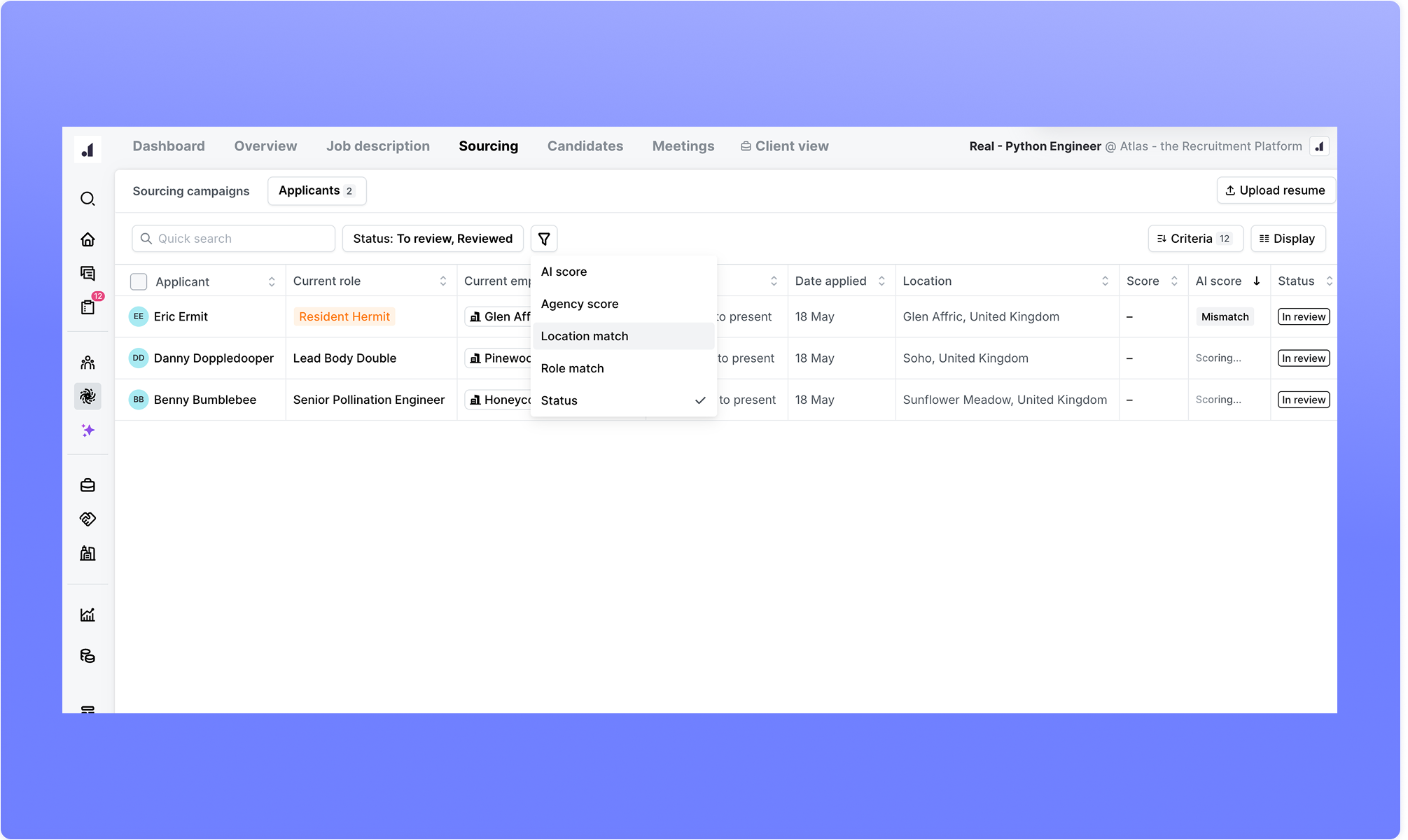
Keeping records current without anyone typing is now a platform capability. Atlas, an AI-powered CRM and recruitment platform, uses agentic AI to take admin off the desk. It monitors role and company changes across your network and updates the matching records in real time. When someone moves, the record moves with them, and the platform can draft the message that reopens the conversation.
That changes what the database is for. People Search runs across everything your team has ever sourced, placed, or spoken to. Paste a job description, or describe the person in plain language. The matches come back from records that are still current.
The commercial effect shows up in outreach. Ethea Solutions runs GTM search across APAC on Atlas. The firm improved candidate response rates by 50% in markets where engagement had always been unpredictable. Admin dropped by more than 15 hours a week.
Accurate records also make multi-touch outreach worth running at all. A sequence into verified data compounds. A sequence into a dead list teaches mailbox providers to treat your domain as a nuisance. It protects the candidate experience too. Nobody enjoys a personalized message addressed to the job they left two years ago.
For the teams around the desk, the gain is consistency. Consultants stop rebuilding contact details by hand. The shortlists that reach hiring teams carry information that was accurate this morning.
Frequently asked questions (FAQs) on candidate database health
There is no published industry benchmark, so treat your first audit as the baseline and improve from there. What matters is the trend and the rate on the segments your desks actively work. An aggregate figure across every record you have ever held tells you far less than a rate per desk.
Quarterly on the segments you work regularly, annually across the whole database, and always before a campaign goes out. Verification is cheap compared with the cost of a damaged sending domain. Agencies running high-volume temp desks usually need the shorter cycle.
Deleting is rarely the right first move. Archive instead, so the history stays searchable while the record drops out of live campaigns and reporting. Keep deletion for records your retention policy requires you to remove, and document the decision.
Mailbox providers score the sending domain, not the individual campaign. A spike in bounces and complaints lowers that score. The effect carries over to ordinary messages from consultants on the same domain. Recovery takes longer than the damage did.
In a modern system, yes. A merge should combine notes, emails, documents, and application history into one record. Check this behavior before you start, because some older platforms overwrite instead of merging.
Before, wherever the timeline allows. Migrating unverified records moves the problem into the new system and inflates the volume you are paying to store. A verification and deduplication pass on the export file is the cheapest point in the whole project to fix it.
The maintenance work nobody should be doing by hand
Candidate database management is a maintenance discipline, and maintenance decides what the asset is worth. A database earns its place in the valuation only when the people inside it can still be reached. Measure contactability, publish it by desk, and audit before the next campaign.
The work of keeping those records current is relentless and repetitive. It is a poor use of a consultant who should be on the phone. Agentic AI absorbs it in the background, watching for job moves and updating records as they happen. It surfaces the people worth a call this week. That is the layer Atlas runs on. It turns a static archive into something your team trusts enough to use.
If a campaign is already in the calendar, the contactability number is worth finding before it goes out.