










// Atlas Technology
Applicant Screening: How Recruiters Keep Their Candidate Database Clean with Atlas
Published: 22 May 2026,
8 min to read
For recruitment agencies and headhunters handling high volumes of inbound applications, the screening process is one of the biggest time drains. Whenever you are running a search for a client, the problem is the same: resumes pile up, hiring managers wait, and somewhere along the way, job seekers who were never really considered end up sitting in the database, making it harder to use over time.
The issue is not the number of applicants. The issue is the lack of resources and a reliable system to handle them. Without proper applicant screening, inbound volume quickly becomes a problem that eats into the time your team should be spending on placements.
At the same time, recruiters often lose track of the candidates already sitting in their database versus the new applicants coming in for each role, and they still need to manually screen them before knowing whether they are actually the right fit or not.
Qualified Applicants Are Lost in Manual Processes
Job boards can generate hundreds of applications for a single role. For most agencies, the way those applicants get reviewed has not changed much: a recruiter opens a CV, makes a call, and moves on to the next one. There is rarely a structured assessment process in place, or even a standard form used to capture consistent candidate details and answers.
At low volumes, that works. At scale, it falls apart. Recruiters end up spending too much time on candidates who are clearly not a fit, pulling focus away from active work. Shortlists take longer to put together, which frustrates hiring managers. Different recruiters apply different standards to the same role, leading to inconsistent results.
Recruiters are also expected to screen candidates quickly while keeping multiple requirements in mind at the same time: skills, education, years of experience, salary expectations, industry background, and the specific criteria the client asked for. In practice, this often means constantly going back and forth between CVs and the job description while trying to keep up with a high volume of applications. And applicants who were never seriously considered end up in the database, making it harder to search and trust over time.
That last point matters more than most agencies realise. A recruitment CRM is only useful if the data inside it is clean and relevant. When unvetted applicants get added without any real review, the database slowly becomes cluttered. Most teams only notice how bad it has gotten when the damage is already done. A common example is when recruiters search their CRM for qualified candidates, only to find outdated or poorly assessed records that cannot be relied on.
What is Job Applicant Screening?
Applicant screening is the process of reviewing and assessing inbound candidates to determine how well they match an open position.
For most recruitment teams, this means going through CVs one by one, filling in forms, assessing each candidate against the job requirements, and deciding who is worth moving forward. When done manually, it is time-consuming, inconsistent, and difficult to scale.
The goal of a structured screening process is to give every applicant a fair, consistent assessment based on clear criteria, so that the best candidates rise to the top quickly and the team can act on them without delay.
What Is Atlas’s Applicant Screening Feature?
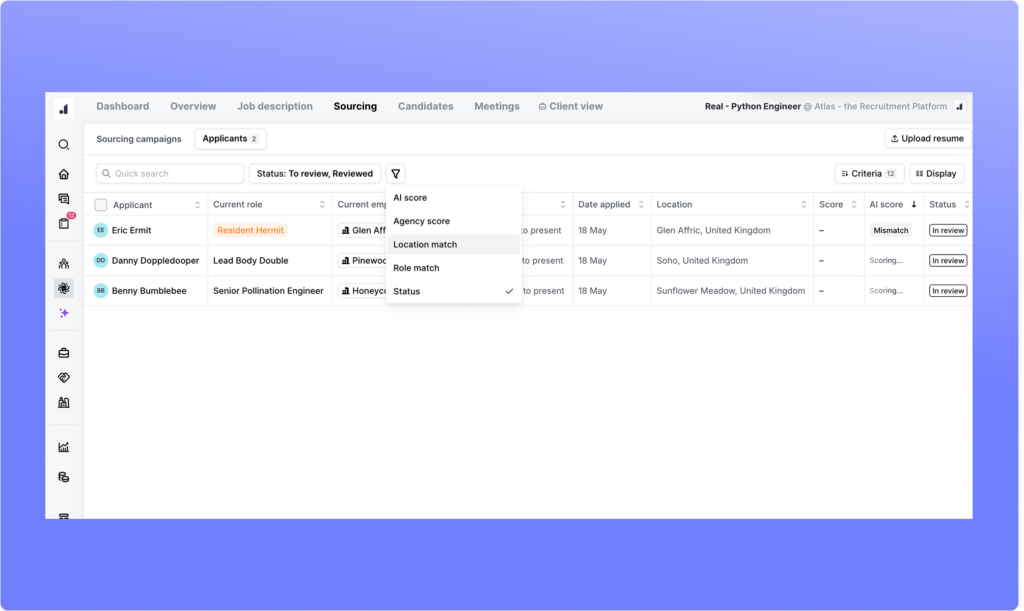
Automated candidate ranking and job applicant triage are at the heart of what Atlas’s Applicants feature does. The idea is simple: every applicant should be assessed against the role in a consistent, structured way, rather than by whoever has a spare moment.
When a role is created in Atlas, the platform reads the job description and builds a set of scoring criteria across three groups: required, preferred, and nice to have. Recruiters can review and adjust these criteria before screening starts, so the team is always working from a standard that reflects what the role and employer actually need.
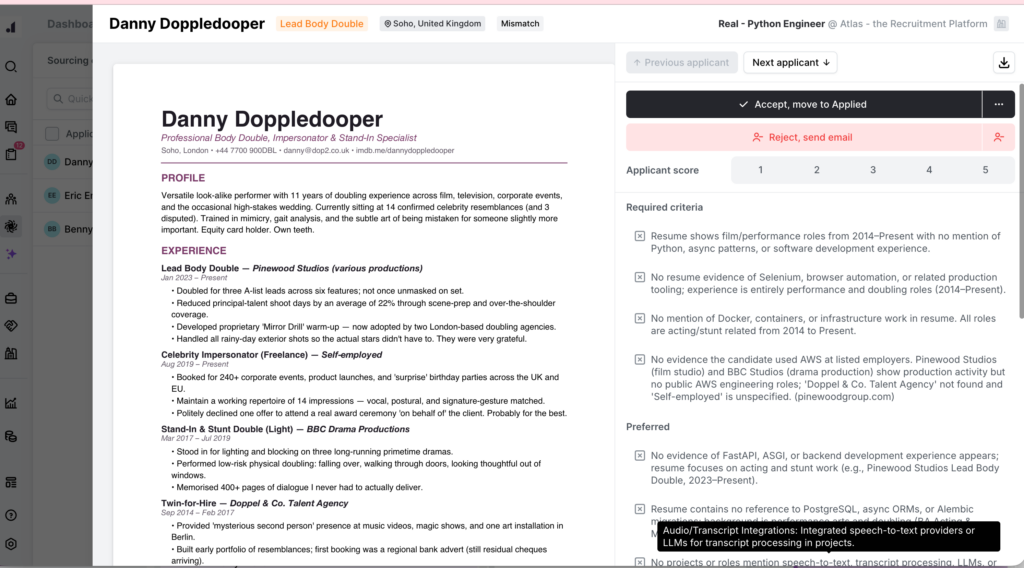
Criteria can be re-edited and applicants re-scored at any time if requirements change.
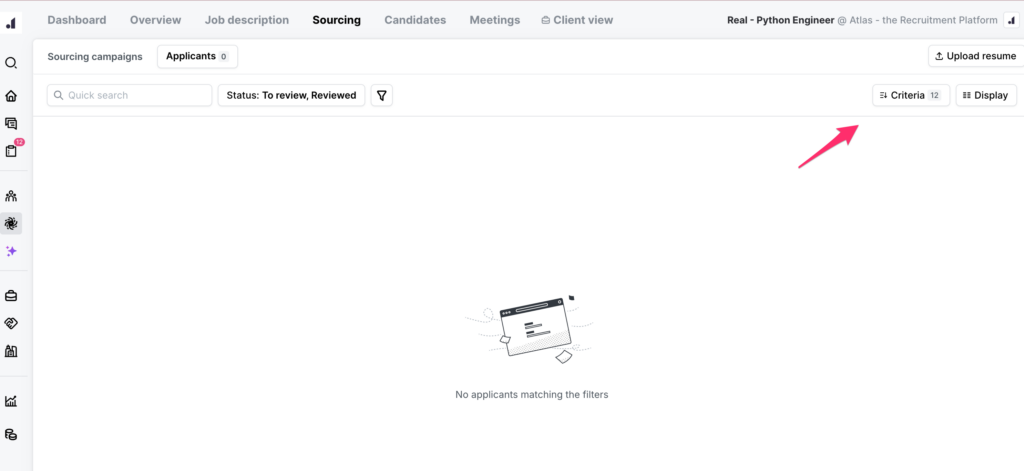
Job seekers can come into Atlas through several channels: manual CV upload for direct applications or forwarded submissions, job board integrations, including social media platforms, so applicants flow straight into the platform.
What Sets Atlas Apart From Other Recruitment Software?
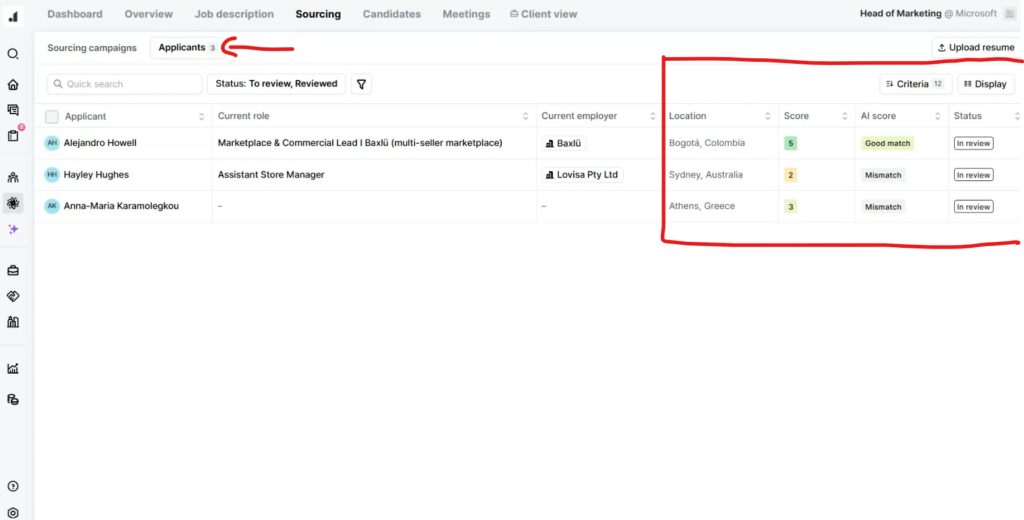
Once applicants are in, Atlas screens them automatically. It looks at two types of criteria: ones based on the candidate’s own experience, such as specific skills or job history, and ones based on the companies they have worked for, such as the size or stage of the business. Where needed, Atlas does its own research to fill in any gaps, so scoring is based on real information rather than just what is on the CV.
Every applicant gets a match score. Atlas also runs two quick checks: whether the candidate’s current role is relevant to the position they have applied for, and whether their location is a practical fit. Recruiters can then click into any applicant to see exactly why they scored the way they did, add their own grade, leave notes, and take action, all from the same view.
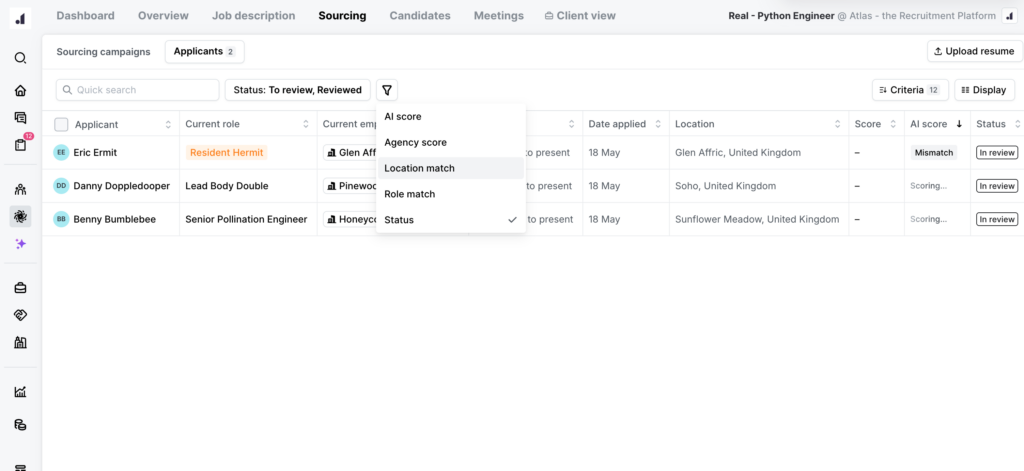
The result is a ranked, ready-to-use list of qualified applicants that a recruiter can work through in a fraction of the time it would take to do it manually.
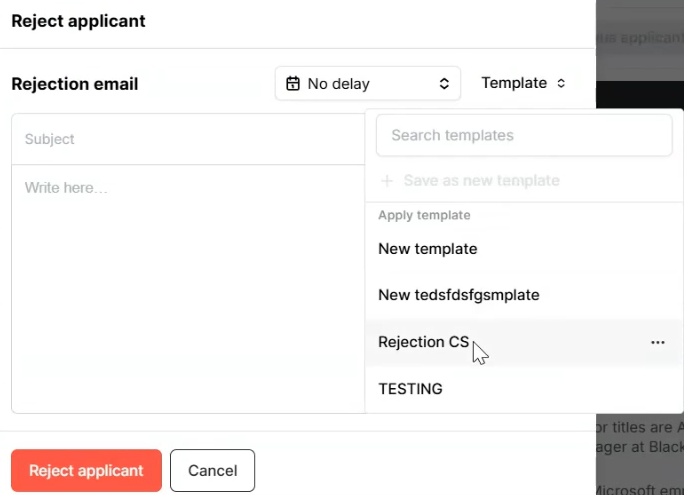
When a recruiter is ready to act, accepting or rejecting takes a single click, rejected applicants can be sent a professional rejection email using pre-built templates, and every decision is logged with the name of the team member who made it and a timestamp.
How Does the Applicant Screening Feature Make Life Easier for Recruiters?
Recruiters are the ones absorbing the most pressure when applicant volumes spike. Here is how the Applicant Screening feature takes that pressure off:
- No more wading through hundreds of CVs manually. Atlas automatically triages and grades every applicant against the role, so recruiters can focus on the qualified candidates
- Scoring criteria are built directly from the job description and fully adjustable, meaning the team always screens against a standard that reflects what the role genuinely needs
- Applicants are kept separate from the candidate database, so high inbound volume never clutters the CRM or degrades the data the team relies on every day
- Every applicant view includes the rationale behind the score, a space for personal notes, and a direct action button, so recruiters can review and move candidates forward from a single screen
But recruiter efficiency is only part of the story. Hiring managers feel the effects of a poor screening process too, even if they are further removed from it. They receive a shortlist and have to trust that it reflects what they asked for. When it does not, the back-and-forth starts, and time gets wasted on both sides.
Because Atlas builds scoring criteria directly from the job description, there is a clear, agreed standard that both recruiters and hiring managers can point to. When a shortlist is delivered, the rationale behind each candidate is already documented. Rather than debating impressions, both sides can work through a list of scored, ranked candidates against criteria they both understand. Decisions get made sooner, and placements move forward more cleanly.
Frequently Asked Questions (FAQs) about the Applicant Screening Feature
Atlas accepts applicants via manual CV upload, job board integrations, and a project-specific email address.
No. Applicants stay completely separate from your database until you accept them. Your applicant screening process runs independently, so your data quality is never affected, no matter how many applications come in.
Yes. Once Atlas generates the criteria from the job description, the team can review them in the criteria tab and add, remove, or edit anything that does not quite fit. Recruiters stay in control of how applicants are evaluated before the hiring process starts.
Yes. Multiple team members can collaborate on the same role, review applicants together, and take action in real time. Every action and decision is automatically tracked with the name of the recruiter who made it, giving you full visibility and a clear audit trail whenever you need to follow up.
Scoring criteria are built from the job description and visible to the team, so shortlisting becomes transparent and consistent. Hiring managers receive candidates graded against an agreed standard, which cuts down on back-and-forth and helps decisions get made faster.
A Smarter Hiring Process for High-Volume Recruiting
Applicant volume is not going away. The agencies that manage it well are the ones that build a proper process around it: screening consistently, keeping their database clean, and giving both recruiters and hiring managers something they can rely on.
Structured triage, criteria-based scoring, and clean separation between applicants and database contacts are what make high-volume inbound recruiting work at scale. That is what Atlas – the Recruitment Platform is built to deliver. As a CRMx powered by agentic AI, Atlas takes the admin out of recruitment, so your team can focus on what actually moves the needle.
By helping recruiters identify top talent faster and manage every stage of the journey more effectively, Atlas creates the foundation for a brighter future in recruitment. One where teams spend less time on admin and more time building meaningful connections with the right candidates.