









// Recruitment Technology
The Best Information About a Candidate Never Reaches the CV
Published: 22 October 2026,
7 min to read
The bottom line
The details that decide a placement get spoken, not written. Relocation appetite, suitability, consultant ratings and not looking right now all land in free-text notes that no search index reads.
Agencies that make that layer searchable fill roles they would otherwise re-source from scratch.
Conversations hold the detail your search index never sees
Your database knows where a candidate worked. Your recruiters know whether he would move for the right package, and that his notice period doubled in March.
Only one of those is searchable. Candidate data captured from a CV covers employment history, technical skills, education and contact details, then stops.
Everything commercially useful arrives later, on a call. It gets typed into a note field and never surfaces again, unless the consultant who wrote it remembers.
Most agencies have one recruiter who can recall a candidate’s relocation radius from a conversation in 2023. That recall is the entire search index for the thing clients actually pay for.
Sixty-six agencies raised this with us on recorded calls. The layer they rate most highly is the layer they cannot query.
Where does the most valuable candidate data actually get recorded?
In free text, written after the conversation that produced it. A CV supplies the facts, and the suitability call supplies the judgment that clients are buying.
A consultant finishes a screening call holding six things that change the shortlist. Willingness to relocate, and on what terms. The real reason for leaving rather than the stated one. Counter-offer risk. Notice period, including garden leave nobody lists on LinkedIn. Comp expectations against comp reality. A rating, usually a number, usually explained in a single line nobody else will read.
All of that goes into notes. Almost none of it goes into a field.
The pattern reaches well beyond recruitment. IBM reports that 90% of enterprise data generated in 2022 was unstructured, with about 1% accounted for in language models.
Pay works the same way. Your sharpest market evidence gets given away free in client briefings. That is why salary benchmarking data sitting in your own conversations beats any published survey.
Why can’t your candidate database return what recruiters wrote?
Because most search runs on fields, and notes are not fields. A keyword query matches strings held in structured attributes such as job title, location, seniority and skill tags.
Free text breaks that model in four ways. Wording varies by consultant. Meaning depends on context. The useful part is often a negative, such as a candidate ruling out shift work. And the note frequently sits on an activity record rather than the profile.
Search in a legacy applicant tracking system was built to retrieve documents and satisfy compliance. Interpretation was never part of the design. The system can locate a document. It stays silent on who in your database would consider a move to Manchester.
This is a data management problem, and it reaches well outside recruitment. Gartner found that 63% of organizations lack or are unsure of the right data management practices for AI.
Duplicates make it worse, because the note and the profile drift apart over time. Agencies that treat candidate database management as an operational discipline recover context that would otherwise sit across three half-finished records.
How much billing disappears into notes nobody can find?
Enough to show up in the quarterly numbers. The cost lands as re-sourcing work on people you have already screened. It shows up again as slower time-to-send, and spec CVs missing the detail that would have won the client.
Fragmentation compounds it. Atlas research found that 56.16% of agency recruiters describe their tech stack as functional but fragmented. The conversation sits in one tool and the record sits in another.
Then the information ages. Data decay removes your easiest placements long before anyone notices the fill rate slipping.
Speed is the visible payoff when that layer is connected. Globus Search reports sourcing and updating candidates 4x faster after every channel started capturing automatically, with placements up 22%.
Can agentic AI turn recruiter conversations into searchable records?
Yes, and the mechanism is plainer than most buying committees expect. Capture the conversation automatically, structure it on the way in, then index meaning rather than keywords.
The habit is already there. Atlas research shows 85% of recruiters use AI for admin work such as ATS and CRM updates and note management. What changes is where the output lands.
A platform that captures, structures, remembers and then answers behaves differently from an applicant tracking system with an AI feature attached. That design sits behind Atlas, an AI-powered CRM and recruitment platform built on agentic AI. What a recruiter gets is a recruitment CRM that enriches every candidate for you instead of waiting to be updated.
The practical test is simple. Search for everyone who said they would relocate for the right role, and see whether names come back. If the answer involves asking a colleague who was on the call, the layer is still invisible.
- Record the conversation. Phone and video calls transcribe straight into the portal, with no consultant writing anything by hand.
- Structure the output. An AI note taker turns each call into scannable notes attached to the right profile.
- Hold the context. Total Memory threads calls, emails, notes and messages into one intelligence layer your whole team can reach.
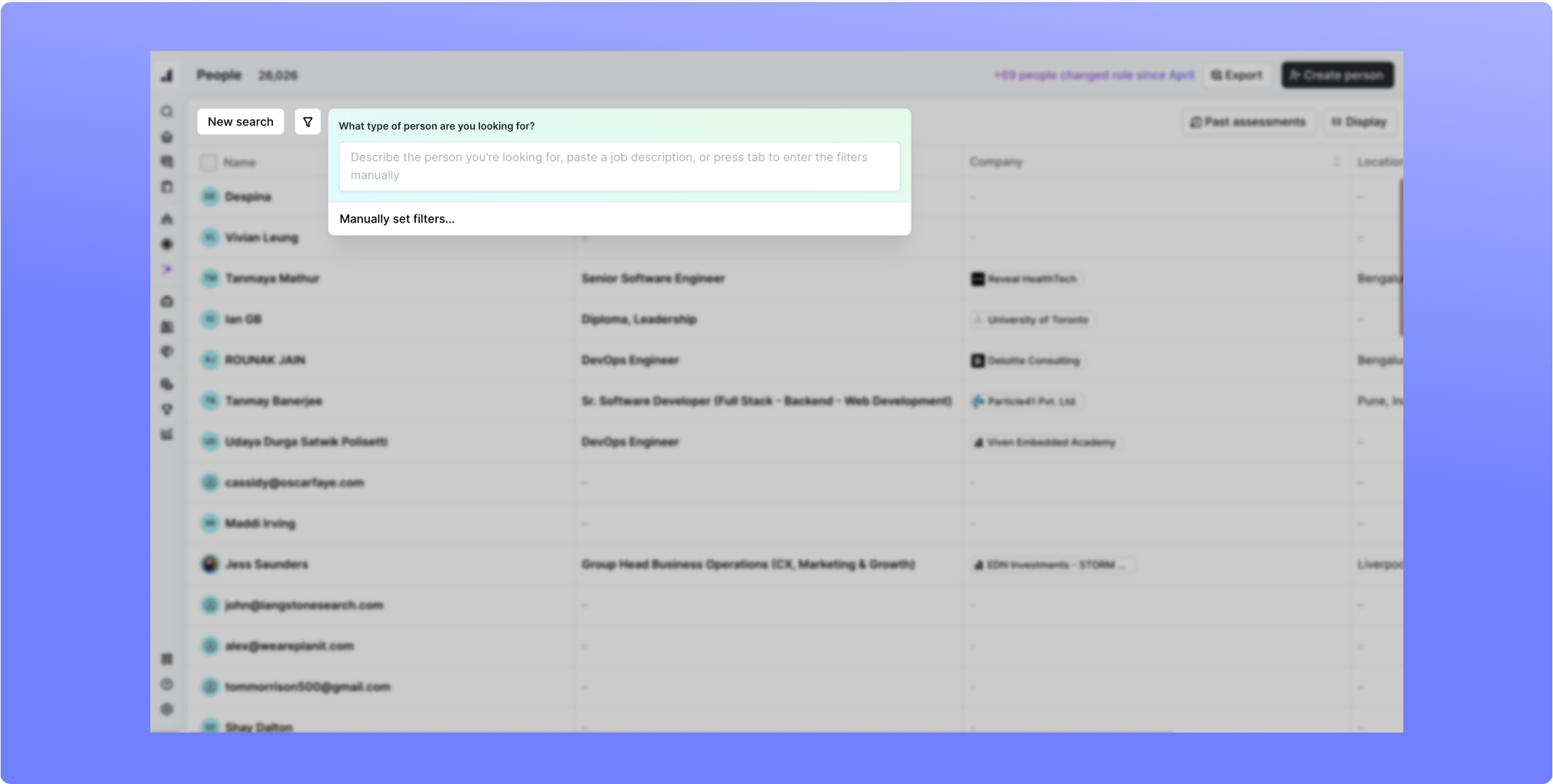
- Query it in plain language. People Search reads the entire database and returns ranked matches with the reasoning visible.
Frequently asked questions (FAQs) on candidate data in recruiter notes
Anything a recruiter learns in conversation that changes a hiring decision. Relocation willingness, counter-offer risk, notice period detail, comp expectations, motivation for moving and a consultant’s own rating all qualify. None of it appears on a resume, and most of it decides whether a shortlist converts.
Most search runs against structured fields rather than free text. Notes vary in wording, depend on context, and often attach to an activity record instead of the profile. Unless the system indexes meaning, that content stays invisible to anyone who did not write it.
By recording and transcribing calls automatically and letting AI structure the result. Consultants stay in the conversation, and the notes exist before the call ends. Manual note-taking is the step that gets dropped under pressure. Removing it is what makes capture consistent.
It creates obligations your agency already carries. Transcripts and notes are personal data. The same lawful basis, retention schedule, deletion rights and candidate consent practices apply. One governed platform is easier to evidence than scattered inboxes.
Track time-to-send, submission-to-interview ratio, the share of shortlists built from existing records, and send-to-placement ratio. When more submissions come from people your team has already spoken to, the conversational layer is being used. Fill rate tends to follow within a quarter or two.
Yes, provided notes and activity history move across with the structured records. Many migrations prioritize profiles, jobs, placements and contacts, then treat free text as optional cargo. That free text is the asset, so it belongs in the scope of the export, the mapping, the testing and the sign-off.
What your desk already knows, now searchable
The advantage is already inside your records. Years of suitability calls and ratings describe your market better than any external list of profiles.
Making that layer searchable is one capability rather than a program of work. Search that reads conversations as well as CVs turns dormant candidate data into a live shortlist. People Search inside Atlas is built for exactly that.
Worth a look the next time a client brief matches someone your team met two years ago.