// Recruitment Technology, Recruitment Strategies
Why AI Search Underperforms on Specialist Desks
Published: 14 October 2026,
8 min to read
The bottom line
Semantic search performs in line with how standard the language is. It handles broad commercial roles well. Accuracy drops on specialist desks, where titles are inflated and jargon is local to a vertical. Credentials also nest in levels a general model reads as near enough.
Keep the manual taxonomy and the coded fields your team built. Run AI search on top of that structure rather than in place of it. The model proposes and the taxonomy constrains.
What a specialist desk asks of its search tool
The demo always works. It runs against a title the model has seen several million times, on a database somebody cleaned the week before.
Then the tool goes live on a desk that places cardiac perfusionists or facade engineers. Match percentages stay high and the names get vaguer. Recruiters start opening every candidate profile by hand. Within a month they are quietly back on the saved filters they trusted.
Semantic search in recruitment is not a uniform capability. Its accuracy tracks how much public text exists about the vocabulary you search in. The same tool feels brilliant on a generalist perm desk and unreliable on the niche contract team upstairs.
Sixty four agencies have raised a version of this with us. The AI finds people. On a specialist vacancy it keeps missing the obvious name that everyone on the desk already knows.
Why does semantic search in recruitment misread specialist job titles?
Because titles are marketing. The same two words describe different jobs at different employers. A general model has no reliable way to price that difference.
A Vice President in US banking is a pay grade. A Vice President at a 40 person software firm is usually the third most senior person in the building. Semantic matching reads both as senior leadership and moves on.
The scale of the problem is documented at national level. The US Department of Labor maps more than 55,000 jobs onto 1,016 occupational titles. The average occupation carries 54 alternate titles, with most falling between 10 and 100 variants.
Your desk works at the granular end of that ratio. The gap between two adjacent titles is the gap between a fee and an awkward call with the client.
Keyword search fails in the opposite direction, dropping anyone who wrote the same role in different exact words. A job title search that expands into related titles covers more ground. The expansion should be yours to review before it runs.
How much sector jargon never reaches a general model?
Most of the jargon that matters. The vocabulary deciding a specialist shortlist is local to a vertical, often to one client. It rarely appears in public text often enough for a model to learn what it implies.
Every niche desk has a term that means one thing inside the client’s building and something else a mile away.
Tier one framework in construction, delegated authority in insurance, QP release in pharma, agency locum in healthcare. Each phrase carries hiring criteria a recruiter on that desk unpacks instantly. A general model reads ordinary English.
Regional drift compounds it. The same role is a Quantity Surveyor in Manchester and a Cost Manager in Dubai. Candidates write whichever version their last employer used.
Semantic similarity then does what it was built to do, which is return near neighbors. Near neighbors are fine on a volume perm role. They are expensive on a retained brief where the client already knows the market.
The vocabulary that closes this gap is already inside your agency. It sits in call notes and in years of conversations with the same few hundred people. Much of it surfaces during talent mapping work. A platform with total recall of those conversations can search that language. A model trained on the open web cannot.
Data enrichment covers the structured half. Standardized company and industry detail keeps filters behaving the same way for every recruiter.
What happens when credentials nest inside one another?
The model reads a level as a synonym when the level is a gate. Credentials in specialist markets are hierarchical, and semantic matching flattens hierarchies by design.
A Series 7 sits on top of the SIE. A Series 24 carries supervisory authority that a Series 63 does not. A nurse practitioner license is not an RN license with extra words on it. A Professional Engineer stamp is not a civil engineering degree.
Semantic matching rates those pairs as close, because the language surrounding them is nearly identical. One candidate can sign off the work and the other cannot.
This is where confidence in the tool breaks down. 26.67% of agency recruiters name trusting the output as their single biggest challenge with AI. On a niche desk, one wrong credential in a shortlist of four costs more than the hour the search saved.
Coded fields do not have this failure mode. A field holding the credential and its level returns the candidates who qualify, or returns nothing. Both answers tell a recruiter something true.
Scoring belongs on top of that structure rather than instead of it. Competency scoring against the brief gives a recruiter something auditable. Desks in healthcare recruitment keep licensure and expiry dates in fields rather than in resume prose.
Where does a well-coded database still beat semantic matching?
Anywhere the answer has to be exhaustive rather than probable. Compliance searches and longlists a retained client will audit both need the complete set. Contractor rebooking before a framework renewal carries the same requirement. Probability answers a different question.
That distinction gets lost in the buying conversation, because the headline problem is real. 36.99% of agency recruiters say candidate sourcing is the biggest factor slowing placements. AI search does fix that, across the broad half of the desk.
The setup that holds up on the other half is hybrid. Describe the person in plain language, then constrain the results with fields your own team coded.
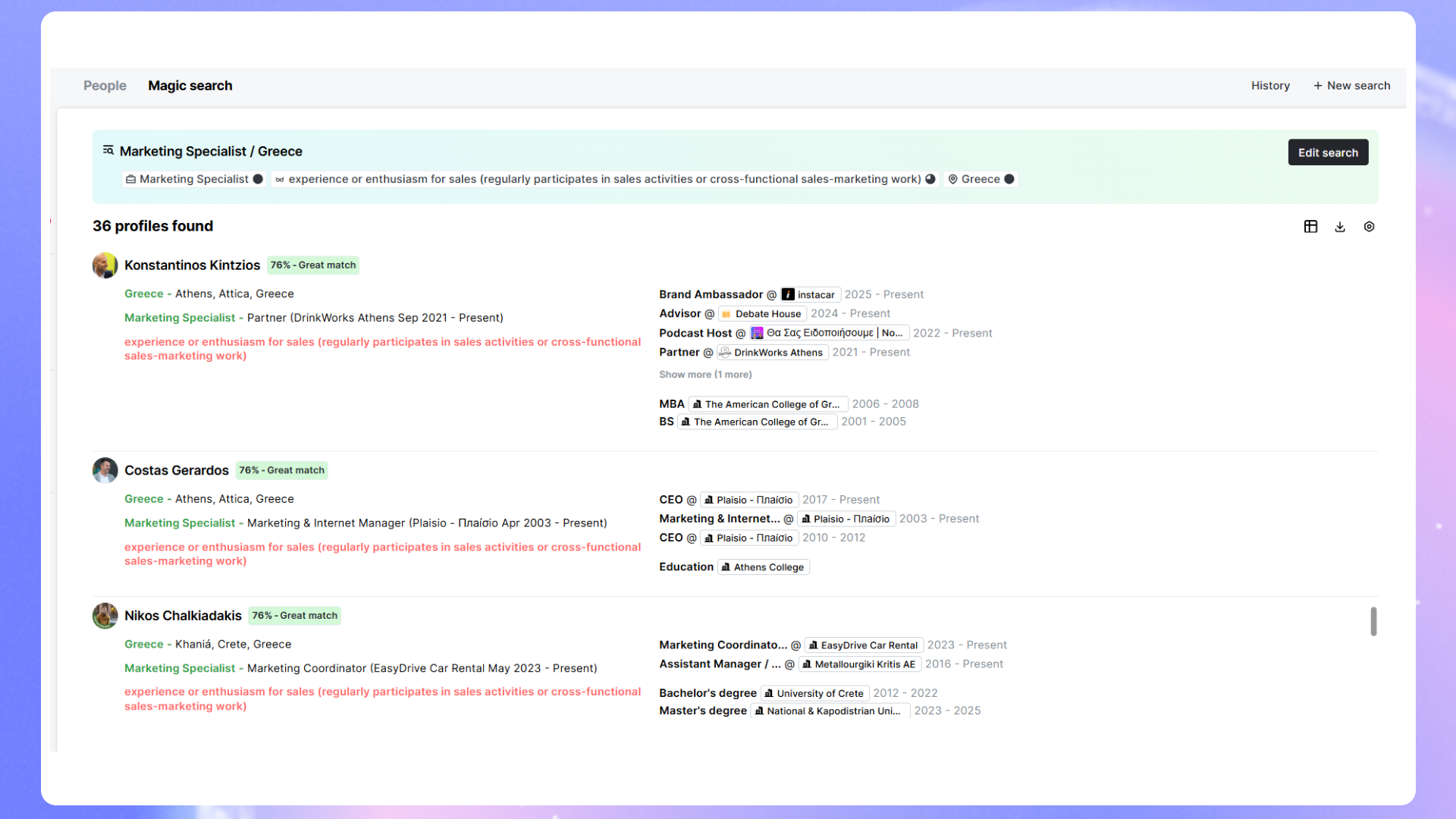
People Search is built that way inside Atlas, an AI-powered recruitment platform that uses agentic AI to eliminate desk admin. Natural language candidate search assembles the filters for you, and phrase match forces terms that every result must contain. Manual filters stay one click away for the search that has to be exact.
A taxonomy only stays valuable if it is maintained. Codes drift and the person who designed them leaves. Data decay turns a clean field into a guess nobody audits. An AI-powered CRM that enriches records as conversations happen keeps the structured layer current without manual upkeep.
Frequently asked questions (FAQs) on semantic search for specialist desks
Semantic search interprets the meaning behind a query rather than matching exact words in a record. A recruiter describes the person they want in plain language, and the system returns candidates whose experience resembles that description. It performs best where role language is standard and loses precision where vocabulary is local to a vertical.
Not on its own. Boolean and filter-based searching answers questions with a defined correct set, such as every candidate holding a specific license. Semantic search is stronger at finding adjacent experience nobody thought to filter for. Specialist desks get the best results running both, with the structured search as the check on the AI output.
No. A coded taxonomy is the only thing that gives an exhaustive answer to a compliance or credential question. Treat it as the backstop underneath AI search rather than something the AI replaces. Assign a clear owner so codes stay accurate as the market and the client base change.
Usually because the relevant evidence never made it into a searchable record. If seniority or licensure lives in a recruiter’s memory or an unparsed call note, no model can rank on it. Capturing conversations automatically into the candidate record fixes more search problems than changing the search tool does.
Run the tool against a vacancy you already filled and compare its shortlist with the candidates your team submitted. Count the known-good names it missed, not the plausible ones it found. Then repeat the test on a role where a credential level decides eligibility. That is where general models fail most often.
It works for discovery and poorly for availability. Finding contractors with the right project history suits semantic matching. Rate, notice period, compliance documents, and finish dates belong in structured fields that can be filtered and reported on. High-volume contract desks need both working off the same record.
The choice in front of specialist desks right now
Two costs are running against each other. Maintaining a taxonomy costs visible hours every quarter. Replacing it with semantic search in recruitment costs placements you never see, because a missed candidate leaves no trace.
Agencies getting real value from AI search on niche verticals kept their structure and added the language layer above it. Running an AI-powered recruitment platform like Atlas over coded fields keeps both halves honest. Agentic AI handles the enrichment and the admin in the background.
If your next retained brief turns on a credential level, start by testing your search against that brief.