









// Recruitment Technology, Sourcing Strategies
Why Job-Title Search Keeps Missing the Right People
Published: 26 October 2026,
7 min to read
The bottom line
Job titles are marketing copy. They are written to attract applicants, not to record what a person can do. The same function sits under a dozen labels across four employers, so search that keys off titles returns whoever used your words and drops the candidates your recruiters remember.
What a job title records, and what it leaves out
Agency recruiters trust their own memory over their own database, and they are usually right to. Forty-two agencies have raised the same problem with us. A consultant knows the candidate exists and remembers the call. The system still will not return them. The string runs clean, the results come back, and the right person is not in them.
Boolean search for recruiters rests on one assumption, that the words on a profile describe the work. Titles break that assumption before the search runs. A title is written by an employer for a job ad. Job ads are marketing documents aimed at applicants. Nobody has ever been promoted into a more searchable title.
Why does a boolean search for recruiters return the wrong people?
Because the string matches language, and language is the least stable thing about a job. Two people can run the same desk and carry the same budget under labels that share no words.
The scale of it is published. In the US Labor Department classification, 1,016 occupations carry 56,495 separate job and alternate titles. That averages more than 50 labels per occupation, and only counts the titles official enough to be cataloged. Internal naming conventions never make the list.
Run that against a live role. One new business seat might be called Account Executive, Client Partner, Business Development Manager, or Growth Manager. Which one depends on who wrote the contract. Each label is another OR term in your boolean strings. Miss one and a qualified candidate never enters the result set. Nothing in the interface says they were skipped.
That is the quiet failure mode here. A search full of irrelevant results looks broken, so recruiters fix it. A search missing the one person who would have placed looks like a clean set of search results.
What does an identical job title say about seniority and salary?
Very little, and public wage data makes that concrete. Software developers in the bottom tenth earn under $82,460 while the top tenth clear $214,670, against a median of $135,980. One occupation, one title, a spread above $130,000.
That range covers two years of experience and twenty. It covers a maintenance role at a regional insurer and a staff software engineer at a platform business. A filter set to the title returns both. The consultant then sorts by hand, at the exact moment speed decides the placement.
Seniority words do not rescue it either. Senior, Lead, Principal, and Head of are awarded for retention as often as for scope. A title inflates when a company cannot afford a raise.
What separates two people with matching titles is budget scope, team size, salary expectation, and stated ambition. Almost all of it arrives in conversation. Agencies sitting on years of recorded calls already hold better salary benchmarking data than any published survey. None of it is indexed by a title.
Where does the evidence of capability actually live?
In the conversation rather than the CV. A consultant remembers what the profile never recorded. That includes the deal they ran, the reason they left, the salary floor, and the relocation they refused.
Recruiters know the gap is there. In Atlas research, candidate sourcing and discovery was the top unmet need, cited by 25.81% of agency recruiters. It is the task they most want better automated. Agencies are not short of candidate data. They are short of a way to ask their own system a question in the terms they think in.
That record has to exist before anyone can search it. Building it automatically is what Atlas does, an AI-powered CRM that uses agentic AI to remove desk admin. Calls, emails, meetings, and messages log themselves and thread into Total Memory, one searchable record per relationship. The AI note taker handles capture, so the detail lands without anyone typing it up.
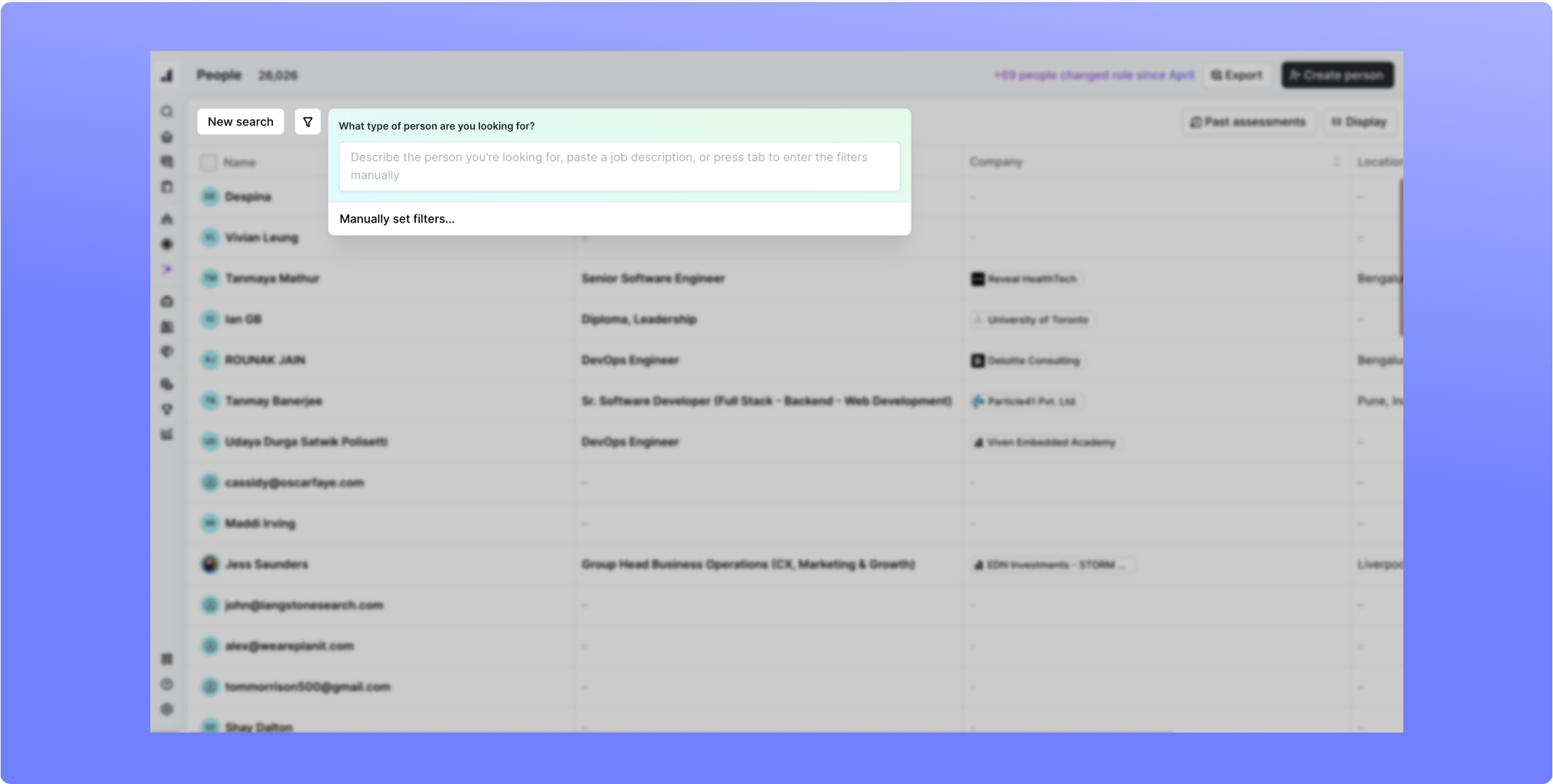
People Search then runs across that whole record instead of the title field. Describe the person in plain language and the system builds the search. It surfaces every relevant variation of a role rather than exact matches alone. Ask for an operations leader. The COO, the VP of Operations, the general manager, and the country manager all surface.
How should agency search work when specific job titles are unreliable?
Treat the title as one weak signal among many and build the search around capability. The practical version is already visible in how candidate sourcing software is being rebuilt around intent rather than exact terms.
The payoff shows up in throughput. Globus Search operates across more than 55 countries. Since moving onto Atlas it reports sourcing and updating candidates 4x faster, with a 22% increase in placements.
None of this retires boolean logic. It runs underneath, assembled from the description instead of typed by hand. Consultants who built a career on search strings lose nothing in the move. Talent mapping benefits for the same reason, because the market view stops depending on whoever remembers the right labels.
- Start from a description, not a string. Write who you need the way you would brief a colleague, then review the search criteria the system generates before it runs.
- Expand to alternative titles automatically. One click should pull in every related label for a role rather than relying on a recruiter to recall all of them.
- Search the conversation layer next to the CV. Call notes, transcripts, emails, and meeting summaries carry the seniority and motivation evidence profiles leave out.
- Keep manual filters for the moments precision beats speed. Phrase match, exclusions, required skills, and location limits still matter on a tightly specified brief.
Frequently asked questions (FAQs) on job title search for recruitment agencies
Yes, as a precision tool rather than a default. Boolean operators are excellent when a brief is tightly specified and the vocabulary is standard. Think of a named certification or a specific technology. They perform badly when the same role carries many labels, because every missing OR term silently removes qualified candidates.
Because titles are set by employers for internal and marketing reasons, with no shared standard behind them. US wage data shows software developers spread from under $82,460 to above $214,670 inside one occupation. Scope, budget, team size, and reporting line vary enormously under identical wording.
Search on what the person did rather than what they were called. Plain-language search interprets seniority, industry context, and career progression, then expands to alternative titles automatically. That surfaces passive candidates who would never appear in an exact match on one job title.
Most of what decides a placement. Salary expectation, notice period, relocation limits, and counter-offer history come up in calls and emails. They rarely appear on a resume. Unless those conversations are captured and indexed, the database holds a formatted document instead of a relationship record.
No, and the better platforms keep both. Natural language gets a recruiter from brief to shortlist quickly. Manual filters on location, seniority, industry, and required phrases give granular control on an exacting brief. The useful setup lets a consultant switch between the two without rebuilding the search.
The search layer that matches how recruiters already think
Titles will keep drifting, because the people writing them are selling a role rather than cataloging one. A database indexed on titles will keep returning the wrong people and hiding the right ones. A better string cannot fix that.
The fix is mechanical. Agentic AI captures every call, email, meeting, and message, then keeps the record current without manual updates. Search finally has something real to run against. That layer is what Atlas is built on, so a boolean search for recruiters becomes something the platform assembles rather than something a consultant maintains.
Worth a look the next time a consultant swears the right candidate is in there somewhere.