// Recruitment Technology
Ten Ways Duplicate Candidate Records Creep Into Your CRM
Published: 14 October 2026,
9 min to read
The bottom line
Duplicate candidate records rarely come from one bad import. They come from ordinary events. A candidate applies from a work address one year and a personal one the next. A formatted CV goes out with the contact details stripped. A switchboard number is shared by an entire floor. A sourcing extension creates a profile for someone you already hold.
Knowing the source tells you which duplicates your matching rules will catch. It also tells you which ones they never will. Prevention at the point of capture beats a merge project every time.
Why duplicate records survive every database cleanup
Every agency database has a cleanup somewhere in its history. Most have several.
The pattern repeats because a cleanup treats duplicates as a backlog rather than as output. A merge project clears what exists on a Tuesday. By Friday the same channels have produced a fresh set, because nothing changed about the way records enter the system. Learning how to handle duplicate records in CRM systems starts with learning which channel produced each one.
Seventy-five agencies have raised this with us on recorded calls. The sources they describe barely vary.
The first duplicate costs nothing. The twentieth is two recruiters calling the same candidate about the same role on the same morning. The client ends up holding two versions of one person.
Which duplicate records arrive through your inbox and job boards?
Most of them. The channels that bring candidates to you also create second copies of people you already hold. Each one carries a different identifier for the same person.
None of this involves anyone making a mistake. 56.16% of agency recruiters describe their technology setup as functional but fragmented. In a fragmented setup, one candidate can walk in through four doors in a month.
- Work email one year, personal email the next. A candidate applies from a corporate address, leaves that employer, and returns two years later on a personal account. Exact email matches find nothing, and the surname may have changed as well.
- The repeat applicant. One person applying to four roles over two years can produce four records when applications drop straight into the database. Screening that holds applicants outside your database until a recruiter approves them removes this category entirely.
- Two job boards, one application. The same candidate arrives through an aggregator and through your careers page in one week. Phone numbers are formatted differently in each feed, and only one carries a middle initial.
- The formatted CV with the contact details stripped. A branded spec CV leaves for the client with the email and number removed. Weeks later it returns as an attachment and gets parsed. The new record has nothing reliable left to match on. Teams that have moved CV formatting inside the CRM avoid that round trip.
What does your own team create without noticing?
More than most managers expect. Manual data entry is still how a large share of candidate records begin. People are inconsistent in ways no matching rule anticipates.
Each of these is a reasonable act by a competent person. That is exactly why they repeat.
- Nicknames, initials, and married names. Dave and David are one person. So are K. Okafor and Kemi Okafor, and so are two surnames either side of a marriage. Fuzzy matching catches some of this, and exact matching catches none of it.
- Two recruiters, two desks, one candidate. A contract desk and a perm desk create the same finisher twice in a fortnight. Neither recruiter searched before adding. A database your team can search in plain language makes the search-first habit realistic rather than aspirational.
- Sourcing straight from the browser extension. A recruiter pulls a profile in from LinkedIn. That person has been in the system since a 2023 application. The old record carries a personal email and a job title three roles out of date, so nothing about the new profile lines up with it.
- Imports, re-runs, and migrations. Conference lists, purchased lists, and a failed import that someone ran a second time all land as new records. Legacy systems carry their own duplicate contacts across too. A migration that deduplicates before load matters more than the switchover weekend.
Why do matching rules miss the duplicates that cost you most?
Your rules trust the phone number and the company name most. Those are two of the least stable fields you hold.
Rules built on exact matches miss everything above. Loosen them into fuzzy matching and they start producing false matches, which is worse. A wrong merge costs more than a duplicate. The surviving record quietly loses the notes, the consent trail, and the interview history from the other side.
There is a compliance edge here too. Personal data has to be accurate and, where necessary, kept up to date. A deletion request actioned on one of two records leaves the other one live. Most teams find that out during an audit.
- The shared switchboard number. Forty candidates at one employer share a single main line. Phone matching either flags people who have never met as the same person, or gets switched off. Most teams switch it off.
- Company name variants from LinkedIn. Acme Ltd, Acme Limited, Acme Group, and Acme UK read as four employers. One candidate enriched from two sources looks like two careers running side by side. Duplicate detection sees two different people.
What changes when you know how to handle duplicate records in CRM systems?
The work moves from merging to capture. Once you can name the source, most duplicates turn out to be preventable at the moment the record is created. That is the one point where the fix is cheap.
Leaving them alone has a price. Gartner reports that poor data quality costs organizations at least $12.9 million a year on average. The same research finds that 59% of organizations do not measure data quality at all.
For an agency the damage is more specific than a dollar figure. Duplicate records split one candidate’s history across two profiles. Submission-to-interview ratios drift, and the dormant database looks healthier than it is. Steady decay in contact data attacks the same numbers from the other direction. Inaccurate reporting is hard to spot, because nothing ever looks broken.
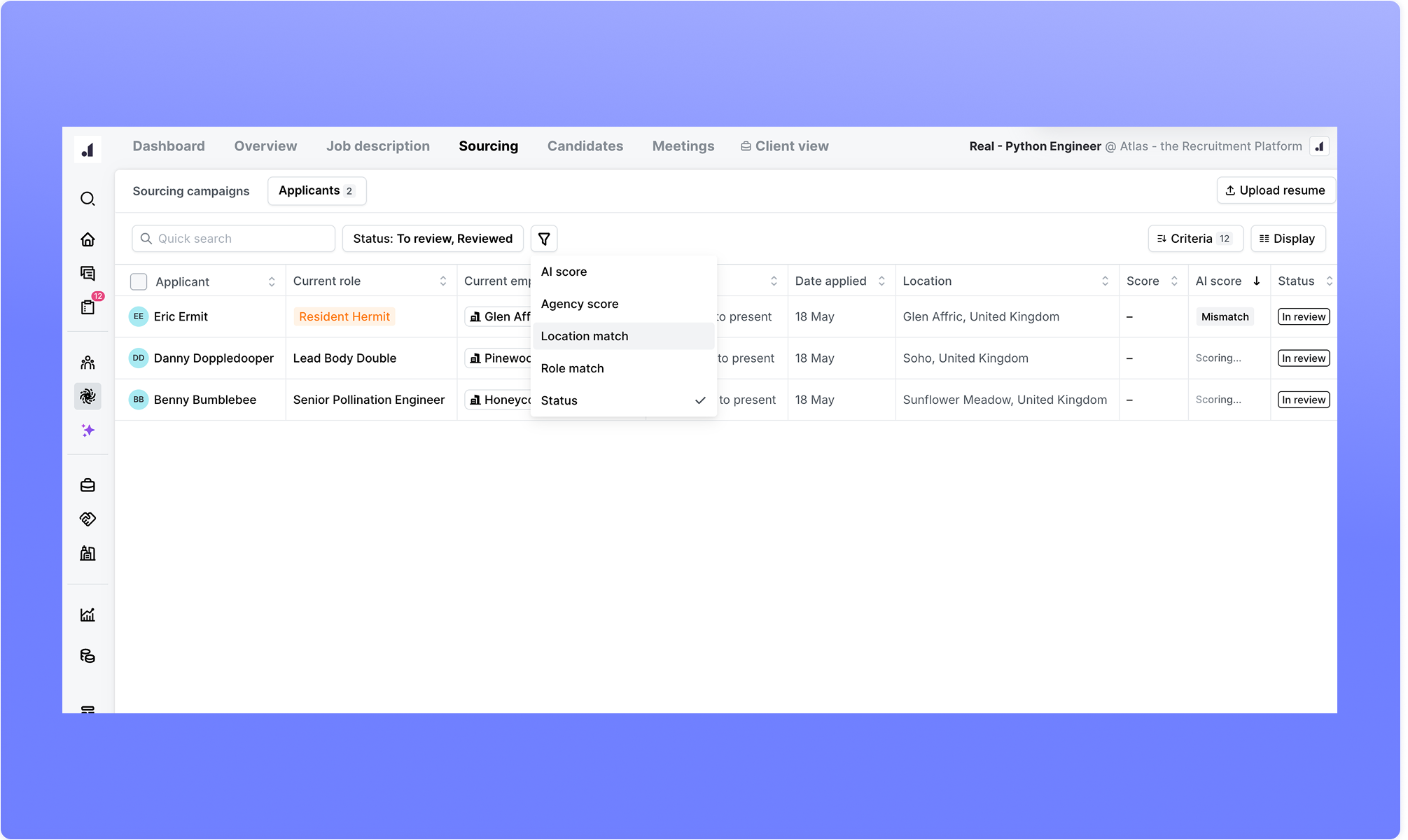
Preventing all this needs a system that builds the record for you. That thinking sits behind Atlas, an AI-powered CRM and recruitment platform. Its agentic AI takes the admin off the desk. It connects to Gmail and Outlook and pulls in every person you have ever emailed, with no manual entry. Every resume that lands in the inbox is parsed on arrival. Applicants stay separate from your database until someone approves them.
Records that assemble themselves from the conversation do not get typed in twice. With AI agents enriching profiles in the background, the second copy never gets created. A quarterly pass of candidate database management then only has to handle what is already there.
Frequently asked questions (FAQs) on duplicate records in your CRM
Most duplicate records come from one person entering through more than one channel. A work email on the first application and a personal email on the next is the common case. A job board feed and a careers page can also deliver the same candidate in one week. Manual data entry supplies the rest, usually through name variants and records created without a search first.
Detection rules lean on email addresses and phone numbers, with names as a fallback. Email changes with employers, phone matching breaks on shared switchboard numbers, and names vary with nicknames and marriage. Formatted CVs often arrive with the contact details stripped out. Nothing reliable is left for a rule to compare.
Review first. A merge decides which record survives, and the losing one takes its notes, consent trail, and interview history with it. Put potential duplicates in a queue that a recruiter confirms. Keep the evidence behind each match visible, so the decision takes seconds.
A quarterly batch pass suits most agencies, with checks at the point of creation doing the heavier lifting in between. If deduplication is the only control you run, the database degrades between passes and the job grows every quarter. Prevention at capture is what keeps that pass small.
It removes most of the causes. When a platform captures contacts from email and parses resumes on arrival, far fewer records get typed by hand. Typing is where variants begin. AI matching also compares more signals than a rule-based check, including work history and the content of past conversations.
They can. A deletion or rectification request actioned on one record leaves the other one live. That undercuts the accuracy obligation attached to personal data. Agencies holding candidate data under GDPR should treat unresolved duplicates as a rights-handling risk rather than a tidiness problem.
What clean data buys a recruitment team
Knowing how to handle duplicate records in CRM systems is mostly knowing where each one came from. Four of the ten sources arrive through channels you do not control. Four more come from your own team working in good faith. The last two come from fields that were never stable enough to match on.
The agencies that stop creating duplicates tend to be the ones that stopped running the setup behind them. A sourcing tool here, an inbox there, a spreadsheet of event contacts. Underneath it all, a CRM that only knows what someone typed into it. Capture candidates from email, resumes, and sourcing in one platform, and you have one record to keep current. Not four to reconcile. That is the case for Atlas, and it is a quieter one than most.
Worth a look if your next cleanup is already in the calendar.