










// Recruitment Technology, Software Comparisons
What SourceWhale Reviews Tell You, and What They Never Will
Published: 15 September 2026,
8 min to read
The bottom line
Reviews of outreach and sequencing tools describe a desk, not a product. Claims about integration depth, deliverability controls, admin overhead, and channel logging transfer from one agency to another. Reported reply rates and ease of use scores almost never do, so read for the operational detail and test the rest against your own sending domain and your own data.
What a review of an outreach tool can actually prove
SourceWhale reviews rank among the most read pages in agency software research, and among the easiest to misread. A glowing write-up from a two-person retained search firm and a scathing one from a 60-seat contract desk can both be accurate. They are describing different desks.
The gap sits in what each reviewer counts as work. A boutique sending 40 researched messages a week judges a sequencing tool on how well it drafts. A contract desk sending 4,000 judges it on whether the fourth follow up stops the moment a candidate replies. Nobody writes a review at the point a sequence emails someone who was placed the week before, which is a shame, because that moment says more than any star rating.
Some claims in a review are portable. Others belong to the person who wrote them, and travel about as well as a warm desk handed to a new starter.
Why do SourceWhale reviews contradict each other so often?
Because the result any outreach tool produces is set by the desk it runs on, and reviews rarely state the desk.
Volume moves the verdict. Market moves it further. A recruiter working a scarce engineering niche in a city with four serious employers sees reply rates a rec2rec desk will never touch. Sender reputation moves it again. An agency mailing from a domain registered in 2011, with clean bounce handling and a real reply address, starts from a different place than one that spun up three lookalike domains last month.
The stack around the tool counts as much as the tool. Reviews written by teams whose CRM already synced mail and calendar read nothing like reviews written by teams who bolted a sequencer onto a fragmented recruitment tech stack. Same product, two experiences, and only one of them is about the product.
Every team also has one recruiter whose reply rate runs at double everyone else’s, and the software has never once been the reason.
Which claims transfer from a review to your own desk?
Four categories transfer cleanly, because they describe the tool rather than the market it was pointed at. Everything else needs retesting on your data.
A fifth category is rarer and worth hunting for: what the vendor did when something broke. A review that describes how support handled a bounce spike or a suspended mailbox beats ten that praise the interface. Our email deliverability guide covers the controls to raise in the demo, in the order they tend to fail.
- Integration depth. Does a reply write itself back to the candidate record, or does a recruiter retype it? Reviews that name the fields a tool updates are worth more than reviews that name the systems it connects to. Anything vaguer than field level detail is a logo on an integrations page.
- Deliverability controls. Sending caps per mailbox, domain warmup, authentication, bounce suppression, and reply detection. Google instructs senders to keep spam rates below 0.3% in Postmaster Tools, and domains sending more than 5,000 messages a day to Outlook.com must pass SPF, DKIM, and DMARC or land in Junk. A tool with loose controls puts your whole sending domain at risk, not one campaign.
- Admin overhead after the reply. Who updates the status, logs the note, and moves the candidate onto the shortlist? Reviews that describe this step honestly are the most useful lines on the page.
- Channel logging. Whether a LinkedIn message, an SMS, and a WhatsApp thread land on the record automatically, or sit somewhere nobody can audit when a client asks what was said.
Do reply rates and ease of use ratings survive the move to your market?
They do not. Both measure a situation, and the situation was somebody else’s.
A reply rate is the output of market scarcity, brand recognition, list quality, sender reputation, and how well one recruiter writes. Change any of those and the number stops meaning anything. The same Google guidelines that set the spam threshold also state that Google does not track open rates and cannot verify the figures third parties report, which is worth recalling the next time a review quotes engagement metrics to two decimal places.
Ease of use has the same defect in different clothing. A single user who configured the tool herself finds it intuitive. Forty recruiters inheriting her setup do not, and CRM adoption usually fails for reasons that have little to do with the interface. Ask a sharper question instead: how long does a new starter take to launch a compliant sequence with no supervision?
Support ratings have a shelf life of roughly a quarter. Read the dates before you read the stars.
What does a review never tell you about SourceWhale pricing?
The license line is the part reviews argue about, and the smaller part of the bill. The rest is paid in recruiter hours spent keeping two systems in agreement, and no review meters that.
Atlas research with more than 1,000 agency recruiters found that 56.16% describe their recruitment technology setup as functional but fragmented, with tools that work individually while recruiters move between them to finish everyday tasks. A standalone sequencer is often one of those tools. Reviews of it capture the sending experience and miss the reconciliation tax entirely.
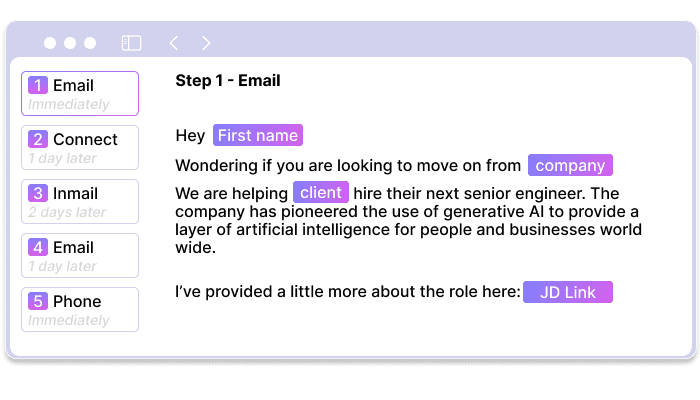
Removing that tax is a product decision rather than a discipline problem. Sequences that run inside the system holding the record never need reconciling, and that is how Atlas approaches it: an AI-powered recruitment platform that uses agentic AI to take admin out of the workflow, with multi-step outreach campaigns built into the same AI-powered CRM that stores the candidate. A candidate showing interest on email or LinkedIn has their status updated automatically, and the Chrome extension adds people to sequences without a copy and paste step.
Ethea Solutions built its search practice on that model and reported a 500% increase in BD outreach with 50% higher candidate response rates, alongside more than 15 hours of admin removed every week. Those are the metrics a buying decision should turn on, because they describe work that stopped happening.
Frequently asked questions (FAQs) on reading SourceWhale reviews
They are reliable for mechanics and unreliable for outcomes. Descriptions of what a tool logs, how it authenticates mail, and what a recruiter has to do after a reply hold up across agencies. Numbers such as reply rates, meetings booked, and time saved belong to the desk that produced them.
Look for per mailbox sending caps, domain warmup, SPF, DKIM, and DMARC handling, bounce suppression, and automatic reply detection. Reviewers who mention a suspended mailbox or a sudden spam folder problem are telling you where the guardrails sit. Both Google and Microsoft now enforce authentication requirements on high volume senders, so these controls decide whether your outreach reaches an inbox at all.
Because a reply rate measures a market and a sender, not a piece of software. Candidate scarcity, brand recognition, list quality, domain reputation, and individual writing skill all move the number more than the tool does. Treat any quoted rate as context for that agency and benchmark against your own historical send to placement data.
Less than complaints about admin. Seat costs are easy to compare and easy to negotiate, while the hours your team spends updating two systems after every campaign never appear on an invoice. Model the total cost by counting the manual steps between a candidate reply and a fully updated record.
Inside, wherever the option exists. When campaigns run in the same platform as the candidate and client records, statuses, notes, and engagement history update as part of one workflow. Separate tools force a sync, and every sync is a place where data quality and reporting accuracy quietly degrade.
Run it on a live role with a real list, not a demo dataset. Send from a mailbox you care about, track what lands on the record without human help, and time how long a new starter needs to launch a compliant sequence. Then check how automated follow ups behave when a candidate replies, bounces, or asks to be removed.
Reading outreach reviews like an operator
Read SourceWhale reviews for the mechanics that repeat across agencies: how mail is authenticated, what writes back to the record, how replies are detected, and who clears the admin afterward. Treat every reply rate as local weather, and every ease of use score as one person’s configuration. The claims worth acting on are the ones that describe the work, not the results.
The capability that changes the arithmetic is outreach that leaves no cleanup behind, and that is the part of Atlas most agency teams notice in the first week. Campaigns launch from the extension, replies update the record, and the desk moves on to the next conversation.
Worth a look if your team is still reconciling two systems after every reply.