











// Recruitment Technology, Atlas Technology
How Recruitment Analytics Software Elevates Performance Tracking and Review Quality
Published: 29 April 2026,
8 min to read
Performance reviews in large recruitment agencies often face a common challenge: too much time is spent on the less impactful aspects of performance.
A manager sits down with a recruiter. Before they can get to anything meaningful, someone has to pull numbers from a spreadsheet, cross-reference a CRMx or applicant tracking system, check an email chain, and piece together what actually happened over the last month. By the time the data is assembled, half the meeting is gone. What was supposed to be a coaching conversation turns into a data reconciliation exercise.
Recruitment analytics software changes that equation entirely. When the numbers are already there, organized, and accurate, managers can walk into every 1-to-1 ready to lead, not to dig. The right recruitment analytics software ensures that this data is always up to date and easy to access.
Why Recruitment Agencies Are Rethinking How They Measure Performance
The staffing and recruitment industry is under more pressure than ever to prove ROI (Return on Investment) at every level of the hiring process. Large recruiting agencies and HR teams manage many recruiters across different roles, offices, and time zones, so relying on gut feeling is no longer enough.
Access to clear data makes a big difference over time. Recruiting teams that understand their numbers can adjust quickly, while those without visibility often don’t spot issues until revenue is impacted.
In the past, gathering this data has been time-consuming for recruiting leaders and talent teams. They’ve had to chase it, organise it, and present it, leaving less time for meaningful conversations about performance and growth. Modern recruitment analytics software removes this burden by centralising and automating data collection.
What Good Recruiter Performance Tracking Actually Looks Like
Not all recruiting analytics tools are built the same way. For recruitment agencies specifically, the metrics that matter go beyond basic activity logging.
Meaningful recruiter performance tracking and hiring analytics cover the full picture of what a recruiter contributes to the business: the number of placements made in a given period, total revenue generated per recruiter, candidate salary data across placements, interview volumes and conversion rates through each stage, and pipeline health across open roles. Leading recruitment analytics software brings all of these metrics together in a single, unified view.
When a manager has visibility across all those dimensions in one place, without having to request reports or manually export data, the nature of their management changes. They spend less time asking “what happened?” and more time asking “what would help you do this better?”.
They can also focus more clearly on the talent acquisition strategies in use and identify specific skill gaps, allowing them to guide recruiters in improving their performance. That shift, from retrospective reporting to forward-looking coaching, is where the real value of recruitment analytics software sits.
The Challenge of 1-to-1s in Large Agencies
In smaller agencies and hiring teams, informal feedback loops fill in the gaps. A manager can keep tabs on a team of five without much infrastructure. But at enterprise scale, with 50 or 100 recruiters, that informality breaks down fast.
Large agencies and enterprise HR teams typically run structured 1-to-1s on a weekly or monthly basis. These sessions are meant to support recruiter development, align on targets, and flag problems early. The intention is right. The execution is where things fall apart.
When prep time is dominated by data gathering, meetings become shallow. Recruiting teams walk out with fewer actionable insights. Managers feel like they’re ticking a box rather than leading. Over time, 1-to-1s become something to get through rather than something to look forward to. The fix is not more meetings or more spreadsheets. With the support of recruitment analytics software, better information is available at the right moment, with no effort required to surface it.
How Atlas Analytics Transforms Performance
When every key metric is already surfaced before a manager opens a meeting, something changes in how they show up. Instead of asking a recruiter to justify their numbers, the manager can open with, “I can see your interview-to-offer conversion has been strong this quarter. What’s working for you there?” Instead of pointing to a gap and leaving it at that, they have enough context to ask what got in the way and what support would help.
This is the difference between performance management and performance development. The data is not the end of the conversation. It is the starting point.
This is exactly where Atlas – the Recruitment Platform, comes into play with its enterprise-grade analytics layer. Atlas is an AI-powered recruiting software designed to manage and optimise the entire hiring lifecycle for scaling teams. One of its core recruitment analytics tools is the Analytics feature, an enterprise-grade capability that analyzes hiring data and gives leaders complete visibility into performance across the organisation through comprehensive analytics.
Through advanced reporting, the Analytics feature provides a powerful, customisable analytics suite, from high-level company performance down to individual recruiter activity. It helps teams track and improve hiring performance by surfacing key metrics such as time to hire, recruiter productivity, candidate sourcing effectiveness, and overall team performance. It also leverages predictive analytics to anticipate trends and guide better decision-making.
By bringing all of this data into one place, Atlas enables teams to optimize workflows, identify what drives results, and consistently deliver the best candidates. This combination of a unified platform and embedded analytics means teams don’t just collect data, they can act on it instantly, turning everyday recruitment activity into clear, actionable insight.
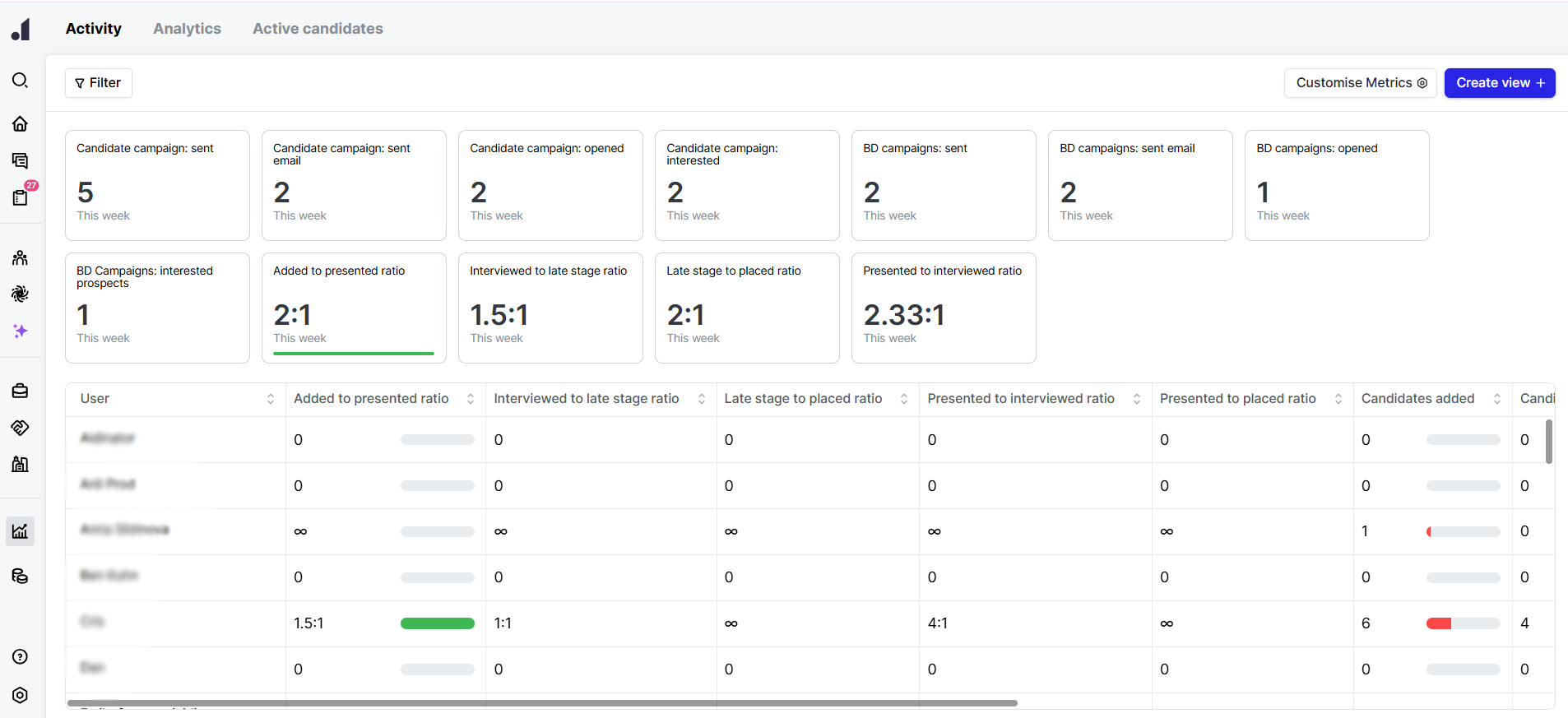
Teams can also create real-time, tailored recruiting analytics dashboards for their exact workflows, or work with support to surface highly specific data points. The result is a system in which no meaningful signal is hidden, and every conversation can start from a place of clarity.
For heads of talent and operations directors managing large recruitment teams, this kind of structured visibility makes it easier to spot patterns across the organisation. Some recruiters are strong closers but slow to build a pipeline, while others generate high revenue yet burn through candidates at the interview stage. Aggregate, flexible recruiting analytics reveal what individual conversations alone often miss and turn those insights into actionable development.
Recruiter KPIs That Enterprise Agencies Should Be Tracking
Different agencies will weigh recruitment data and financial data differently depending on their specialism and commercial model during the hiring process, but 4 categories consistently matter at enterprise scale:
1) Activity metrics
Interviews arranged, calls made, candidates submitted, and the number of job positions each recruiter is managing across different job boards gives you a clear read on pace and volume across your team. They are the earliest signal that something is picking up or slowing down before it shows up anywhere else.
2) Conversion metrics
Offer acceptance rates, time-to-hire, interview-to-placement ratios, and submission-to-interview rates show you where candidates are dropping off and why. Strong activity numbers mean nothing if the process is leaking at every stage of the recruitment process.
3) Commercial metrics
Placements made, total revenue per recruiter, cost per hire, and average candidate salary connect individual effort directly to business outcomes. These are the numbers that matter most in a performance review and the ones that should never require manual digging to find.
4) Pipeline metrics
Open roles being worked, time-to-fill, and role aging give managers early warning before a quiet week becomes a missed target. Keeping an eye on pipeline health at the team level is what separates reactive management from proactive leadership.
When these recruitment analytics are tracked consistently and supported by real-time insights, managers and talent leaders have a full picture without having to request it, making it easier to forecast hiring needs and plan ahead with confidence.
From Data Chaos to Coaching Clarity
The agencies that will build the strongest recruitment teams over the next decade are not the ones that track the most data. They are the ones who use the right data in the right moments to have better conversations with their people. That’s why it’s critical to find the best recruitment analytics software, one that doesn’t just collect data, but makes it usable in real time for both leaders and hiring managers.
Recruitment analytics software makes that possible by doing the heavy lifting before the manager even opens a meeting. The numbers are there. The context is there. All that’s left is the conversation. This is where recruitment analytics software becomes a true competitive advantage for modern agencies.
By removing the admin burden from recruitment workflows, Atlas – the Recruitment Platform ensures that recruitment data is captured seamlessly as part of the work itself, not as an extra task. Its Analytics feature then puts complete recruiter performance data at your fingertips: job postings, placements, revenue, interviews, candidate salaries, and more, all in one place. So when it’s time for a 1-to-1, your managers can walk in ready to coach, not to compile.