










// Recruitment Technology, Software Comparisons
Recruiterflow Pricing 2026: What Per-Seat Really Costs at Agency Scale
Published: 18 August 2026,
11 min to read
The bottom line
Recruiterflow publishes one price and quotes the other. The Platform Plan is $149 per user per month billed monthly, or $119 per user on an annual commitment. The AIRA plan that carries the AI agents is answered with one line: let’s chat custom pricing. Reviewers rate it 4.7 out of 5 from 332 reviews on Capterra. The cost objections there are aimed at the seat model rather than the sticker.
Last reviewed: August 2026.
Where per-seat ATS costs stop behaving predictably
Per-seat software assumes your headcount holds still. Agency recruitment is not a still-headcount business.
Recruiterflow pricing is clean on the page. One published rate, one plan behind a quote, a currency switcher, and a discount for committing to a year. It models beautifully on a whiteboard. The complexity arrives in month seven. Two consultants have resigned, a desk has gone to a part-time researcher, and finance is still paying for all of them.
That is not an unusual quarter. Professional and business services posted a quits rate of 2.2% in June 2026. Ordinary churn, in other words. It is also enough to pull a per-seat contract out of step with your org chart before the first renewal.
How much does Recruiterflow cost per user?
Recruiterflow costs $149 per user per month on monthly billing. On an annual commitment the rate falls to $119 per user per month. That is the Platform Plan, and it is the only figure the company publishes.
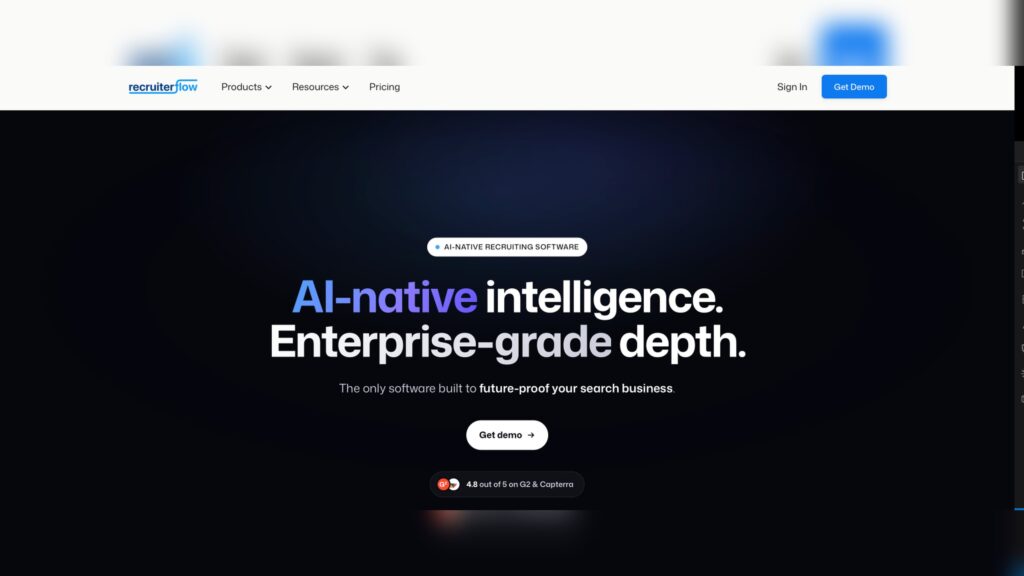
The plan is sold as a full ATS and CRM rather than an entry tier. It includes multichannel sequences, recruitment and sales automation, client and team access control, bulk sourcing through the Chrome extension, reports and API access. Recruiterflow frames the product as AI native intelligence paired with enterprise grade depth. The Platform Plan is the depth half.
The pricing page carries a currency switcher. Sterling buyers see £115 monthly and £89 annual. Euro buyers see €149 and €119, so the annual saving is roughly a fifth in every currency listed.
Capterra lists Recruiterflow as a single plan starting at $119 per user per month. The same listing notes that its closest alternatives start between $10 and $25. Value for money still scores 4.7 there. The price is high for the category, and reviewers largely think it earns that.
| Plan | Published price | Billing | What the plan covers |
|---|---|---|---|
| Platform Plan | $149 | Monthly | ATS and CRM, multichannel sequences, recruitment and sales automation, client and team access control, bulk sourcing via Chrome extension, reports, API access |
| Platform Plan | $119 | Annual commitment | Identical feature set, discounted for the twelve month commitment |
| AIRA Plan | Let’s chat custom pricing | Quote only | Everything in the Platform Plan, plus the AIRA agents, LinkedIn in the communication sync, phone and email finder, and custom BI dashboards |
Which capabilities sit behind custom pricing?
The AI layer has no published price. Everything branded AIRA sits on the second plan. The pricing page answers that plan with a sentence rather than a number.
AIRA covers the Notetaker, the Field Updates Agent, the Matchmaker, the Submission Agent, the Task Agent and job change alerts. Omnichannel communication sync and custom BI dashboards ride with it. Recruiterflow’s FAQ is firm that there are no add ons. Every current and future AIRA agent is included at no extra cost once you are on that plan.
Read the scope closely. The promise applies to your selected plan, and the agents live on the plan without a published figure.
The split matters most in reporting. Platform buyers get basic analytics. RF BI and the custom dashboards arrive with AIRA, so an agency that wants consultant-level performance data is buying the quote-only tier.
Reviewers have raised the reporting gap directly.
| Capability | Platform Plan | AIRA Plan |
|---|---|---|
| Communication sync | Email, calls, text | Adds LinkedIn |
| Analytics | Basic | Basic plus RF BI and custom BI dashboards |
| AIRA Notetaker | Not included | Included |
| Field Updates Agent | Not included | Included |
| Phone and email finder | Not included | Included |
| Job change alerts | Not included | Included |
| Published price | $149 monthly, $119 annual | Quote only |
We are struggling a lot with the reports, KPIs Management, objectives management and the overall performance management for our recruitment activities.
Geoffrey B, CEO, Human Resources, 201-500 employees, September 1, 2023 · Capterra
What costs are missing from the headline number?
Four lines sit outside the license. Data migration, job board spend, the AI plan itself, and seats you keep paying for after the people holding them have gone.
Migration is the first to price. Recruiterflow offers a free self-serve CSV import and a paid white-glove migration. The paid route typically runs six to eight weeks, and the fee depends on data volume. Neither number is published, so it belongs on your model as an open line. The free import has its own bill, and it arrives later as cleanup.
Job board spend is the second. Sponsored posting is bought by the agency rather than bundled into the seat. Reviewers describe the trade off in specifics.
The third line is the reason this page exists. A seat is billed whether or not anyone opens it. Warm desks churn, researchers work part time, contract projects end, and maternity cover comes and goes. On the published annual rate, one dormant seat costs $1,428 a year. Users have asked Recruiterflow for a different structure.
the organic posts are ignored and I have to go through another ATS in front of yours to post and boost jobs, as they have a partnership with indeed.
Thomas C, Recruiter, Human Resources, June 19, 2023 · Capterra
The transition from our previous system was quite rocky; not all of our data imported correctly, and our old records are still not entirely accurate.
Kim B, Talent Research and Technical Lead, Human Resources, September 6, 2023 · Capterra
I wish they had a pricing option for groups vs. seats. Or lower cost for each additional user.
Jen S, Founder and Managing Director, Staffing and Recruiting, June 23, 2023 · Capterra
Does the math still work at 25 seats?
At 25 seats on the published annual rate, the license is $35,700 a year. Across three years that reaches $107,100 if the price holds. The same seats on monthly billing cost $44,700 a year, so committing is worth $9,000 annually.
That $9,000 is the number sales will lead with, and it is real. It is also the price of the flexibility you sell back. A twelve month commitment pays for every seat for twelve months. That includes the seats of the two consultants who resign in March.
Five stranded seats hand back $7,140 of the $9,000 you saved. At agency scale, the annual discount and ordinary attrition are close to the same size. The seat plan matters more than the seat price.
What the model excludes: the AIRA quote, the migration fee, job board spend, and any renewal increase. None of those can be calculated from public information. Recruiterflow publishes no renewal uplift terms, so treat the three year total as a floor.
| Cost line | Year 1 at 25 seats | Basis | Assumption behind the row |
|---|---|---|---|
| Platform Plan license, annual billing | $35,700 | Published: $119 per user per month | 25 seats billed for twelve months |
| Same license, monthly billing | $44,700 | Published: $149 per user per month | Same 25 seats, no annual commitment |
| Three year license total | $107,100 | Published price held flat | No renewal uplift assumed, because none is published |
| AIRA plan uplift | Not calculable | Quote only | Recruiterflow publishes no figure for the AIRA plan |
| White-glove migration | Not calculable | Published as paid, price depends on data volume | Free self-serve CSV import is the alternative |
| Job board and sponsored posting | Not calculable | Bought separately by the agency | Sits outside the license entirely |
| Each seat carried after a leaver | $1,428 per seat | Derived from published $119 per user per month | Seat billed for a full twelve months |
Can you negotiate a better Recruiterflow contract?
Yes, and the leverage sits in the terms rather than the rate. The published price is the same for everyone. What moves is your protection against changes in headcount and scope.
Take these into the call, and get the answers onto the order form.
- Get the AIRA plan quoted per seat, with the same monthly and annual split the Platform Plan publishes.
- Ask what happens to that quote when new AIRA agents ship mid-term.
- Cap any renewal increase in writing, with a percentage and a notice period.
- Establish whether seats can be reduced mid-term, and what notice that needs.
- Ask whether unused seats can be parked instead of paid for.
- Push for the white-glove migration fee to be waived, which the vendor’s own FAQ says is open to discussion on multi-year contracts.
- Run a pilot desk on monthly billing before the full team moves to the annual rate.
- Get the exit path in writing: export format and how quickly you receive your database, with the cost stated.
Who gets the most value from this pricing model?
Per-seat pricing rewards a stable team of full-time recruiters. If your 12 consultants each bill, each log in and each stay, the Platform Plan is easy to budget. Reviewers rate the value highly on that basis.
The model works against you in the opposite conditions. Temp and contract desks flex with demand. Researchers and resourcers work part time. Seasonal peaks come and go, and every one of those users is billed at full seat price. Occasional access for finance or compliance costs the same as a top biller.
Where Recruiterflow is still the better choice deserves stating plainly. Small and mid-sized search firms with flat headcount get a capable ATS and CRM at a predictable rate. Support is the most praised thing in its reviews by a distance. Agencies leaving an expensive legacy system often find it materially cheaper than what they left.
Reviewers make that comparison themselves.
There are many features, linkedin chrome extenstion, and automations freely available which other Recruitment Platforms incurr high fees.
Geo W, Director, Financial Services, 2-10 employees, October 1, 2024 · Capterra
How is Atlas structured differently on price?
A per-seat rate becomes predictable only when the rest of the contract stops moving. Atlas is priced per seat, and modules are not sold separately. No automatic annual uplift is written into the contract, and contract length is agreed deal by deal. Nothing sits behind its own quote, so the AI is never a tier you graduate into.
What that structure protects is the admin inside each seat. Atlas is an AI-powered CRM for agencies that uses agentic AI to do the data work itself. It pulls every contact from Gmail and Outlook, parses each resume on arrival, enriches the company behind each candidate, and does all of it without anyone touching a field. A swarm of recruitment AI agents runs on top, scoring BD opportunities and drafting outreach in your voice. Native dashboards come with the platform rather than with a quote.
The outcomes show up on the desk. Novify cut shortlist delivery by 96% and saves more than 20 hours of admin a month. No extra tools, no extra headcount. Across the wider market, 56.16% of agencies describe their tech stack as functional but fragmented, which is what buying capability one tier at a time produces.
If Recruiterflow is your current system, a few pages are worth the click. The Atlas vs Recruiterflow comparison covers the product differences. The migration guide covers the move itself, and our in-depth Recruiterflow review covers daily use. Read them next to why CRM adoption fails, because seats nobody opens cost you twice.
Frequently asked questions (FAQs) on Recruiterflow pricing
The Platform Plan is published at $149 per user per month on monthly billing. An annual commitment brings that to $119 per user per month, checked on the vendor’s pricing page in August 2026. Sterling pricing shows as £115 and £89. The AIRA plan is quote only.
No. Larger teams are routed to the AIRA plan, which the pricing page answers with custom pricing rather than a rate. Ask for that quote expressed per seat. It can then be compared with the published Platform Plan figure and modeled against your headcount plan.
Recruiterflow’s pricing FAQ states there are no add ons. All current and future AIRA agents are included at no extra cost for customers on the AIRA plan, and multi-year custom plan customers are covered for the contract duration. The agents come with a plan rather than being sold individually, and that plan carries no published price.
Capterra’s listing records a free trial as available, no free version, and no credit card required, checked in August 2026. A trial is a useful way to test seat utilization before committing. Watch the part-time researchers and occasional users, because each one still costs a full seat.
The self-serve CSV import is free. The white-glove migration is paid, typically takes six to eight weeks, and is priced on data volume, so no public figure exists. Recruiterflow’s own FAQ says a fee waiver can be discussed on multi-year contracts, which makes it a fair ask in negotiation.
Recruiterflow does not publish its mid-term seat reduction terms, so treat this as a question for the order form. Ask for the notice period, whether seats can be parked, what happens if headcount falls below the committed number, and how fast a change takes effect. Get the answer in writing before you sign.
Capterra places the $119 starting price toward the higher end of its category, noting that the closest alternatives start between $10 and $25 per user. That comparison is less useful than it looks. Cheaper tools often price sourcing and automation separately, so compare total cost at your seat count instead.
What to settle before you sign an annual deal
Recruiterflow pricing is transparent where it is published and quiet where it matters most for larger teams. The work sits in modeling seat count against your hiring and attrition plans. Price the leavers, the part-time users, the occasional logins and the AIRA quote before you commit to a year.
The deeper question is how much of each seat goes on admin. Agentic AI can absorb the record updates, the note taking, the enrichment and the follow-ups in the background. Atlas is built that way, with agents running continuously rather than waiting on a higher tier.
Worth a look before your renewal date decides for you.
Sources checked for this page: Recruiterflow’s pricing page and pricing FAQ, both on August 17, 2026. Capterra’s Recruiterflow pricing and reviews listings, also August 17, 2026. Quits data from the US Bureau of Labor Statistics Job Openings and Labor Turnover Survey, table 4, June 2026.