










// Recruitment Technology, Software Comparisons
Mercury Pricing 2026: The Licence Stack Buyers Discover Late
Published: 18 August 2026,
11 min to read
The bottom line
Mercury does not publish list pricing. What you are quoted is one layer of three: the Mercury license, the Microsoft licenses underneath, and the implementation work. Microsoft publishes its half. At 25 seats, the Dynamics 365 and Power Platform lines reach $40,800 a year at list price.
On reviews, Mercury holds 4.5 out of 5 on Capterra and 4.5 on G2, from four reviews each.
Last reviewed: August 2026.
A quote that covers one layer of three
Every platform quote leaves something out. Mercury pricing leaves out an entire second vendor.
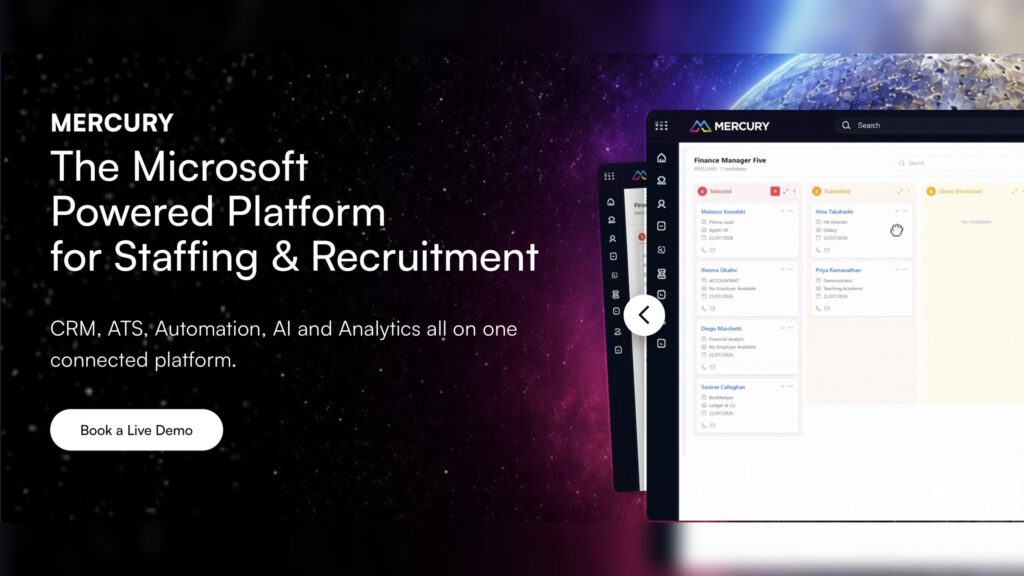
Mercury is a recruitment CRM and ATS built on Microsoft Dynamics 365. The system your consultants log into is an application layer running on Microsoft’s. That architecture is the product’s headline strength. It is also its least understood cost line.
The Mercury license is quoted by Mercury. The Microsoft licenses are priced per user and published openly. The configuration work that turns Dynamics into a working desk is scoped agency by agency.
Few buyers see all three in one document. They see them in sequence. The third usually arrives after the first has been signed.
What does Mercury cost per user in 2026?
Mercury does not publish a per-user price. Capterra’s listing shows the starting price as Contact vendor, with no free trial, checked August 2026. ITQlick reconstructs software pricing from buyer data. It states that Mercury does not publicly list its pricing. Its own estimate runs from $50 to $300 per user per month. That is an estimate, not a vendor figure.
Treat the range as a reconstruction. What matters more is which lines of the bill are published at all. Only one of the three is.
The pattern is worth naming plainly. Mercury publishes no prices. Microsoft publishes seven.
| Cost layer | Who invoices it | Published price? | Where the position is stated |
|---|---|---|---|
| Mercury platform license | Mercury | No, quote only | Capterra listing shows Contact vendor |
| Microsoft Dynamics 365 Sales | Microsoft or a reseller | Yes | Microsoft Dynamics 365 Sales pricing page |
| Power Platform licenses and storage | Microsoft or a reseller | Yes | Microsoft Power Apps and Power Automate pricing pages |
| Implementation and configuration | Mercury or an implementation partner | No, scoped per agency | Not stated publicly |
| Training | Mercury | No | Capterra lists in person, live online, webinars, documentation and videos |
Which Microsoft licenses sit underneath Mercury?
Microsoft prices Dynamics 365 Sales per user per month and publishes three tiers. The entry tier is $65 per user per month for Sales Professional, paid yearly. Sales Enterprise is $105 and Sales Premium is $150, on the same basis. Microsoft Relationship Sales is not published at all, and carries a 10-seat minimum.
The footnotes matter as much as the tiers. Two capability rows on Microsoft’s own comparison table carry the same note: they require additional licenses. Those rows are customization and automation through Power Automate, and custom apps through Power Apps.
So the platform layer has its own add-on ladder. Power Automate Premium is $15 per user per month, paid yearly. Power Apps Premium is $20 per user per month. Dataverse database capacity above the included entitlement is $40 per GB per month. A recruitment database full of CVs is not a small object, and storage is pooled at tenant level.
| Microsoft license | Published price | What it covers | Basis |
|---|---|---|---|
| Dynamics 365 Sales Professional | $65 per user per month | Core sales force automation, Microsoft 365 interoperation, reporting and dashboards | Paid yearly, published |
| Dynamics 365 Sales Enterprise | $105 per user per month | Adds custom apps, advanced automation and Copilot capabilities | Paid yearly, published |
| Dynamics 365 Sales Premium | $150 per user per month | Adds sales intelligence and 1,000 Copilot Credits per user per month | Paid yearly, published |
| Microsoft Relationship Sales | Variable, contact sales | Sales Enterprise plus LinkedIn Sales Navigator, 10-seat minimum | Not published |
| Power Apps Premium | $20 per user per month | Unlimited apps and pages for the assigned user | Paid yearly, published |
| Power Automate Premium | $15 per user per month | Cloud flows and premium connectors beyond the app context | Paid yearly, published |
| Dataverse database capacity add-on | $40 per GB per month | Storage above the entitlement included with user licenses | Paid yearly, published |
What costs land after the quote is signed?
The services layer cannot be priced from public information. It is also the layer that varies most between agencies. Configuration, data migration, training and internal ownership are all scoped per deal.
Each of these is a real line in a real budget.
One reviewer put the buying advice bluntly.
Every Dynamics build also acquires a house expert. Someone learns why a field was renamed in year two. That knowledge tends to leave when they do.
- Implementation and configuration. Turning a Dynamics environment into a recruitment desk is project work. Mercury or an implementation partner quotes it per agency.
- Data migration. Moving a legacy database into a new schema is its own workstream, as any recruitment data migration shows.
- Training. Capterra lists in person, live online, webinars, documentation and videos. The first two are people’s time.
- Internal system ownership. A configurable platform needs an owner. That is either a named internal admin or retained partner days.
- Third-party integrations. Capterra records 16 integrations, including Broadbean, Daxtra, LinkedIn Recruiter and ZoomInfo. Those products carry their own contracts.
- Storage growth. Dataverse capacity is pooled at tenant level, so a growing database is a growing bill.
- Renewal terms. Any annual uplift is a contract clause. Read it before signature rather than after.
When you buy Mercury, make sure you go for a complete suite instead of cherry-picking the best ones. It’s less of a headache when you have all your features integrated and interconnected rather than disconnected.
Verified user in Human Resources, small business, September 2019 · G2
How much does the license stack total at 25 seats?
At 25 seats, the platform layer alone comes to $40,800 in year one on published Microsoft prices. Over three years that is $122,400, before Mercury invoices a single license. The figure assumes Sales Enterprise, a Power Automate Premium license per user, and 10 GB of extra storage.
A lighter configuration changes the arithmetic. Sales Professional at $65 per user per month brings the Dynamics line to $19,500 a year at 25 seats. The trade is the customization and automation capability Microsoft reserves for higher tiers.
Read the table as the published portion of the bill. Neither the Mercury license nor the services layer can be sized from public sources. The part of the stack you can verify in advance is the part Microsoft sells.
| Cost line | Assumption | Year 1 | Year 2 | Year 3 | Three-year total |
|---|---|---|---|---|---|
| Dynamics 365 Sales Enterprise | 25 seats at $105 per user per month, published | $31,500 | $31,500 | $31,500 | $94,500 |
| Power Automate Premium | 25 seats at $15 per user per month, published | $4,500 | $4,500 | $4,500 | $13,500 |
| Dataverse database capacity | 10 GB above entitlement at $40 per GB per month, published | $4,800 | $4,800 | $4,800 | $14,400 |
| Microsoft layer total | List prices held flat, no negotiated discount | $40,800 | $40,800 | $40,800 | $122,400 |
| Mercury platform license | Quoted per deal, not published | Quoted | Quoted | Quoted | Not calculable |
| Implementation, migration and training | Scoped per agency, not published | Quoted | Quoted | Quoted | Not calculable |
What do reviewers actually say about Mercury?
Mercury holds 4.5 out of 5 from four reviews on Capterra and 4.5 from four reviews on G2. Both were checked in August 2026. Capterra’s sub-scores are ease of use 4.0, value for money 4.0, customer service 5.0, and features 4.5.
Both samples are small, and both are old. Capterra’s most recent Mercury review is dated June 2022. G2’s is dated May 2024. Capterra labels all four of its reviews as vendor referred or incentivized. That does not make them false, but it does make them selected.
One reviewer appears on both platforms. The distinct count across the two sites is therefore seven, not eight. Weight the themes below accordingly, and ask for reference customers at your seat count.
| Platform | Rating | Reviews | Most recent review | Date checked |
|---|---|---|---|---|
| Capterra | 4.5 out of 5 | 4 | June 2022 | August 2026 |
| G2 | 4.5 out of 5 | 4 | May 2024 | August 2026 |
Where does Mercury earn consistent praise?
Reviewers praise Mercury for the reason it costs what it costs: it is Dynamics, with recruitment built on top. Familiarity with the Microsoft interface lowers the training load. Power BI gives managers reporting depth most recruitment CRMs cannot match natively.
Configurability is the second theme. Agencies that want the system shaped around their process can have it, if someone is free to do the shaping.
Support and account management come through strongly as well. Capterra’s customer service score of 5.0 sits above its other sub-scores.
Mercury’s greatest strength is its intuitive set up, based on Dynamics, it feels logical to users and reduces some of the pressures on teaching people how to use the system.
Stephen R., Group Marketing and Operations Director, small business, March 2023 · G2
Mercury is a very powerful platform which can be tweaked and modified to suit your individual businesses needs.
Lee C., Talent Acquisition Partner, Staffing and Recruiting, July 2020 · Capterra
Great team, good product, fair price, fantastic support.
Anna J., Managing Director, Human Resources, April 2022 · Capterra
Which complaints come up more than once?
The recurring complaint is effort. The platform rewards agencies that invest in it and frustrates those that do not. That shows up as depth nobody uses and an adjustment period for recruiters arriving from lighter systems.
The most expensive line in any review sits in a recommendation rather than a complaint. It names the internal resource the platform assumes you already have.
That is a headcount question dressed as a software preference. It belongs in the budget alongside the licenses. Agencies that underestimate it are where CRM adoption stalls after go-live.
Probably most recommended to companies who have a dedicated internal system support or training function.
Lee C., Talent Acquisition Partner, Staffing and Recruiting, July 2020 · Capterra
I don’t think that Mercury is as easy to use as other platforms which we tested, even though it has the most features, most people either don’t know about them or how to use it properly
Lee C., Talent Acquisition Partner, Staffing and Recruiting, July 2020 · Capterra
difficulty to search for certain things.
Jacob F., Recruitment Consultant, Renewables and Environment, May 2022 · Capterra
How can you negotiate a better Mercury contract?
Ask for the quote to be broken into its three layers before you discuss the total. A single blended number hides which vendor owns which cost. Every ask below is answerable, and each moves a variable cost toward a fixed one.
Bring these to the second call, not the first.
- Ask for the quote split into three lines: Mercury license, Microsoft licenses, and services.
- Ask which Microsoft SKU each user role requires, and get the answer in writing.
- Ask whether the Microsoft licenses are resold by Mercury or bought direct, then price both routes.
- Ask for a fixed-price statement of work with named deliverables and a go-live date.
- Ask how many partner days and internal admin days the configuration assumes.
- Ask what happens to the Dataverse storage line as the database grows.
- Ask for the renewal uplift to be capped in the contract, in writing.
- Ask for the data extraction format and process on exit before you sign the entry.
- Ask for a reference customer at your seat count, on your desk type, in your market.
Which agencies should still choose Mercury?
Mercury remains the better choice for agencies already standardized on Microsoft. That is truest where an internal Dynamics or Power Platform administrator is already on the payroll. If that person exists, configurability becomes an advantage rather than a cost.
It also suits firms whose reporting requirement is genuinely Power BI at group level. Multi-office businesses needing different configurations per region fit the same profile. So do procurement teams whose approved vendor list is built around Microsoft.
The fit weakens elsewhere. An agency with no internal system owner will carry the configuration burden itself. So will teams that want AI handling admin from day one rather than after a build phase. If your evaluation is about time to value, start with the difference between AI built in and AI bolted on.
How is Atlas structured differently?
A platform that owns its whole stack has one price to explain, not three. That is the structure behind Atlas, an AI-powered CRM that uses agentic AI to remove admin from recruitment work. There is no third-party license underneath, because there is no third-party platform underneath.
The structure: priced per seat, modules not sold separately, nothing behind its own quote, and no automatic annual uplift. Contract length is agreed per deal rather than a forced twelve months.
The capability follows the same logic. AI agents run in the background, updating records, generating outreach, scoring BD opportunities, and creating tasks as the pipeline moves. They are not a priced module bolted on after a configuration project. That matters when 56.16% of agency recruiters describe their tech setup as functional but fragmented. A fragmented tech stack is what the second and third invoices pay for.
For a feature-level view, the Atlas and Mercury comparison sets both platforms side by side. The platform feature breakdown goes deeper on what each system does natively.
Frequently asked questions (FAQs) on Mercury pricing and reviews
No. Capterra’s listing shows the starting price as Contact vendor, with no free trial, checked August 2026. ITQlick states that Mercury does not publicly list its pricing. Any per-user figure online is a third-party reconstruction, not a published vendor price.
Mercury is built on Microsoft Dynamics 365, and Microsoft prices Dynamics 365 Sales per user per month. The Microsoft layer is therefore a separate cost line from the Mercury license. It is also the only part of the stack with published prices. Ask which Microsoft SKU each user role requires before comparing totals.
Microsoft publishes three tiers, checked in August 2026. Sales Professional is $65 per user per month and Sales Enterprise is $105, both paid yearly. Sales Premium is $150. Microsoft Relationship Sales adds LinkedIn Sales Navigator, is quote-only, and carries a 10-seat minimum.
Power Automate Premium at $15 per user per month and Power Apps Premium at $20 are published Microsoft add-ons. Dataverse database capacity is $40 per GB per month. On top of those sit implementation, data migration, training, and any third-party job board or CV parsing tools. None of that last group is published.
Mercury holds 4.5 out of 5 on Capterra from four reviews, and 4.5 on G2 from four reviews. Both were checked in August 2026. The samples are small and dated. The newest Capterra review is from June 2022, and the newest on G2 is from May 2024.
Vendors that quote rather than publish are negotiating by design. The leverage sits in the structure rather than the discount. Ask for the quote split by layer, a fixed-price statement of work, a capped uplift, and a written exit process. Those four asks are worth more over three years than a percentage off year one.
What the license stack tells you before you sign
Mercury pricing is not one number. It is a Mercury quote, a published Microsoft bill, a services line, and whatever internal admin time the configuration assumes. At 25 seats, the Microsoft half alone reaches $40,800 a year on the configuration modeled above. Agencies that map every layer before signing negotiate from a stronger position.
The alternative is a platform where agentic AI handles the admin inside the product. There is no configuration project bolted onto someone else’s CRM. That is the work Atlas takes on. Records update themselves, outreach draws on your own conversations, BD opportunities are scored, and tasks appear without anyone creating them.
If your renewal is on the horizon, it is worth seeing what a single-vendor stack looks like on your desk.
Sources checked August 2026: Microsoft’s Dynamics 365 Sales, Power Apps and Power Automate pricing pages. Capterra’s Mercury listing, G2’s Mercury xRM reviews, ITQlick’s Mercury xRM review, and The State of Agency Recruitment 2026 Benchmark Report by Atlas.