










// Recruitment Technology, Software Comparisons
Ezekia Review 2026: Too Few Public Reviews to Trust, So Ask These 12 Questions
Published: 18 August 2026,
12 min to read
The bottom line
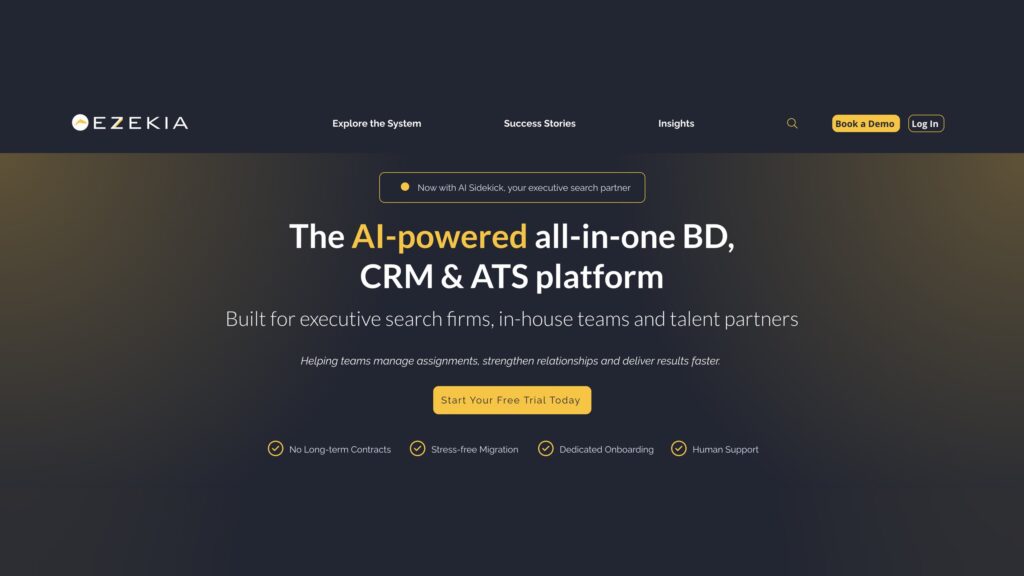
Ezekia carries five public reviews, and four were posted in August 2020 by reviewers the vendor invited. That is too little evidence to sign a contract on, and no proof of a weak product either. Ezekia publishes no price either. The demo has to answer both questions, and the 12 below are what to take into it.
Last reviewed: August 2026.
Where the Ezekia review trail runs out
Search firms take references for a living.
Then they buy a search CRM on four reviews from 2020. Ezekia reviews are the clearest case of that habit. The homepage claims 750+ executive search firms worldwide. The public record adds up to five entries across Capterra and G2. Four of them landed in one month, six years ago.
The gap deserves naming, because most roundups quote the 4.8 and move on.
A thin footprint is not a verdict on the software. It closes the shortcut buyers rely on: reading what a few hundred strangers said first. The burden of proof moves to the demo. Everything below was read off a live page in August 2026, or written as a question to ask on the call.
What do Ezekia reviews actually say?
Ezekia holds 4.8 out of 5 from four reviews on Capterra. G2 shows 5.0 out of 5 from a single review. Both were read off the listings in August 2026. All four Capterra reviews were posted in August 2020. Each carries Capterra’s Vendor Referred label, which states the reviewer was invited by the vendor. The G2 review is dated August 5, 2026 and is marked organic.
The themes are consistent across all five: ease of use, Outlook and LinkedIn integration, dashboards per assignment, and fast support.
Reviewers who switched were leaving heavier systems behind. One Capterra reviewer recorded FileFinder Anywhere as the platform they left.
Read those quotes for what they are. Four consultants at small firms, writing in one month, at the vendor’s invitation, six product years ago. They show that early adopters found the platform quicker to learn than the legacy tools of the day. They say nothing about 40 seats, three offices, or an AI roadmap.
| Review site | Rating | Number of reviews | Most recent review |
|---|---|---|---|
| Capterra | 4.8 out of 5 | 4 | August 28, 2020 |
| Software Advice | 4.8 out of 5 | 4 | August 2020 |
| GetApp UK | 4.8 out of 5 | 4 | August 28, 2020 |
| G2 | 5.0 out of 5 | 1 | August 5, 2026 |
Easy to use, saves on time and can include as much or as little detail as you need. A wonderful management tool which makes the organization of a Search simple and effective. Fantastic customer support .
Robert C, Managing Director, Management Consulting, August 2020, vendor referred review · Capterra
Gives us additional benefits over previous software especially the ability to search across many platforms. We are very happy
Michael H, Managing Director, Human Resources, August 2020, vendor referred review · Capterra
Moving between Ezekia and LinkedIn is straightforward, and this usability is much more effective than other CRMs I’ve used.
Charlie M, Director, small business, August 2026, organic review · G2
Why do 750+ executive search firms produce five public reviews?
Because the customer base and the review record were never connected. Retained search is also a segment where almost nobody posts. The homepage claims 750+ firms, and the pricing page cites more than 70 countries. The public output from all of them is five reviews.
A second effect matters here, before you start counting sites instead of reviews.
Capterra, Software Advice and GetApp UK publish the same four reviews. Same reviewers, same dates, same wording, same order. Three listings look like three samples. They are one sample of four people, shown three times. A search for Ezekia reviews returns a wall of agreement built on very little.
The G2 listing has its own quirk. Ezekia sits in the Executive Recruiting Firms Provider category, under Staffing Services. The alternatives shown beside it are search firms rather than software vendors. One rating collected there carries limited weight.
None of that criticizes the product. It does change what the numbers can carry:
- The rating cannot describe behavior at your seat count, because no reviewer describes a large team.
- No review mentions a renewal or an uplift, so contract pressure is untested in public.
- An absence of complaints is not an absence of problems, because invited reviewers wrote in month one.
- Any 2026 roundup quoting a 4.8 for Ezekia is quoting four consultants from 2020.
How much does Ezekia cost per user?
Ezekia publishes no price. The pricing page lists a free 30-day trial at zero. Beside it sits an enterprise plan shown as CUSTOM, priced per user and billed monthly. Every plan is scoped and quoted individually. Directory listings put a starting point of £120 per user per month against the product. That is a listing figure rather than a published tier.
Put plainly: Ezekia publishes a trial price and quotes everything else.
A pricing page with no price still tells you plenty. The number is set in the room rather than on the site. Your seat count, your migration, your timing and your renewal date are all inputs to it.
What the page does commit to is clear, and worth holding the vendor to in writing. No per-search or per-placement fees. Reporting and dashboards included as standard. Support and onboarding inside the price. Monthly contracts with no lock-in. Data export on exit, described as free of hidden exit fees.
| Cost line | What is stated publicly | Where that comes from |
|---|---|---|
| Platform license | No figure published. Enterprise plan shown as CUSTOM, per user, billed monthly | Ezekia pricing page, published |
| Entry point | £120 per user per month shown as the starting price | Capterra, Software Advice and GetApp listings, reported |
| Free trial | 30 days, full platform access, no credit card required | Ezekia pricing page, published |
| Contract length | Monthly, no annual commitment, no penalty for canceling | Ezekia pricing page, published |
| Per search or per placement fees | None charged | Ezekia pricing page, published |
| Reporting, dashboards, onboarding, support | Included in every plan | Ezekia pricing page, published |
| Data migration | Handled by the vendor, no figure published | Ezekia homepage, published |
| Exit and data export | Export supported, described as free of hidden exit fees | Ezekia pricing page, published |
Which 12 questions should you ask in an Ezekia demo?
Ask what the review sites cannot tell you. Recency and scale come first. Then what the AI does rather than answers. Then renewal, and the cost of leaving. Roadmap answers are free, so make each question about what runs in your account on Monday.
Take these into the call. Ask for the answers in writing afterward. Our recruitment agency software evaluation template gives you somewhere to score them consistently across vendors.
- How many firms of our size and desk model went live in the last 12 months, and can we speak with two of them?
- What is the per-user price at our seat count, and what changes that price at renewal?
- Which AI Sidekick capabilities run in a live account today, and which are still on the roadmap?
- Does the system capture call and interview notes itself, or does that run through MetaView, Quil, Corecruit or Carv on a subscription we buy separately?
- What do we sign before the OpenAI-powered features process candidate personal data, and who is the controller under it?
- Who performs the migration from our current system, which fields do not map cleanly, and what does that work cost?
- Your pricing page says reporting, dashboards, onboarding and support are included: will the order form say so in those words?
- Which integrations are native, and which depend on Zapier or Integrately at our expense?
- Who configures the client portal for a new assignment, and how long does that take on the tenth search rather than the first?
- What happens to the workflow when perm, interim or contract work runs alongside retained mandates?
- Weekly releases sound good: how are they tested, can we defer one, and where do we read the changelog?
- On exit, in what format does our data leave, how long does it take, and what does it cost?
Who should still choose Ezekia?
Firms whose client experience runs through a client portal, and who run retained work almost exclusively. Ezekia is built around assignments rather than job requisitions. That shape suits a practice where the mandate is the unit of work.
Several other profiles fit it well:
- Retained practices and in-house teams where every field, layout and report maps to one operating model.
- Buyers who want a UK-registered vendor with ISO 27001 certification, both stated in Ezekia’s own footer.
- Teams that refuse an annual commitment, since monthly contracts with no lock-in are published rather than negotiated.
- PE and VC talent partners who need relationship history and business development tracking more than throughput.
- Firms with the appetite to configure heavily, because customization of fields, workflows and reports is the stated strength.
How is Atlas structured differently for search firms?
On four structural points, and a firm buying executive search software can hold any vendor to all of them. Seats are priced per user. Modules are not sold separately, so no capability sits behind its own quote. No automatic annual uplift is written into the contract. Contract length is agreed per deal rather than defaulted to twelve months.
The product difference is what happens to the admin.
Most search CRMs give consultants an assistant that answers questions about a record. An AI-powered CRM built on agentic AI does the record-keeping itself. That is the design behind Atlas, an AI-powered recruitment platform that removes admin with agentic AI. Its AI agents update records, log activity, chase the missing detail and prepare the next action. Consultants spend the day on mandates rather than data entry. Calls and interviews arrive as structured notes through the AI note taker, rather than as homework at 7pm.
Admin is where the capacity goes. In Atlas research with more than 1,000 agency recruiters, 56.16% described their tech stack as functional but fragmented.
The effect shows up on delivery speed. Novify cut shortlist delivery by 96% after moving to Atlas. Client feedback cycles ran 50% faster, and the team saved more than 20 hours of admin a month.
Two practical points sit behind any switch. Migration is run by the Atlas team and scoped before anything moves. That scoping step is where most data migration decisions stall. Adoption is the other half, and CRM adoption fails for reasons that have little to do with features. The feature-level detail sits on the Atlas vs Ezekia page.
Frequently asked questions (FAQs) on Ezekia reviews and pricing
Five across the two major directories, checked in August 2026. Capterra carries four and G2 carries one. Software Advice and GetApp UK show the same four reviews as Capterra. The reviewers and the dates match exactly.
It is accurate as an average and weak as evidence. All four ratings behind it were posted in August 2020. Capterra labels those reviewers as vendor referred, meaning the vendor invited them. Four invited reviews from one month say little about a platform six years later.
Ezekia does not publish a price. The pricing page lists a free 30-day trial. Beside it is an enterprise plan shown as custom, priced per user and billed monthly. Directory listings show a starting figure of £120 per user per month. That is a listed starting point rather than a published tier.
No. The pricing page states monthly contracts with no lock-in and no annual commitment. It also states no penalty for canceling, and no per-search or per-placement fees. Ask for those terms in the order form, because a published policy and a signed contract are different documents.
It is built for retained executive search, where work is organized around assignments rather than job requisitions. Firms running perm or contract desks alongside retained mandates should test that workflow during the 30-day trial. One database covering every desk type is a different product decision.
Use the 30-day trial as the evidence-gathering exercise the review sites cannot provide. Run one real assignment end to end. Ask for two references from firms of your size that went live this year. Put the 12 questions above to the vendor in writing before you sign.
The evidence you can gather in 30 days
Five reviews, four of them invited and six years old, cannot carry a platform decision. Your database and your client list deserve better evidence than that. A trial, two references, one real assignment and 12 direct questions will supply it. That costs two weeks of work rather than a three-year contract.
One test separates the demos quickly: ask what the system does while nobody is logged in. Turning conversations into client-ready documents is where the answer shows first. Executive search reports are generated from the notes, calls, emails and history Atlas has already captured for you. Nobody writes them on a Friday evening. If a shorter path from mandate to shortlist is what your desk needs, that is worth an hour of your time.
Ezekia’s own pages were checked in August 2026: the pricing page, the homepage, the AI and automation page, and the site footer. Review data came from the Capterra listing, the G2 listing, the Software Advice profile and the GetApp UK listing. Ezekia is named here for identification only.