










// Recruitment Technology, Atlas Technology
Build a Recruitment Stack That Runs Itself with an Open CRM API
Published: 20 July 2026,
7 min to read
The bottom line
A CRM API lets your recruitment tools share data automatically, so your CRM becomes the hub of your stack rather than one more silo. Agencies that connect their systems this way strip out manual admin and keep candidate records current. That frees recruiters to sell and place. The ones still copying data between disconnected apps are paying for that gap in lost billings.
Why your recruitment tools should share one source of truth
Most agencies do not have a technology problem. They have a connection problem. The tools are capable. They sit in separate boxes, and data never moves between them unless someone copies it by hand.
An open CRM API changes that. It gives your systems a shared language. A candidate who applies on your website lands in your database as a record. An update in one place shows up everywhere else. That single shift, from disconnected apps to a connected stack, is where the real gains hide.
What is a CRM API, and why does it matter for a recruitment agency?
A CRM API is a set of rules. It lets other software read from and write to your recruitment CRM automatically, with no human clicking through screens. Picture your CRM as a filing cabinet full of candidate and client data. The API hands another tool a key and a rulebook, so it can pull or add records on its own.
That is the core of any API integration: two systems exchanging data in a format both understand. The meaning is simpler than the word sounds. One tool asks a question, the other sends back an answer, and you stay out of the middle.
For a recruitment agency, this matters because your day is full of data that moves between tools. A CV arrives by email. A call gets logged in your phone system. An interview goes in a calendar. Without a connection layer, each of those becomes a separate job for a recruiter to key in twice.
How does an open API connect the tools in your recruitment stack?
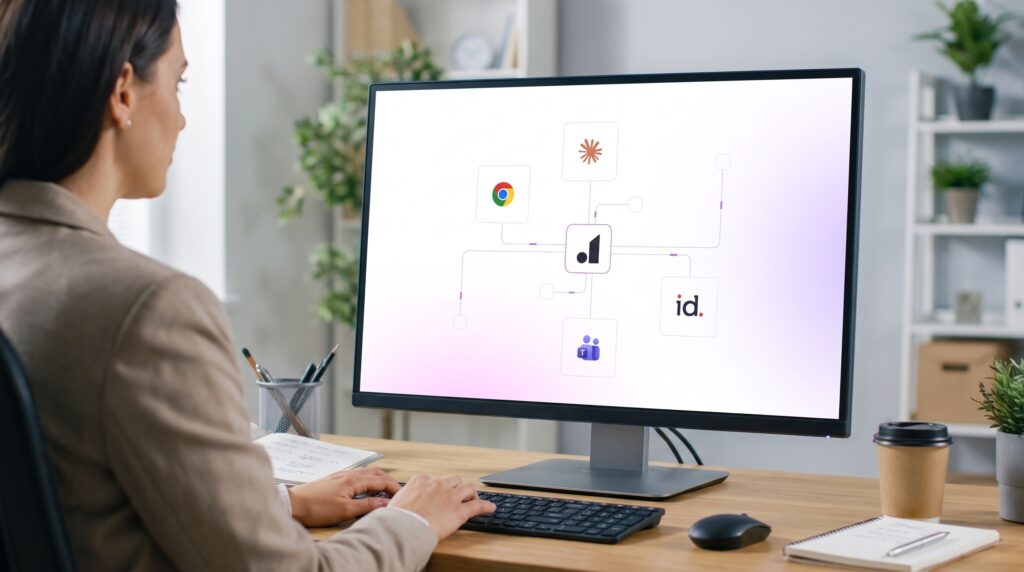
An open API connects your stack by letting each tool trigger actions in the others, in real time. A typical agency runs email, a phone system, a job board poster, a scheduling tool, and a CRM. Left unconnected, every one of them turns into another place to update by hand.
That sprawl is growing again. Companies now deploy an average of 27 AI-powered SaaS apps, and portfolios are expanding after two years of trimming. More tools without more connections means more busywork, not less.
Here is what an API integration platform makes possible across a recruitment workflow:
- A candidate applies on your site, and their details create a new person record automatically.
- A job board or LinkedIn integration pushes interested candidates straight into your pipeline.
- Your phone and email tools log every call and message against the right contact.
- A client portal pulls live shortlist updates, so clients see progress without a status email.
Connected this way, the stack updates itself. An AI-powered recruitment platform like Atlas is built for exactly that. It removes admin through agentic AI. Native integrations for the email, phone, video, and productivity tools you already use sit alongside an open API for anything custom.
Where does a connected stack save your team the most time?
The biggest savings come from admin that never needed a human: data entry, status updates, note logging, and scheduling. These tasks eat hours that should go to candidates and clients.
The scale of that drain is well documented. Recruiters lose an average of 17.7 hours per vacancy to manual admin, more than two working days per hire. On top of that, 61% point to manual data entry as a top reason hiring slows down.
Agencies that close those gaps see it in the numbers. Ocean Red Partners grew billing by 85% after consolidating their workflow and cutting tools. Attis increased CVs sent by 44% and won 35% more clients once their systems worked together.
This is where recruitment automation earns its keep. With connected data flowing through the API, AI agents can tag candidates, sync salaries, draft outreach, and book meetings. No recruiter has to lift a finger. Ethea Solutions used a connected workflow to grow BD outreach by 500% and save 15+ hours a week.
Which recruitment CRM has the API integration your agency needs?
The right recruitment CRM treats its API as a core feature, not something bolted on for enterprise buyers who ask. When you assess a CRM for recruitment agencies, look past the feature list to how open the platform really is.
A few things separate a genuinely connected system from a closed one. It should expose documented endpoints for the records you care about. An open API should let non-developers connect tools through no-code options like Zapier or Make. And it should ship with native integrations for the phone, email, job board, and scheduling tools your desk lives in. And it should move your history over cleanly. Getting the data migration right matters as much as the API itself.
Watch for AI that is built in rather than bolted on, since retrofitted features rarely share data cleanly. The wrong setup leaves you with a recruitment tech stack that holds the team back. An open one powers real analytics dashboards that pull from every stage of your pipeline. That difference compounds as you scale.
Frequently asked questions (FAQs) on CRM API integrations
A CRM API lets other software talk to your recruitment CRM without a person in the loop. An outside tool can read your data or add to it by following rules the CRM publishes. In practice, a new candidate or an update moves between systems on its own.
Not always. No-code tools like Zapier or Make let you connect a CRM to other apps through a visual, drag-and-drop interface. AI-assisted coding tools also let non-developers build working integrations by describing what they want in plain language. A developer helps for complex custom work, but plenty of agencies start without one.
An API is the connection point a piece of software exposes, and an integration is what you build with it. Think of the API as the socket and the integration as the appliance you plug in. One tool can offer an API that powers many different integrations.
An open API feeds automation with live, connected data, which is what makes it reliable. When your tools share one source of truth, automated actions fire on accurate information. Without that connection, automation runs on stale records and creates more cleanup than it saves.
Reputable platforms secure API access with keys that identify your agency and can be revoked at any time. You control which tools get a key and what they can access. Treat those keys like passwords, and keep them out of public or shared locations.
Yes. A well-built API and a solid migration process move your candidate records, notes, emails, and client history into a new system. That keeps your database intact and your team productive from day one. You avoid losing months of context in the switch.
Why the best-run desks let the software do the admin
The agencies pulling ahead are not working longer hours. They have handed the repetitive admin to software that runs in the background. It moves data between tools while recruiters focus on people. Agentic AI is what makes that possible. It acts on your data the moment it changes, rather than waiting for someone to update a field.
Built on that model, Atlas is an AI-powered recruitment platform. An open API and agentic AI keep your whole stack in sync without the manual work. If your team still spends its days updating records instead of placing candidates, a connected stack is worth a look.