










// Recruitment Technology, Sourcing Strategies
Candidate Contact Data: Why You Run Three Tools and Still Complain
Published: 07 October 2026,
8 min to read
Coverage claims and the third subscription nobody audits
Three subscriptions, one shared seat, and a recruiter who still asks the candidate for their mobile on the first call. Most mid-sized agencies now run two or three B2B contact database providers side by side. The complaint is rarely about one vendor in particular. It comes from buying coverage on faith, then finding the gaps on live roles.
56.16% of agency recruiters report a functional but fragmented tech stack. Candidate contact data is where that fragmentation turns costly. Every gap looks like a reason to add another tool from a crowded market of contact database providers. Almost nobody measures whether the new one covers the desks that actually bill. So the stack grows and the hit rate stays a mystery.
Why do contact data hit rates vary so much by niche?
Because the people behind the records behave differently, and a record is only a snapshot of that behavior. A provider’s aggregate coverage figure averages markets that have nothing to do with each other. That makes it useless for predicting your own results. The clearest proxy is how often your target population moves.
Median job tenure in the US tells that story. It runs 2.1 years in leisure and hospitality against 5.7 years in mining and oil and gas extraction. A hospitality desk’s records decay almost three times faster than an energy desk’s, on identical data from one vendor. That is the same mechanism behind data decay. It also explains why two teams in one agency rate the same subscription completely differently.
Four variables move the number more than anything a sales deck mentions:
- Geography, where coverage built on US filings thins out quickly across APAC and continental Europe
- Seniority, where C-suite records are guarded and mid-level records are abundant
- Record type, since an email pattern can be inferred from one colleague while a personal mobile cannot
- Recency, because a contact captured in a hiring boom ages differently to one captured in a freeze
What makes a mobile number harder to source than a work email?
Work emails follow patterns and mobiles do not. Once a provider knows one address at a company, it can infer the format for everyone else. Bulk verification then confirms it cheaply. A personal number has no format to guess and no public directory behind it. No bulk check confirms it belongs to the person you want.
Even a correct number is only permission to try. Eight-in-ten Americans say they do not generally answer their cellphone when an unknown number calls. A verified mobile proves the number exists and nothing more. A recruiter who treats verification as reachability will forecast on dials that never connect.
The practical gap between the two record types looks like this:
- Email formats can be inferred from a single known colleague, then verified at scale
- Mobiles get ported, replaced and unlisted, with no equivalent bulk verification
- Direct dials frequently resolve to a switchboard or a desk nobody sits at now
- Personal numbers carry consent obligations that a work address does not
How much does poor data quality actually cost a desk?
More than the subscription, and the overspend lands where no invoice records it. A cheap record priced per credit looks efficient at first. Then a recruiter spends forty minutes chasing a number belonging to somebody who left in 2023. That time is billable capacity, the most expensive input on the desk.
Bad addresses do quieter damage. Bounced sends erode the sending reputation your whole team depends on. One badly sourced campaign can degrade email deliverability for everyone. Accurate contact details compound in the other direction.
Ethea Solutions saw candidate response rates climb by 50% across APAC markets where reaching talent traditionally takes more effort. They ran structured multi-touch outreach rather than more volume. Reachability improves faster through better records than through extra send volume.
The costs worth tracking never appear on a renewal quote:
- Dial time burned on dead numbers
- Sender reputation damaged by bounced sends
- Duplicate records created when two vendors disagree about one person
- Candidate trust lost when a personal number rings a former employer
Which benchmark should you run on B2B contact database providers?
Give every provider the same list of people you are actually trying to reach, and score what comes back. A trial that lets the vendor pick the sample measures their best market. The test takes an afternoon. It settles arguments that would otherwise run for years.
Run it like this:
- Pull 200 real people from live roles across your two busiest niches, in the geographies you genuinely cover
- Ask each provider to return records for that exact list, rather than a sample they select
- Score work email, personal email and direct mobile separately, because one blended figure hides the weakness
- Dial and send a portion of the results, since a verified flag is a claim and not an outcome
- Re-run it each quarter, as coverage shifts with every refresh cycle
What does that test usually reveal about your own data?
That your highest hit rate already sits in data your team generated and never captured. Every recruiter’s inbox holds numbers and addresses no provider sells. They sit in signatures, reply threads, call notes and old shortlists. On a target list drawn from your own niche, that material usually beats anything you can buy.
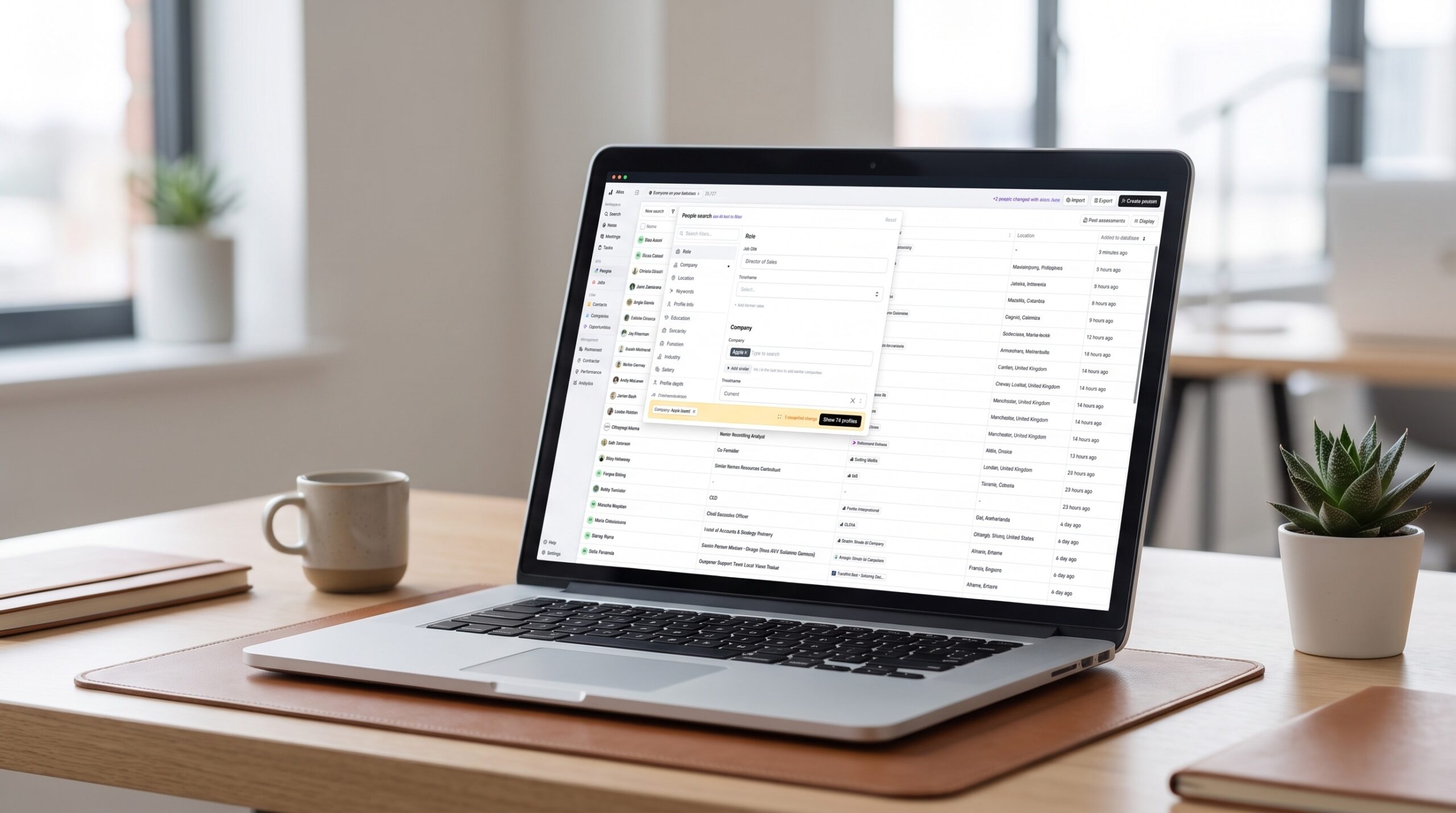
Turning it into a searchable asset is the part agencies skip, because doing it by hand is unthinkable at scale. That capture is what Atlas handles on its own. The AI-powered CRM and recruitment platform uses agentic AI to strip admin out of agency workflows. It connects to Gmail and Outlook and pulls every person your team has ever emailed into the database. Resumes are parsed on arrival, so contact details enter the record correctly the first time.
Role and company changes are tracked in real time, which keeps records current without anyone maintaining them. The result is a candidate database you can search in plain language, where the contact data improves every time somebody does their job.
Frequently asked questions (FAQs) on B2B contact database providers
Most agencies need fewer than they run. Two providers with genuinely different sourcing methods usually outperform three that license overlapping data. The only way to know is to score them on one shared target list. Consolidating also removes the duplicate records that appear when vendors disagree.
It depends so heavily on market and seniority that any single figure misleads. Mobile coverage runs consistently lower than work email coverage. It falls further for senior people and for markets outside the US. Treat a vendor’s blended number as a starting question and measure your own niche first.
Timebox it and fix the sample before any vendor is contacted. Most trials stall because each provider is assessed on different people at a different moment, which makes the results impossible to compare. Decide the scoring rules in advance and hold every vendor to the same deadline.
Frequently, because the price per record ignores the recruiter time spent on wrong numbers. A low-cost credit that resolves to a stale record consumes dial time and damages sender reputation. It also pollutes the database with duplicates. Cost per successful conversation is the metric that matters.
Both, in that order of priority. Your own conversations, emails, call notes and placements are the highest-quality contact data you will hold. Bought data is best used to fill the gaps around it. Agencies that capture their first-party data automatically depend far less on external coverage.
Continuously, and at a rate set by your market rather than a calendar. High-turnover sectors invalidate records within a couple of years, while stable industries hold far longer. Systems that track role and company changes as they happen remove the need for periodic clean-ups.
The case for fewer tools and fresher contact data
Stacking B2B contact database providers on top of each other does not add up to coverage. It adds up to three invoices and a blended hit rate nobody has measured. The agencies that fix this stop shopping and start testing, on their own list, in their own markets.
There is a structural fix underneath the buying decision. When capture, enrichment, search and outreach run in one platform, contact data stops being something you rent. It becomes something your team accumulates. That principle is what Atlas was built on, and the database updates itself while recruiters work.
Worth a look the next time a fourth subscription lands on your renewal list.