










// Recruitment Technology, Software Comparisons
Best Candidate Search & Sourcing Tools — and How to Choose the Right Type
Published: 02 October 2026,
13 min to read
Recruiters shopping for “candidate search tools” or “best candidate sourcing tools” often get pulled into the same scoreboard: who claims the largest external profile index. That framing misses a real buying decision. Some tools search your ATS or CRM. Others sell access to external people databases and outreach. A third group mainly finds emails and phone numbers. Mixing those jobs creates expensive stacks that still leave placements buried in dormant records.
This guide is a commercial-investigation shortlist by tool type and fit—not a vanity #1–#10 ranking. It covers how to choose between internal ATS/CRM people search, outbound AI sourcing platforms, and (briefly) contact-info finders. Atlas appears where it belongs: as internal people search inside an agency ATS/CRM, via Atlas People Search (also called Magic Search)—the same feature. Deep product detail lives on the recruitment database software page; a supporting explainer is Atlas People Search.
Who this guide is for
Agency desks and in-house talent teams comparing search/sourcing software before a buy or stack redesign. You will get the most from this page if:
- You already store candidates in an ATS/CRM and suspect strong people are hard to retrieve.
- You are evaluating outbound people-search platforms (SeekOut-, Gem-class, and other outbound AI sourcing platforms) and need an honest split from internal search.
- You want evaluation criteria and fit scenarios—not a fake universal ranking.
If your only problem is “I need verified personal emails/phones for people I already found,” jump to the adjacent contact-info finders section. That is a different purchase.
Three types of “candidate search” tools (do not conflate them)
1) Internal ATS/CRM candidate search
What it is: AI or advanced search over candidates you already own—sourced, placed, spoken to, or applied—inside your ATS/CRM (or a search layer on top of it).
Job to be done: Re-find and shortlist from dormant or unevenly tagged records; reduce Boolean/taxonomy tax; explain why someone matches.
Examples of the category: Atlas People Search (same feature as Magic Search); ATS-search products such as Candidate Search AI (vendor-stated: natural-language search over an existing ATS database).
2) Outbound people-search / AI sourcing platforms
What it is: Platforms that index or access large external talent pools, often with semantic search, filters, and outreach workflows. Some also rediscover past ATS applicants.
Job to be done: Find net-new passive candidates beyond your database; run multichannel outreach; sometimes unify external + ATS search.
Examples of the category (vendor-stated positioning): SeekOut Recruit (vendor-stated: search across a large external profile index and ATS); Gem AI Sourcing (vendor-stated: AI sourcing agent over a large profile index plus ATS/CRM rediscovery); and other outbound AI sourcing / AI people-search platforms (vendor marketing commonly emphasizes large external indexes and outreach—treat index sizes as vendor-stated / not independently verified here).
3) Contact-info finders (adjacent)
What it is: Tools whose primary job is enriching email, phone, or social contact for identified people or lists.
Job to be done: Reach people you already decided to contact—not discover who fits a role from first principles.
Why adjacent here: “Best software for finding candidate contact info” is a distinct commercial intent. It is acknowledged below and in FAQs, not treated as the primary shortlist this page optimizes for.
How we evaluate (transparent criteria—no fake universal score)
We do not assign #1–#10 ranks. Buyers should score tools against the problem they actually have.
| Criterion | What to ask | Why it matters |
|---|---|---|
| Data scope | Internal-only, external index, or both? | Prevents buying an outbound DB when the bottleneck is “can’t find people we already have.” |
| Search UX | Natural language, Boolean, manual filters, or combination? | Desk adoption depends on how recruiters actually brief a role. |
| Explainability | Match rationale, evidence, adjustable criteria? | Trust and client-facing confidence. |
| Outreach needs | Built-in sequences / enrichment vs search-only? | Outbound platforms often win when engagement is in-scope; internal search may pair with separate outreach. |
| Integration model | Native ATS/CRM feature vs add-on on existing ATS vs full platform | Implementation cost and data ownership. |
| Team shape | Agency desk vs in-house TA; shared database discipline | Agency CRM reuse vs enterprise inbound volume. |
| Pricing model | Per seat, credits, bundled platform, sales-led | Contact vendor for current pricing; confirm the unit (seat, credit, or bundle) before buy. |
| Compliance / data handling | Where data lives; enrichment sources | Especially for external indexes and contact finders. |
Methodology note: Competitor profile-index sizes and ROI stats on vendor sites are COMPETITOR_OBSERVATION / vendor-stated. They are attributed that way below—or omitted—rather than treated as verified facts for Atlas marketing.
Quick comparison by tool type
| Tool / class | Type | Best for | Search focus | Outreach / enrichment | Pricing (public) | Notes |
|---|---|---|---|---|---|---|
| Atlas People Search | Internal ATS/CRM people search (native in Atlas) | Agencies that need to search candidates already sourced, placed, or spoken to | Plain-language + manual filters + Phrase Match; optional deeper assessment with explanations (same feature also called Magic Search) | Not positioned as an outbound mega people-search DB | Contact vendor for current pricing | Primary product page: recruitment database software |
| Candidate Search AI (Candidately) | Internal ATS search add-on | Teams that keep their ATS and want natural-language search over that DB | Vendor-stated: natural language + filters over connected ATS | Vendor-stated outreach/automation options on product site—verify before buy | Contact vendor for current pricing | Category peer for internal search; see candidatesearch.ai |
| SeekOut Recruit | Outbound + unified search | Teams needing external discovery (and often ATS rediscovery) at scale | Vendor-stated: semantic search across large external index + ATS | Vendor-stated: outreach campaigns / contact workflows | Sales-led / contact vendor for current pricing | Vendor-stated index size on product pages (e.g. “1B+” style claims)—not independently verified here |
| Gem AI Sourcing | Outbound AI sourcing + CRM/ATS workflows | Teams wanting sourcing agent + rediscovery + outreach in one workflow | Vendor-stated: conversational/AI sourcing over large profile index + past applicants | Vendor-stated: personalized outreach; verified contact claims on marketing pages—verify | Sales-led / contact vendor for current pricing | Vendor-stated “800M+” profile claims—vendor-stated only |
| Other outbound AI sourcing / AI people-search platforms | Outbound AI sourcing / people search | High-volume or workflow-heavy TA orgs evaluating external discovery + outreach | External indexes and/or ATS rediscovery (typical category promise—confirm on each vendor site) | Outreach / engagement automation commonly emphasized—confirm per vendor | Contact vendor for current pricing | Category peers on commercial SERPs; do not invent index sizes, ratings, or ROI here |
| Contact finders (Lusha, RocketReach, Hunter, Skrapp, etc.) | Contact enrichment (adjacent) | Enriching email/phone for known targets | Not primarily “who fits this role” discovery | Core job | Varies / credits — check with vendor | Adjacent intent only |
Shortlist by archetype
Archetype A — Internal AI ATS/CRM search
Choose this class when: The expensive problem is retrieving people already in the system—uneven tagging, Boolean fatigue, junior vs senior search inconsistency, or “we sourced them last year and can’t find them.”
Atlas People Search (also called Magic Search)
Atlas People Search is the candidate search capability inside Atlas’s recruitment database / CRMx. People Search and Magic Search are the same feature. After this sentence, this article uses People Search as the display name (including in tables).
What Atlas pages state (capabilities—not inferred extras):
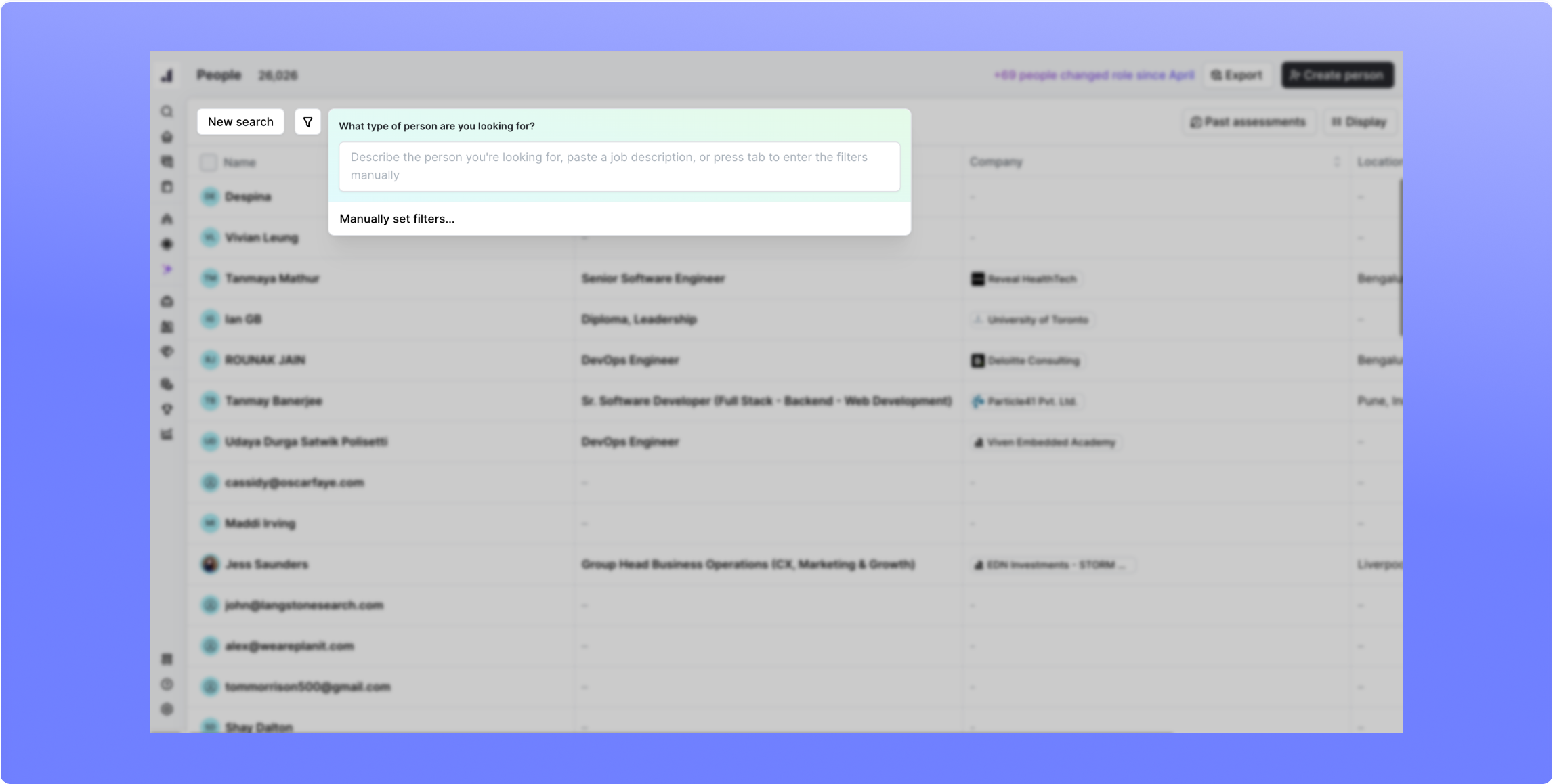
- Describe who you need in plain language (or paste a brief / job description); Atlas builds searchable criteria from that description.
- Search across the shared database of candidates the team has sourced, placed, or spoken to.
- Use a full manual filter suite (role, company, location, seniority, education, industry, and more) when you want precision control.
- Use Phrase Match to require phrases, accept alternatives (any-of groups), and exclude disqualifiers.
- Review and adjust AI-generated filters before running; repeat past searches without rebuilding from scratch.
- Resolve time/context cues such as company milestones, funding rounds, or career stages into search criteria (as described on Atlas product pages).
- As stated on the recruitment database software page: expand or tighten role/company/industry variations (e.g., “Add similar”) so exact-title matching does not dominate.
- On the Magic Search presentation of the same feature: natural language or voice; match percentages with evidence-backed explanations; search across structured and unstructured material the company has captured (e.g., resumes, notes, calls, messages—as stated on Atlas pages); refine without rewriting the whole request.
What Atlas is not (honest boundary): Atlas People Search is not an outbound SeekOut-/Gem-class people-search database of hundreds of millions of external profiles. Do not evaluate it as one.
Learn more: Recruitment database software (primary) · People Search explainer · same-feature alternate URL: Magic Search
Supporting POV (why taxonomy-only search fails): Skill tagging vs searchable meaning
Candidate Search AI (category peer)
Candidate Search AI positions itself as an AI search engine for your existing ATS: connect ATS, index profiles, search in natural language, combine with filters/custom fields, and show evaluation reasoning (vendor-stated). Marketing ROI stats on that site are vendor-stated and are not reused here as Atlas proof.
Fit tip: If you will not move CRMs, an ATS-search add-on may be the internal-search path. If you want search native to an agency-oriented platform, evaluate Atlas People Search in that frame instead.
Archetype B — Outbound AI sourcing platforms
Choose this class when: You need net-new passive talent, broad external coverage, and often built-in outreach—especially when your owned database cannot supply the role.
Describe these vendors honestly as outbound / unified sourcing tools. Index sizes below are vendor-stated on primary marketing pages as of research fetch (2026-09-30); treat as unverified for Atlas claims.
SeekOut Recruit
Vendor-stated positioning includes AI search across a large external candidate index and ATS, inbound evaluation, outreach at scale, and ATS rediscovery (SeekOut Recruit). FAQ/marketing copy references search across nearly one billion / “1B+” profiles—vendor-stated; not independently verified here.
Best-for sketch: Enterprise or scaled TA teams that need external discovery plus ATS silver-medalist rediscovery in one workflow.
Gem AI Sourcing
Vendor-stated positioning: AI Sourcing Agent that matches candidates to roles, searches a large profile index, rediscovers past ATS/CRM applicants, and personalizes outreach (Gem AI-powered sourcing). Marketing pages state “800M+” profiles—vendor-stated only.
Best-for sketch: Teams that want sourcing + relationship history + outreach in a CRM/ATS-centric workflow.
Other outbound AI sourcing / AI people-search platforms
Beyond the named SeekOut and Gem examples above, the same outbound AI sourcing / people-search conversation on commercial SERPs includes additional platforms that emphasize large multi-source indexes, semantic search, and outreach automation. Treat them as a category, not as individually endorsed shortlist picks here. Do not invent profile counts, G2 scores, or ROI. Confirm current claims and pricing on each vendor’s primary site before purchase decisions.
Archetype C — Contact-info finders (adjacent intent only)
Tools such as Lusha, RocketReach, Hunter, Skrapp, and similar products primarily enrich contact details. They are useful after you know who to reach. They are not substitutes for internal ATS people search or for full outbound sourcing platforms.
If Watchtower-style demand for “best software for finding candidate contact info” matters to your stack, evaluate enrichment beside—not instead of—search/sourcing. Atlas should not be pitched as winning that cluster by default.
When to use both (owned database first, then outbound)
A practical sequence for many agency and TA teams:
- Search what you already paid to collect with strong internal people search (Atlas People Search or an ATS-search peer).
- Fill gaps with outbound people-search / LinkedIn Recruiter-class tools when the role truly needs net-new coverage.
- Enrich contacts only for the shortlist you intend to engage, if your sourcing stack does not already include reliable contact data.
Outbound databases remain complementary. Internal search does not replace LinkedIn Recruiter or SeekOut-class coverage when the talent is not in your CRM. Conversely, buying a large external index does not fix a CRM you cannot search.
For Atlas’s broader built-in AI sourcing feature set (Atlas-only roundup—not this multi-vendor shortlist), see the descriptive page on Atlas AI sourcing capabilities. For buyer education on what sourcing software should do inside a database you own, see candidate sourcing software.
Buyer checklist and mistakes to avoid
Checklist
- [ ] Name the primary failure mode: “can’t find owned candidates” vs “need net-new outbound” vs “need emails/phones.”
- [ ] Require a clear data-scope answer (internal / external / both) in every demo.
- [ ] Ask how matches are explained and whether criteria are editable before run.
- [ ] Test shared-database behavior (team-added candidates searchable).
- [ ] Map outreach: included, integrated, or separate tool.
- [ ] Confirm pricing unit (seat vs credit vs platform bundle) in writing.
- [ ] For external indexes: ask how data is sourced, refreshed, and governed—not only “how many profiles.”
- [ ] For Atlas: evaluate People Search as internal database search via the recruitment database software page—not as an outbound mega-DB.
Mistakes to avoid
- Treating profile-count marketing as the only scoreboard when your pain is dormant CRM search.
- Rewriting your evaluation around contact finders when discovery/search is the real gap.
- Assuming AI search on an ATS add-on and native CRM search are operationally identical without testing data quality and workflow.
- Expecting internal search alone to replace outbound coverage for brand-new markets.
- Comparing Atlas to SeekOut/Gem on external index size—that is the wrong axis.
FAQs
Candidate search tools help recruiters find suitable people for a role. In practice the category spans (1) search over an internal ATS/CRM database, (2) outbound people-search / sourcing platforms with large external indexes, and (3) related contact-info finders. Buying well starts by naming which job you need.
Search usually means retrieving and ranking people against a brief (from owned data, external indexes, or both). Sourcing usually emphasizes proactive outbound discovery and engagement. Overlap is common—many “sourcing” platforms include search, and strong internal search can reduce fresh outbound—but the commercial intents are not identical. This page compares both under a type-based shortlist.
ATS/CRM search runs on candidates your organization already holds (applications, sourced profiles, notes, prior placements). Outbound people-search databases provide access to large external talent indexes you did not collect yourself, often with outreach. Cost, privacy, coverage, and workflow differ. Atlas People Search sits in the internal-search class.
If consultants cannot reliably retrieve people already in the CRM, prioritize internal people search first. If the desk needs continuous net-new passive coverage and sequenced outreach, evaluate outbound platforms. Many agencies eventually use both: owned-database search for speed and margin, outbound tools for coverage gaps.
Often yes, for complementary jobs. AI search over your ATS/CRM improves reuse of owned relationships; LinkedIn Recruiter-class products remain common for live external market access and InMail-style workflows. Treat them as stack companions unless a specific outbound platform fully replaces that channel for your team—which you should validate in workflow, not assume from a landing page.
They are the same feature. Atlas People Search (also called Magic Search) is AI/natural-language people search over the agency’s existing Atlas database—not an outbound hundreds-of-millions people-search DB. Primary product page: recruitment database software. Supporting explainer: candidate search tools / People Search. Same-feature alternate URL: Magic Search.
Prioritize data scope (internal vs external), search UX (natural language + control), explainability, outreach needs, integration model, team shape (agency vs in-house), pricing unit, and compliance. Prefer fit scenarios over universal #1 lists.
No. Contact finders enrich how you reach someone. Candidate search/sourcing tools help determine who belongs on the shortlist. You may need both; they are not interchangeable.
When the dominant problem is “we can’t find people we already have”—empty skill tags, Boolean-only CRM search, or inconsistent junior/senior retrieval. In that case, fix or upgrade internal search before adding another external index.
Patterns vary: per-seat platform fees, credit-based enrichment, bundled AI modules, and sales-led enterprise contracts are all common. No Atlas price is stated here. Contact the vendor for current pricing.
Next step
If your shortlist problem is finding placements already sitting in your database, evaluate Atlas People Search in its proper category—internal ATS/CRM people search—on the primary product page:
Recruitment database software — Atlas People Search
For a deeper product explainer (not this multi-vendor shortlist), read Atlas People Search.