









// Recruitment Influencers
The Atlas30 for June: Recruitment Influencers Shaping the AI Conversation
Published: 09 July 2026,
9 min to read
June sat at the midpoint of the year, and for agency recruiters, that timing mattered. Mid-year targets came into sharper focus, and many desks used the weeks before summer to stress-test their approach against real results. Looking back at the month now, a handful of posts capture exactly where recruiters’ attention was.
This edition of the Atlas30 revisits those posts. Each edition spotlights the recruitment voices bringing genuine value to agency professionals through their content, and June’s lineup leaned heavily into how AI in recruitment is changing the way desks operate. From smarter use of an AI-powered CRM to sharper thinking on outreach and candidate engagement, these are the posts worth a second look.
Fresh thinking and proven tactics from June 2026’s top recruitment influencers
Hishem’s case for protecting culture before you ever need to rebuild it
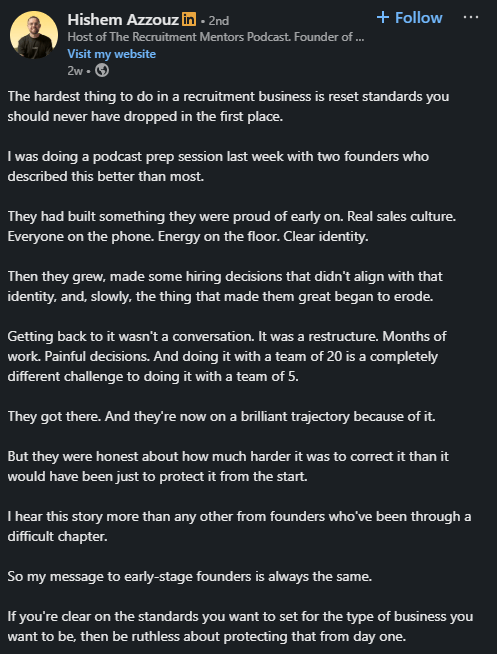
Hishem’s post looks back at a podcast prep session with two founders who had built something strong early on: real sales culture, energy on the floor, a clear sense of identity. That clarity slipped as they grew and made hiring calls that didn’t match it. The value in the post is watching how deliberately he traces that decline, because most agency leaders recognize the pattern the moment he names it.
What makes the post land is the honesty about what came next. Getting back to their original standard took months of restructuring and painful decisions, and doing that with a team of 20 carried a different weight than doing it with a team of five.
Hishem’s point cuts through the usual growth-at-all-costs messaging: correcting course after the fact is far harder than holding the line from day one. For agency leaders scaling headcount or opening new desks, it’s a timely reminder to check hiring decisions against the culture they’re meant to protect.
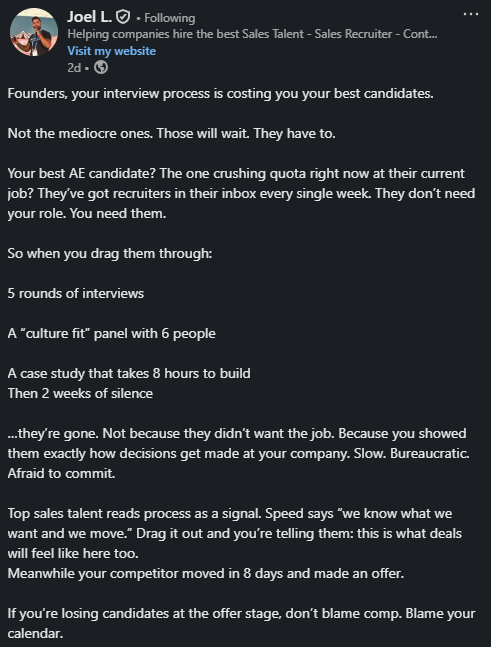
Joel’s warning about what a bloated interview process signals to top talent
Joel’s post makes a sharp argument about why strong candidates disappear mid-process, and it isn’t about compensation. Top performers, the ones already crushing quota at their current job, have recruiters reaching out every week. They don’t need a role, so a drawn-out process reads as a signal rather than a formality.
Joel breaks down what that signal looks like in practice: five rounds of interviews, a six-person culture fit panel, an eight-hour case study, then two weeks of silence. The insight that lands hardest is what candidates take from that experience. Speed tells a candidate a company knows what it wants and moves fast.
A slow, bureaucratic process tells them the opposite, and top talent reads that as a preview of what working there will actually feel like. Agency recruiters spend plenty of time managing client expectations around process length, and Joel’s framing gives them a sharper way to push back when a client wants to add another round.
Ben’s reminder to sanity-check requirements before they go live
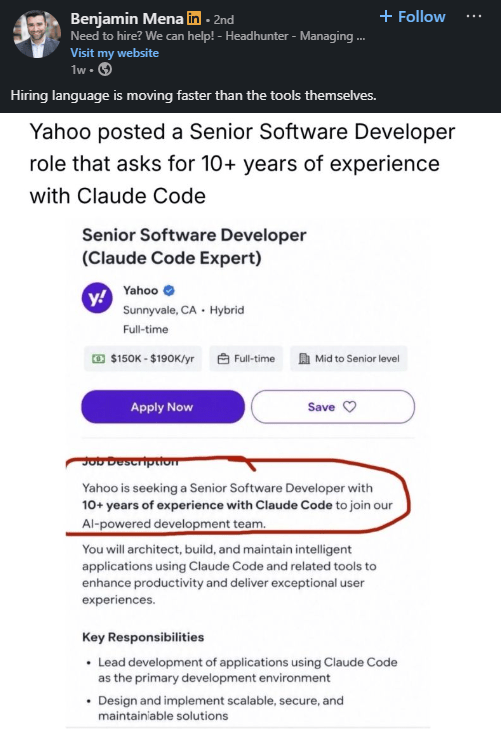
A Yahoo job posting for a Senior Software Developer asked for 10+ years of experience with Claude Code, a tool that has existed for a fraction of that time. Ben’s framing gets straight to it: hiring language is moving faster than the tools themselves, and nobody caught it before the post went live.
The moment is amusing, but the underlying lesson matters for anyone writing requirements on behalf of a client. AI tools and platforms change fast, and a hiring manager drafting a job description doesn’t always track how long something has actually existed before setting an experience threshold around it.
A recruiter reviewing that brief before it goes to market is the last line of defense against a requirement that quietly makes the role impossible to fill. Catching an error like this early saves the awkward conversation later, when qualified candidates start asking how anyone could possibly meet the bar.
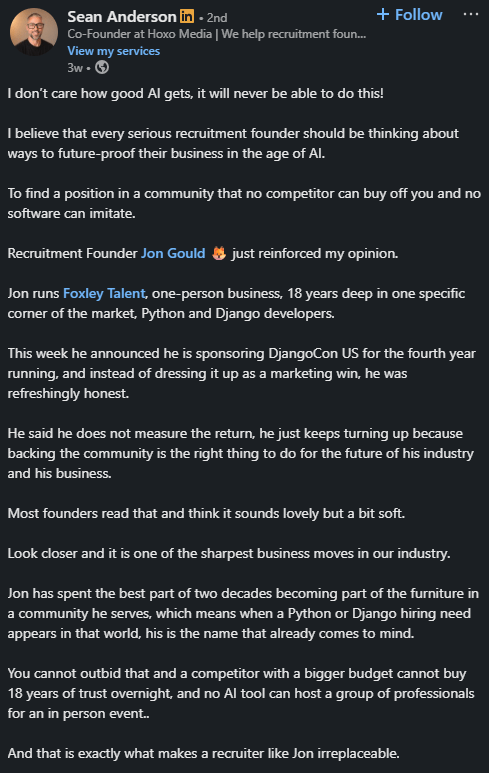
Sean’s take on why community roots beat any AI tool
Sean’s post centers on a recruitment founder, Jon, who has spent 18 years building a one-person business around a single niche: Python and Django developers. Jon recently announced he is sponsoring DjangoCon US for the fourth year running, and what stands out is his honesty about why. He doesn’t measure the return. He shows up because backing that community matters for the industry and his business, full stop.
Sean’s argument builds from there, and it’s a compelling one for anyone thinking about how AI reshapes recruitment. Eighteen years of trust inside a niche community can’t be bought or automated.
A bigger competitor budget doesn’t close that gap, and no AI tool can replicate the standing that comes from being a known, trusted presence at an in-person event year after year. When a Python or Django hiring need surfaces in that world, Jon’s name is already the one people think of. As AI capability keeps climbing, the moves that hold up best might be the ones no algorithm can copy: deep community roots built over years, not months.
Andrew on why the least interested candidate often wins the role
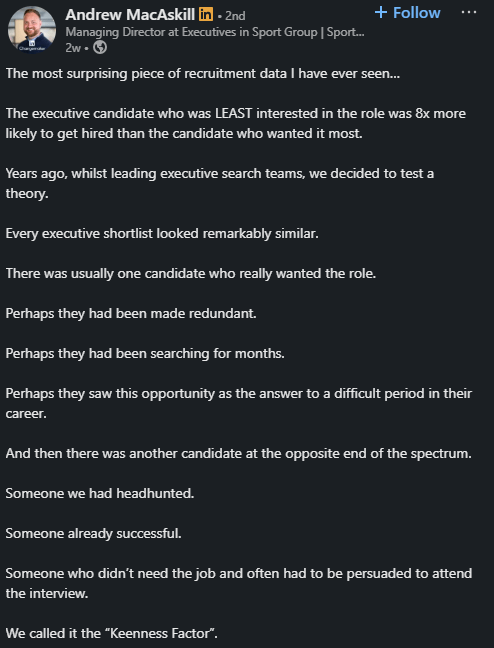
Andrew’s post shares a finding from years of leading executive search teams. It runs against instinct. The executive candidate who seemed least interested in a role was eight times more likely to get hired than the one who wanted it most.
His team noticed a pattern across shortlists. One candidate was desperate for the opportunity, often coming off redundancy or a long search. Another had been headhunted, was already successful, and sometimes needed convincing to show up for the interview. Andrew’s team called it the Keenness Factor.
The finding challenges a habit that’s easy to fall into on executive search: reading enthusiasm as a green flag. Andrew’s data suggests hiring managers often read desperation as a red flag instead, whether consciously or not. They reward the candidate with the least to lose by walking away. For anyone running executive search, it’s worth watching for on future shortlists, especially when a client seems drawn to the candidate pushing hardest.
Practical playbooks from June 2026’s top rising recruitment influencers
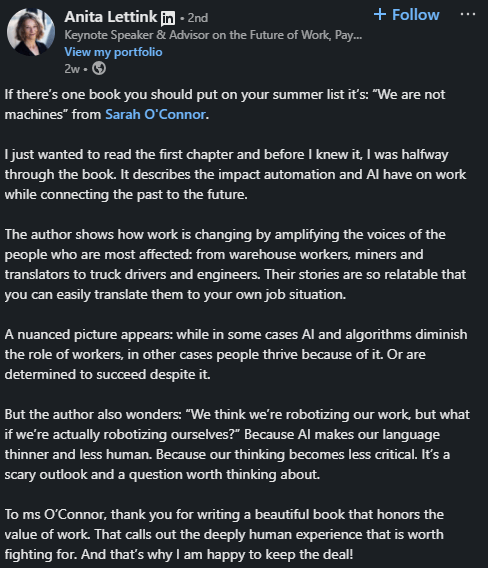
Anita’s case for reading “We Are Not Machines” this summer
Anita’s post is a book recommendation with real substance behind it. She points readers toward “We Are Not Machines” by Sarah O’Connor, a book that traces how automation and AI are reshaping work by centering the voices of the people most affected by it.
Warehouse workers, miners, truck drivers, and engineers all feature, and Anita notes how easily their stories translate to a reader’s own situation, agency recruitment included. What she pulls from the book is a nuanced picture rather than a simple warning. AI diminishes some workers’ roles while others thrive because of it, or push through despite it.
The line she highlights from the author lands hardest: we think we’re robotizing our work, but what if we’re actually robotizing ourselves, as language gets thinner and thinking gets less critical. For agency recruiters navigating how much AI to lean on day to day, it’s a genuinely useful prompt to sit with.
Ben’s argument for becoming a consultancy, not just an agency
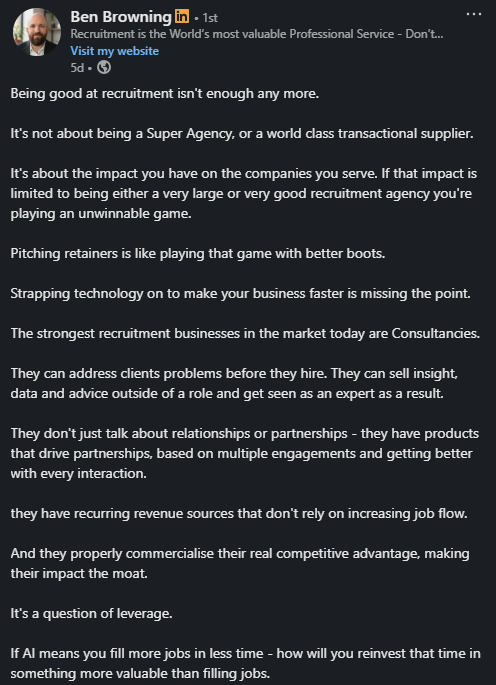
Ben’s post challenges the idea that being good at recruitment is enough on its own. Being a super agency or a world-class transactional supplier doesn’t guarantee impact on the businesses being served, and chasing that scale alone is a tough game to win.
Pitching retainers or bolting on new technology doesn’t change the underlying model. Ben’s argument is that the strongest recruitment businesses today operate more like consultancies. He breaks down what that looks like in practice.
These businesses solve client problems before a role even opens, sell insight and data as a service in its own right, and build products around partnerships rather than one-off placements. That creates recurring revenue that doesn’t depend on job flow constantly increasing, and it turns real expertise into a genuine competitive moat rather than a talking point.
Recruitment voice to tune into in June 2026
Rich Rosen on working harder, not less, even with AI doing more
This episode of The Resilient Recruiter, hosted by Mark Whitby, features Rich Rosen, a recruiter with over 1,200 placements and seven consecutive years on Forbes’ list of America’s Top 50 Recruiters. What makes the conversation worth a listen is the surprising detail behind his strong year: he says he’s worked twice as hard for it, despite spending more time experimenting with AI and recruiting technology than almost anyone in the industry.
Rich’s view cuts against a common assumption about AI in recruitment. He doesn’t use it to work less. He uses it to eliminate low-value tasks, speed up research, and walk into calls better prepared, while still spending four to six hours a day on the phone with clients and candidates.
That’s the real value of the time AI gives back: reinvesting it into the highest-value work a recruiter can do, not stepping away from it. The conversation also covers why searches feel tougher than they did a few years ago, and what Rich is doing differently to keep producing results in a harder market.
The common thread running through June’s recruitment conversations
Agency recruiters looking to apply these lessons don’t need a complete overhaul. Reinvesting time saved into deeper client conversations, sanity-checking requirements before they go live, and holding a clear standard for the business, these are practical starting points drawn straight from this month’s standout posts.
Getting that balance right, using an AI-powered CRM to remove admin without losing the human judgment that makes recruitment work, is where the strongest desks are heading next. Atlas supports that shift by handling the busywork agentically, so recruiters can put their time back into the calls and relationships that build a business worth protecting.