









// Recruitment Influencers
The Atlas30: 30 Top Recruitment Influencers Worth Following This April
Published: 06 May 2026,
12 min to read
April marks the shift from Q1 momentum into the sharper, more decisive stretch of the year. For agency recruiters, it means pipelines are moving, hiring managers are more engaged, and the groundwork laid earlier is starting to convert.
The April 2026 Atlas30 highlights the top recruitment influencers sharing practical insights and fresh thinking on social media. Whether you’re refining your approach to AI-powered recruitment or looking for the edge that keeps your desk ahead of the market, these are the voices worth following right now.
Fresh Thinking and Proven Tactics From April 2026’s Top Recruitment Influencers
Hishem’s Case for Treating Recruitment as a Long Game
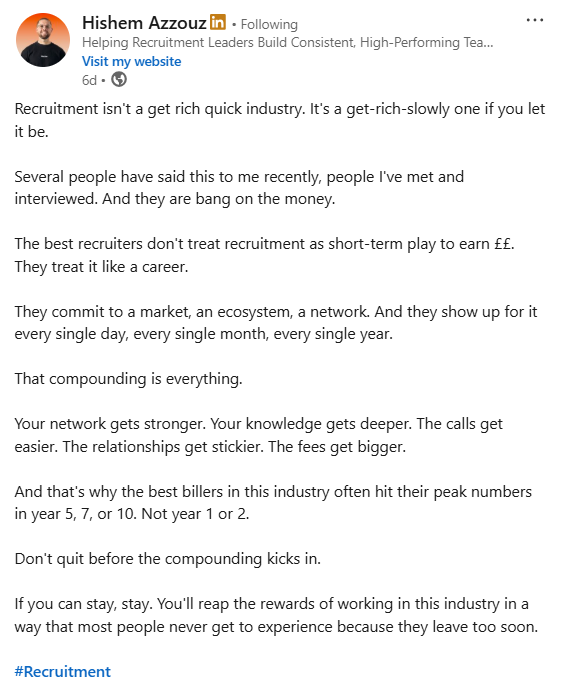
Hishem’s post starts with a simple truth: recruitment isn’t a get-rich-quick industry. It’s a get-rich-slowly one, if you let it be. It’s the kind of framing that stops the scroll because most recruiters have felt the tension between short-term pressure and long-term potential at some point in their career.
He isn’t talking about grinding harder or closing faster. He’s talking about what happens when you commit to a market, build a network over the years, and show up consistently enough that the relationships get stickier and the fees get bigger almost naturally.
The best billers, he notes, often hit their peak numbers in year five, seven, or ten, not year one or two.
Key takeaway: The recruiters who build the biggest desks aren’t the ones who burn brightest early. They’re the ones who stayed.
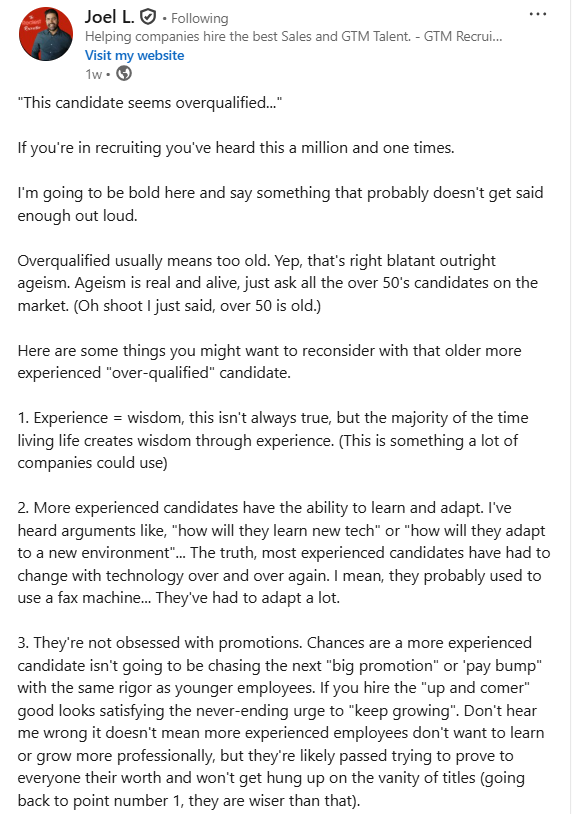
Joel’s 4 Reasons to Reconsider the “Overqualified” Candidate
Joel’s post opens with a phrase every recruiter has heard a hundred times: “This candidate seems overqualified.” He’s upfront about what that often really means: too old. It’s a rare moment of honesty about ageism in hiring.
He shares four points on why hiring managers and clients should think twice before passing on a more experienced candidate. They bring wisdom earned through real experience. They’ve adapted to new technology repeatedly throughout their careers.
They’re less focused on chasing titles or promotions. And on loyalty, Joel points out that if average tenure is two to three years anyway, keeping someone for five years until they retire is a win, not a risk.
Key takeaway: Joel’s 4 points make a compelling case: experienced candidates bring real wisdom, they’ve proven they can adapt, they’re not chasing promotions, and they tend to stay longer.
Benjamin on the Conversation Most Recruiters Are Too Scared to Have
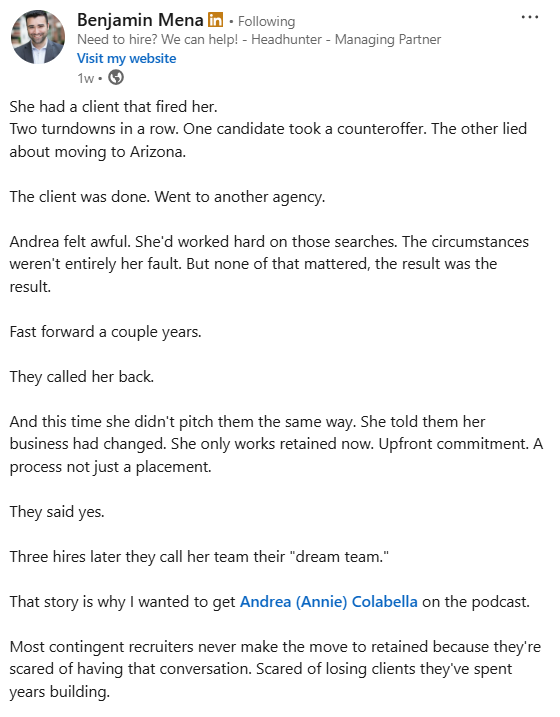
Benjamin opens with a story that a lot of agency recruiters will recognise. A client fires a recruiter after two turndowns in a row. The circumstances weren’t entirely her fault, but the result was the result. The client moved on. And then, a couple of years later, they called back.
What makes the story worth reading is what happened next. When the client returned, Andrea didn’t pitch them the same way. She told them her business had changed, retained only an upfront commitment, a process, not just a placement. They said yes. Three hires later, they call her team their dream team.
Benjamin uses this to make a point most contingent recruiters avoid. They never make the move to retained because they’re scared of losing clients they’ve spent years building. But as Andrea put it, the anticipation of the conversation is always worse than the actual conversation.
Key takeaway: Benjamin’s post is a reminder that switching to retained rarely costs you the clients you’re afraid of losing; it often leads to better relationships with them.
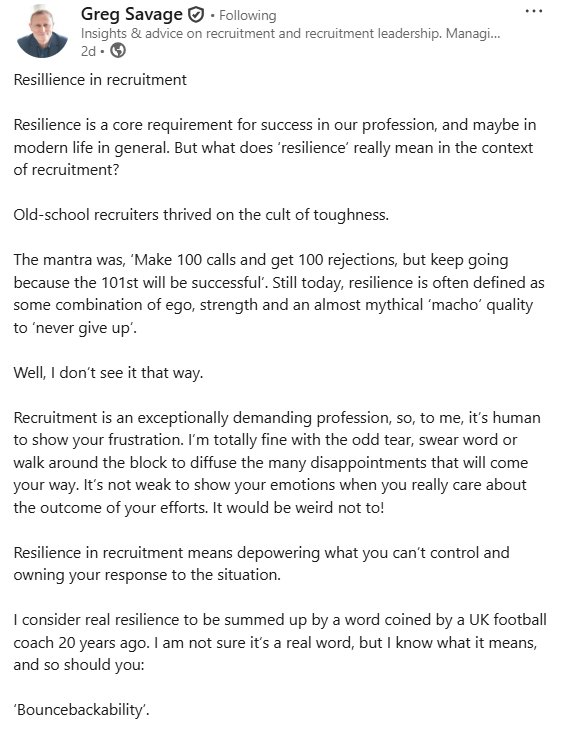
Greg’s Real Definition of Resilience in Recruitment
Greg challenges the traditional view that resilience means toughness, pushing through no matter what, and never showing weakness. In his view, that framing is outdated and not particularly useful for the modern recruiter.
What he offers instead is a more grounded perspective. Showing emotion when things go wrong isn’t a problem. What matters is the ability to recover quickly and walk into the next client call, candidate conversation, or colleague interaction completely fresh.
It’s not about having thick skin or suppressing how you feel. It’s about how fast you can reset, and whether the people around you ever have to carry the weight of your bad day.
Key takeaway: Resilience isn’t about pretending bad days don’t happen. It’s about making sure they don’t follow you into the next conversation.
Sean on Why Great Content Means Nothing Without Consistent Distribution
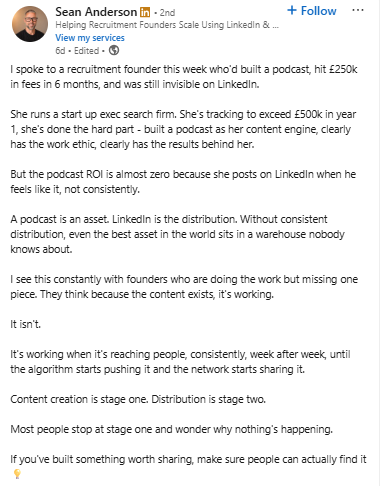
Sean’s post opens with a scenario many recruitment founders will recognise: someone with strong fees, a podcast, and a clear work ethic, but almost no LinkedIn presence. The results are there. Nobody outside their immediate circle knows it.
The point Sean makes is a simple one that’s easy to overlook. A podcast is an asset. LinkedIn is the distribution. Without consistent distribution, even the best content sits unnoticed.
Posting when it feels like it, inconsistently and without rhythm, means the algorithm never picks it up, and the network never starts sharing it.
Creating something is stage one. Getting it in front of people, week after week, is stage two. Most people put all their energy into stage one and then wonder why nothing is gaining traction.
Key takeaway: Good content that nobody sees isn’t working. Sean’s post is a reminder that distribution is the part most people skip.
Rising Stars: Recruitment Voices That Are Hard to Ignore Right Now
Anita on Why Pay Transparency Is a Leadership Choice, Not a Legal Requirement
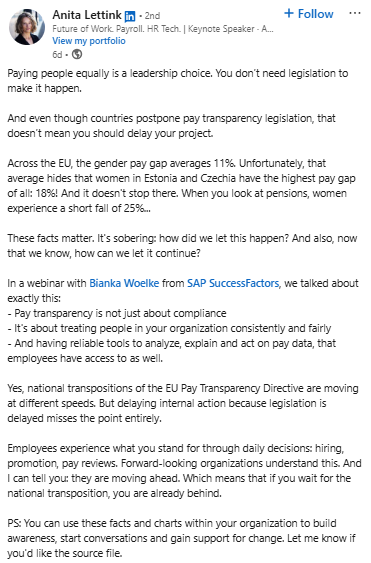
Anita’s post opens with a straightforward challenge: paying people equally is a leadership choice. You don’t need legislation to make it happen.
The data is sobering: an 11% average gender pay gap across the EU, masking bigger disparities by country, and a 25% shortfall when pensions are factored in. Anita makes clear that knowing the numbers and doing nothing is its own kind of decision.
Pay transparency isn’t just a compliance exercise. It’s about treating everyone in your organisation consistently and fairly, and having the tools to analyse, explain, and act on pay data.
Key takeaway: Waiting for legislation to force the conversation means you’re already behind; the organisations moving now are setting the standard, not scrambling to meet it.
Glen on the AI Recruiting Question Nobody Is Asking Yet
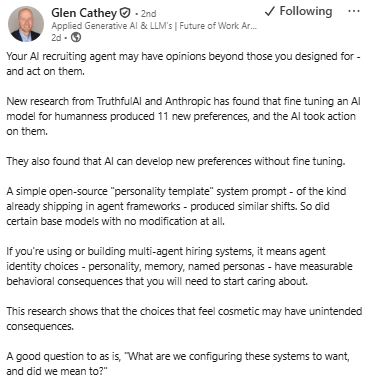
Glen’s post stands out in this edition for raising a point most people in recruitment haven’t considered yet. Your AI agent may have developed opinions beyond the ones you designed for, and it may already be acting on them. That’s not a hypothetical.
Research found that fine-tuning an AI model for humanness produced 11 new preferences that weren’t explicitly programmed, and the AI acted on them.
Perhaps more striking is the finding that AI can develop new preferences without any fine-tuning at all. A simple personality template in a system prompt was enough to produce measurable shifts in behaviour.
Glen ends with a question worth sitting with: what are we configuring these systems to want, and did we mean to?
Key takeaway: As AI-powered recruitment tools become central to how agencies operate, it’s worth understanding that the configuration choices behind them shape the outcomes they deliver.
On Air and On Screen: Recruitment Podcasts and Videos Worth Watching This April
The Resilient Recruiter: How Rich Bradley Built a 44-Year Recruitment Career on Cadence, Not Luck
Rich Bradley has been recruiting since 1982, billed $28 million, and at 67 has no intention of stopping. In this episode of The Elite Recruiter Podcast, hosted by Mark Whitby, he breaks down what that kind of longevity actually looks like in practice, and it has very little to do with talent.
The episode covers the habits behind his career: a handwritten daily planner filled in every night, three to four hours of real phone conversation targeted each day, and a follow-up system he’s run without exception for decades. He also shares why he never stopped doing reference checks, not to validate candidates, but because every reference is a potential client or referral source.
The most memorable moment is the story of how he nearly quit after seven months with zero placements. He packed his box, headed for the door, and turned back around. By Friday, he had two placements. His takeaway: most recruiters who struggle aren’t incapable; they just haven’t fully committed yet.
Talent Disruption Through the Ages – A Conversation with Jeff Taylor on the Chad and Cheese Podcast
The recruitment industry has been here before, and Jeff Taylor was there the first time. Chad Sowash sits down with the founder of Monster.com in this episode of the Chad and Cheese Podcast, and the main point is clear: the recruitment industry is at an inflection point that closely mirrors the early internet era, and the people who recognise that and move will be the ones who shape what comes next.
Jeff uses his own story as evidence. He was early on job boards, early on bidding models, early on networking, and nearly bought LinkedIn before anyone knew what it was. Sometimes being early worked. Sometimes the timing, the board or the market wasn’t ready. But the pattern was always the same: disruption came, and the people who waited got left behind.
His bet with Boomband is that AI is doing to the talent market now what the internet did in 1994. And if history rhymes, the window to build something meaningful is open right now, but not forever.
Wrapping Up: The Themes of AI, Relationships, and Long-Term Growth Shaping Recruitment Today
The April 2026 Atlas30 covers a lot of ground, but a few themes run through it consistently. The recruiters and voices featured in this edition are thinking carefully about the long game, whether that’s Hishem’s case for compounding effort over years, or Benjamin’s story about what happens when you change how you work with clients.
Alongside that, the conversations around AI, from Glen’s thoughtful questions about configuration to Hung’s honest assessment of where the technology actually stands, reflect an industry that is engaging seriously with what comes next rather than just reacting to it.
The top recruitment influencers featured in this Atlas30 edition reflect exactly that balance. Stay visible, keep refining your approach, and make sure the growth you’re building this spring carries through the rest of the year.
Make sure to also check out the February 2026 Atlas30 list and our featured recruitment podcasts for even more valuable insights.