









// Recruitment Leaders
Top Recruitment Voices in North America for August 2026 | Atlas – Hoxo Elite 100
Published: 05 August 2026,
8 min to read
Recruitment keeps shifting shape. AI tools are reshaping how sourcing and screening get done. Candidates expect faster, more personal engagement than ever before.
Data is steering more of the decisions recruiters make day to day, and the agencies that lean into it are pulling ahead. Speed and personalization aren’t nice-to-haves anymore, they’re the baseline candidates expect.
In this August edition of the Atlas – Hoxo Elite 100, we spotlight the recruitment voices driving those conversations across North America. Some names have moved since our last ranking, but everyone here continues to represent the best the industry has to offer, consistently showing up with insight, content, and real dialogue worth following. As always, explore Hoxo if you’re looking to elevate your social media presence.
Let’s take a closer look at our August 2026 recruitment voices ranking:
Looking for the Top 100 in other regions? Check out our lists for:
Top Recruitment Voices in Europe for June 2026
How the Atlas x Hoxo Elite 100 Rankings Are Calculated
The Elite 100 isn’t about who had one post go viral. It rewards recruiters who show up consistently and add real value over time. Rankings weigh a mix of factors: LinkedIn audience size, how often someone posts, the engagement their content generates, how active they are in comments and conversations, and how they’ve performed in past editions. The goal is to recognize steady growth and genuine influence, not short bursts of attention.
A Quick Reminder: How the Elite 100 Leagues Work
The Elite 100 is split into four leagues of 25 recruiters each: Atlas League, Gold League, Silver League, and Bronze League, with every recruiter ranked 1 to 25 within their league. This structure means a wide range of voices get recognized while keeping the competition sharp and the rankings easy to follow. At the heart of it, the Elite 100 is about celebrating the recruiters who spark real conversations and push the standard of recruitment content higher.
What North America’s Leading Recruiters Focused on in August 2026
Kelly’s take on following the right people for the right reasons
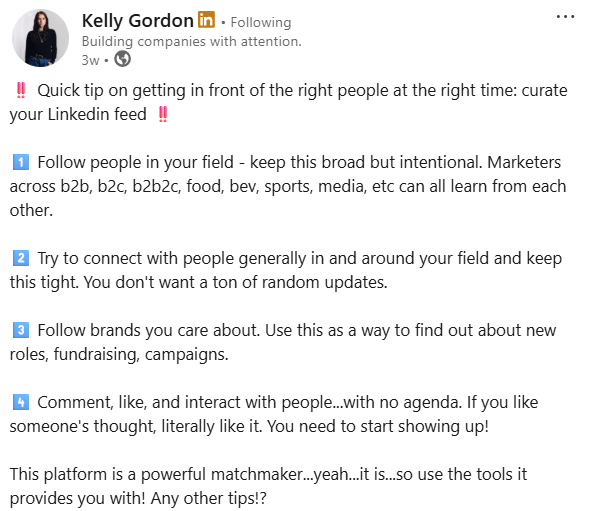
Kelly treats social media as a tool you have to shape, not just post on and hope for the best. Her recent post on curating your feed with intention breaks this down in a way agency recruiters can put to use right away.
Her approach is about being deliberate. Follow people in your field broadly, since insight often comes from adjacent industries too. Keep connections tighter and more purposeful, so your feed stays useful rather than noisy.
One point stands out: following brands directly turns your feed into an early signal for new roles, fundraising, and campaigns. For recruiters trying to stay ahead of hiring activity, that’s a small habit with a real payoff.
Kelly also pushes back on passive scrolling. Liking, commenting, and engaging without an agenda is how relationships actually build here. Her closing line says it best: LinkedIn works as a matchmaker, but only if you use the tools it gives you.
Nick explains how candidates can get on a recruiter’s good side
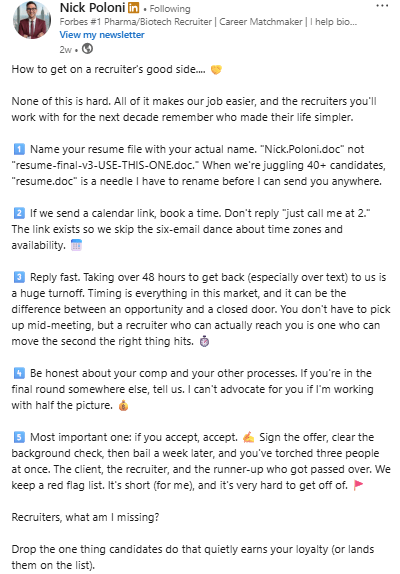
Nick shared five things candidates can do that make a recruiter’s job easier, and every point lands because it comes from someone juggling dozens of candidates at once. Name your resume file properly. Book a slot instead of asking for a call. Reply fast, since a 48 hour delay can be the difference between an opportunity and a closed door.
What stands out most is the honesty point. Nick asks candidates to be upfront about competing offers or other processes, because a recruiter working with half the picture can’t advocate properly. It’s a small ask that changes how the whole process runs.
The post ends on the one thing that actually damages trust: accepting an offer, then backing out after the background check is cleared. Nick calls it a red flag that sticks, and it’s easy to see why. It burns the client, the recruiter, and the runner-up all at once.
Tony on the startups that still show up for their people
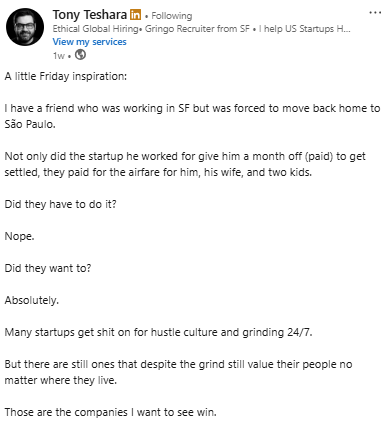
Tony shared a story about a friend who moved back to São Paulo from San Francisco, and what stuck with people wasn’t the move itself. It was how the startup handled it. They gave him a paid month off to settle back home, then covered airfare for him, his wife, and their two kids.
Tony’s point lands because none of it was required. No policy forced that startup’s hand. They simply chose to take care of someone who had given them good work, even as he was leaving their home base for good.
It’s a fair jab at hustle culture too. Plenty of startups talk a big game about grinding around the clock, but fewer actually back their people when it counts. Tony’s post is a nod to the ones that do, and a reminder of what actually earns loyalty over time.
For agency recruiters, this is worth sharing with clients. Candidates notice how companies treat people on the way out just as much as on the way in, and it shapes how a brand is talked about long after someone leaves.
Innesa on why critical thinking is the real job security
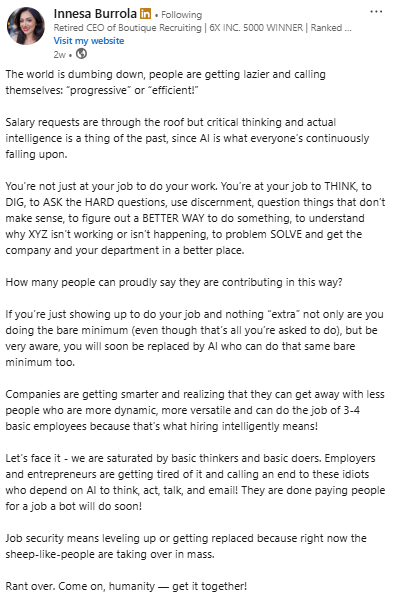
Innesa’s post makes a sharp case for staying indispensable at work. Her argument is simple. If your job is just showing up and doing the bare minimum, AI will eventually do that same bare minimum, and it won’t need a paycheck to do it.
She pushes for something harder than task completion. Ask the tough questions. Dig into why something isn’t working. Find a better way to do things instead of following the same process out of habit. That’s the kind of thinking that actually moves a company forward, and it’s exactly what gets overlooked when people lean too hard on AI to think for them.
Innesa’s point about companies getting leaner lands hard too. Employers are realising they can hire fewer people who are sharper and more versatile, rather than a larger team doing basic work. For anyone in the job market, that shift changes what makes a candidate worth hiring.
It’s a direct wake up call, and one that fits right into conversations recruiters are already having with clients and candidates about what real value looks like on a team.
What North America’s Recruitment Voices Got Right in August
This edition covers a lot of ground, but the common thread is easy to spot. Kelly reminded us that a strong network doesn’t happen by accident, it takes intention and real engagement. Nick showed how small habits on the candidate side build the kind of trust that keeps a recruiter coming back. Tony pointed to the companies that back their people even when nothing forces them to. Innesa pushed everyone to think harder and do more than the bare minimum.
Different topics, same underlying idea. Whether it’s building relationships, earning trust, taking care of people, or staying sharp at work, these recruitment voices keep circling back to the human side of the job. None of it is flashy. All of it works.
Their perspectives are a good reminder that recruitment moves forward when people lead with judgment, care, and consistency, not shortcuts.
10 Emerging Recruitment Voices to Watch in August 2026
Recruitment keeps moving fast, and a new group of professionals is helping shape where the industry heads next across North America. Through fresh perspectives, consistent visibility, and real contributions to their networks, these voices are steadily building influence in the space.
Spotlighting emerging voices helps recognise the people sparking meaningful conversations, sharing new ways of thinking, and supporting growth across the recruitment community. Here are ten rising recruitment voices to watch in August 2026.
The Platform Powering Better Hiring Decisions
None of the habits featured in this edition happen without time, and time is exactly what most recruiters are short on. Atlas gives that time back by cutting down the admin work that piles up around sourcing, screening, and candidate tracking.
The recruiters in this list all lean on proactive outreach, sharp judgment, and knowing their market inside out. Atlas supports that same way of working by keeping candidate data organised and easy to search, so recruiters can move fast when the right person shows up instead of digging through spreadsheets.
With a structured candidate database, agencies can track relationships over time, match people to open roles faster, and spend more energy on the parts of the job that actually need a human. Check out the previous Top 100 list if you missed it, and keep sharing what you know. There’s still time to make it onto the 2026 list.
Introducing the Atlas Referral Programme
Atlas offers a referral programme for people who introduce recruiting agencies to the platform. Referrals can be submitted by sharing an agency’s contact details, after which the Atlas team handles outreach and onboarding discussions directly.
If a referred agency becomes an active customer, the referrer receives a reward, while existing Atlas customers can also earn account credit for successful referrals.
Referred agencies receive a credit towards their first invoice, along with onboarding support from the Atlas team to help them get started.