









// Recruitment Technology, Atlas Technology
What the Best Contract Staffing Software Gets Right About Your Recruitment Data
Published: 21 July 2026,
6 min to read
The bottom line
Most contract staffing software stores your data. The best kind connects it, so notes, CVs, transcripts, messages, and reports feed one another and your team without manual effort. Contract desks that make this shift stop losing hours to admin and finally see their whole portfolio in one place.
Why contract desks outgrow their tools faster than anyone else
Contract recruitment moves in more directions at once than any other desk. A single consultant might manage active runners, chase timesheets, prep extensions, and source for three new roles in the same afternoon. That pace is exactly why contract staffing software built only to hold records starts to strain so quickly.
Every one of those moving parts generates data. A call becomes a note. An interview becomes a transcript. A candidate becomes a CV, a rate, a start date, and a margin. When that information sits in separate tools, your team spends the day copying it between them instead of placing people. The problem is not that you lack data. It is that your data cannot talk to itself.
What happens when contract staffing software only stores your data?
Fragmentation happens, and it quietly taxes every placement. When your CRM, notes, outreach, and reporting live in different systems, recruiters become the integration layer. Atlas research backs this up. 56.16% of agencies describe their tech stack as functional but fragmented. A further 36.99% name too much manual work as their biggest operational challenge.
On a contract desk, that tax compounds. Miss a note on a runner’s end date and the extension conversation slips away. Lose a transcript and the next consultant starts a client relationship blind. The tools were meant to save time, yet the seams between them create the very admin they promised to remove. Agencies feeling this pain are already rethinking why the modern recruitment tech stack holds teams back.
Why should a contract desk connect its entire recruitment database?
Because a placement is never one data point. It is the sum of everything you know about a person, a client, a role, and a rate. A connected recruitment database software approach treats those fragments as one living record rather than scattered files.
In practice, connected contract staffing software ties together five things that legacy tools keep apart:
- Notes from every BD call and candidate catch-up, captured without typing.
- CVs and spec CVs, generated and versioned against the live role.
- Transcripts from interviews and client meetings, searchable months later.
- Messages across email, phone, social, and chat, logged to the right contact.
- Reports and shortlists, built from the data already in the system.
When a platform captures every conversation into one source of truth, the record updates itself. An AI note taker turns a call into a summary and a set of to-dos, then files them against the contractor automatically. Nobody rekeys anything, and nothing falls through the gaps between apps.
How does connected data protect gross profit on a contract desk?
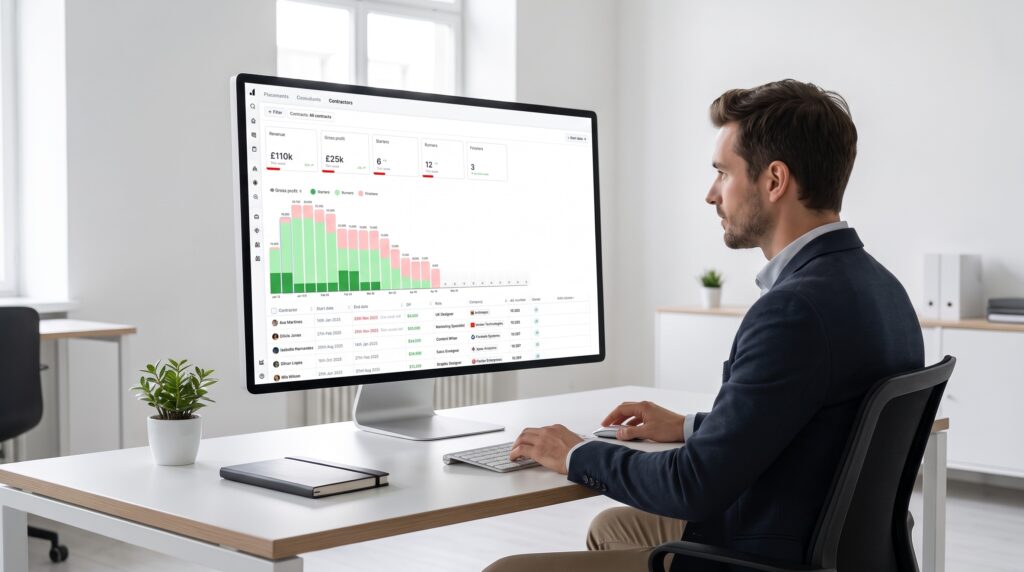
It gives leadership a live view of movement before it reaches the P&L. Contract performance is driven by flow: starters, runners, and finishers. If finishers outpace starters, revenue slips. If runners are not backed by new contracts, margin erodes. A real-time dashboard that reads connected data shows those trends as they form, not a month later in a spreadsheet.
That visibility depends on the underlying records being complete. When contract recruitment software pulls GP, rates, and status from the same system that holds your notes and messages, the numbers are trustworthy by default. Strong candidate tracking on a contract desk keeps every finisher in view for redeployment, so a contract ending becomes a new one starting rather than lost revenue.
Which capabilities separate the best contract staffing software?
The ability to act on data, not merely file it. This is where agentic AI changes the math. Instead of a recruiter updating a record after a call, the system does the work. It captures the call, updates the record, drafts the follow-up, and flags the extension due next week.
The commercial results are already visible. Ocean Red Partners grew monthly billing by 85% and cut tech spend by £300 per user each month after moving to a single connected platform. Attis, running an AI-first setup, won 35% more clients and increased CVs sent by 44%. Those gains come from an AI-powered CRM that removes the admin between tasks, freeing consultants to sell and place. Client-ready candidate reports built straight from the database close the loop without extra work.
Frequently asked questions (FAQs) on contract staffing software
Contract staffing software helps agencies manage temporary and contract placements across their full lifecycle. That runs from sourcing and compliance to timesheets, extensions, redeployment, and gross profit tracking. The strongest platforms also connect candidate data, communications, and reporting so a contract desk runs from one system rather than several.
A standard applicant tracking system is built mainly to move candidates through a perm hiring funnel. Contract staffing software adds the financial and lifecycle layers a temp desk depends on, including rates, margin, starters, runners, and finishers. When both live in one platform, recruiters avoid duplicating data across tools.
Yes. Enterprise-grade platforms are designed to manage hundreds of live agreements across consultants, clients, and regions from a single dashboard. Advanced filtering and structured contract creation keep even large contractor books organized and commercially transparent.
It does, and the effect is significant. When notes, CVs, transcripts, and messages feed one record automatically, recruiters stop rekeying information between systems. Atlas research found 80.82% of agencies already use AI for admin and data entry, the most common application of the technology today.
Prioritize how well the system connects your data, not the length of its feature list. Look for automatic capture of calls and notes, plus native reporting from live records. The best systems also give real-time GP tracking and AI that acts on data rather than storing it. A short migration path matters too.
It standardizes how every temp and contract placement is created, tracked, and billed, which keeps reporting clean as volumes grow. Connected data means a finisher on one desk can be redeployed elsewhere quickly, protecting both margin and candidate relationships.
What your contract desk looks like once the admin disappears
Picture the desk after the change. Consultants spend the morning on BD calls and candidate conversations, not data entry. Notes write themselves, extensions surface before they lapse, and the GP dashboard is already current when leadership logs in. The work that used to fill the day, updating records and chasing details across tools, now happens in the background.
That is the desk connected contract staffing software makes possible. Behind it is Atlas, an AI-powered recruitment platform that captures every conversation and uses agentic AI to keep contract data connected and self-updating. Consultants work the desk instead of feeding it. Worth a look the next time your team spends more time on the system than on placements.