









// Reports
From Copilot to Autopilot: What Agency Recruiters Think About AI Agents 2026 Report
Published: 02 July 2026,
17 min to read
The recruitment software conversation has shifted from what a tool can store to what a tool can do on a recruiter’s behalf. Over the past year, AI agents have moved out of product demos and into live agency workflows, and a large part of that shift comes down to plumbing.
Recruitment platforms like Atlas now have native MCP connectors that link directly into assistants like Claude, so an agent can act on a recruiter’s data and hand the work back finished rather than half-built.
That changes the question agencies are asking. The early promise of AI in recruitment was a copilot sitting beside the consultant, suggesting and drafting. What is arriving now looks closer to autopilot, where an agent runs a task from start to finish on its own.
For a profession built on relationships and judgment, that surfaces a real and unresolved tension: how far should the consultant’s day run automatically, and what stays unmistakably human?
To understand where recruiters actually stand, Atlas surveyed 1,000+ agency recruiters. We asked how they perceive AI agents, how far they trust them, which parts of their work they already hand over, and where they draw the line. The result is a data-led read on adoption from the people doing the actual work.
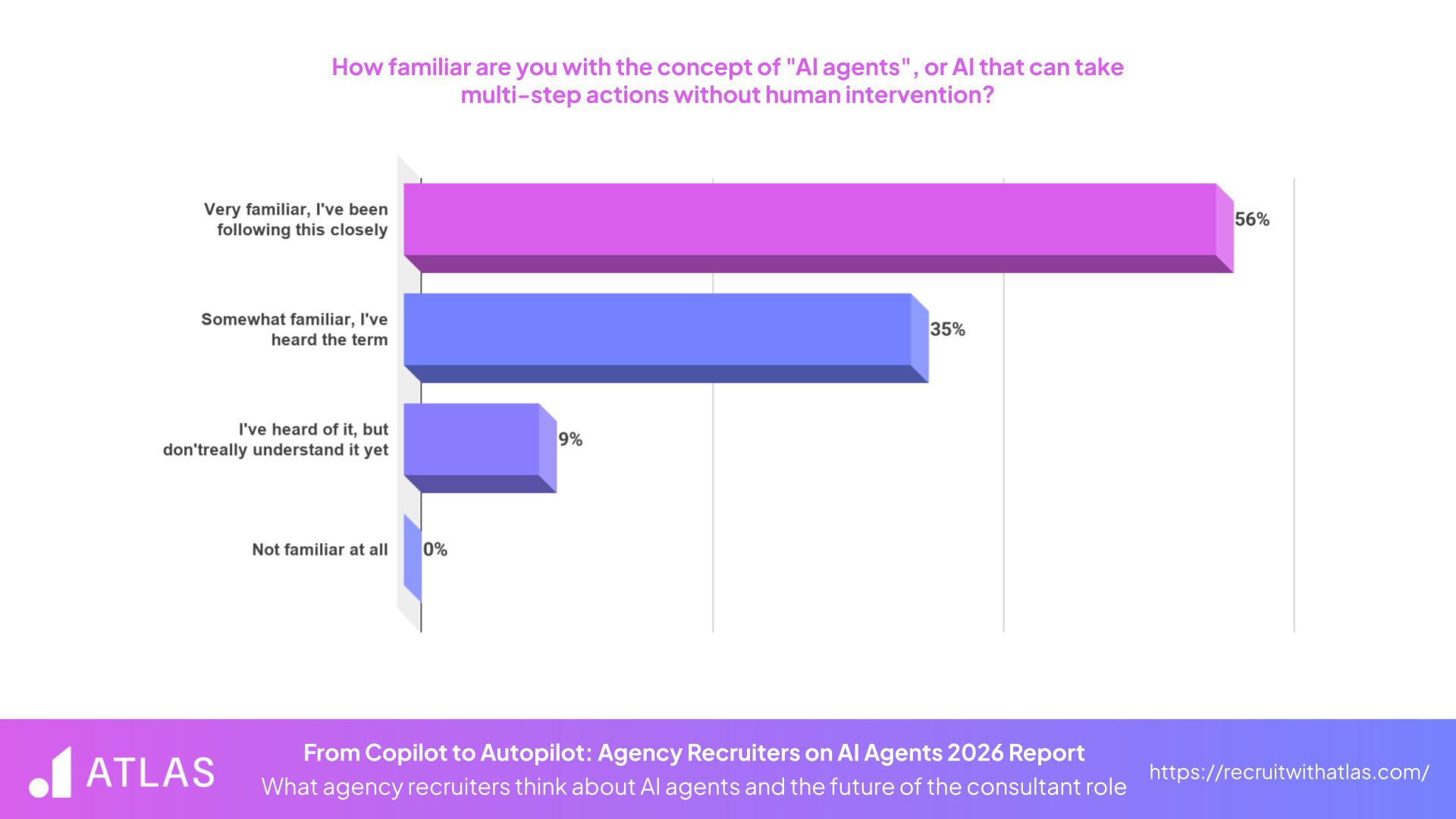
1. 56% of agency recruiters are very familiar with AI agents
Familiarity with AI agents is close to universal among agency recruiters. 56% of respondents said they are very familiar and have been following the space closely, with an AI agent meaning software that takes multi-step actions without human intervention. Another 35% are somewhat familiar, 9% have heard the term without fully grasping it, and 0% were unaware of the idea altogether.
When nobody in a profession is unfamiliar with a technology, the conversation has moved from what it is to what it should be allowed to do. Your peers are no longer asking what an AI agent is.
They are deciding how much of the desk to hand over, and how much stays human. That tells you something useful as you make the same call: the question facing your agency is one the whole market is working through right now, and AI agents are already shaping how recruiters expect their tools to behave.
2. 62% of agency recruiters have already tried AI agents at work
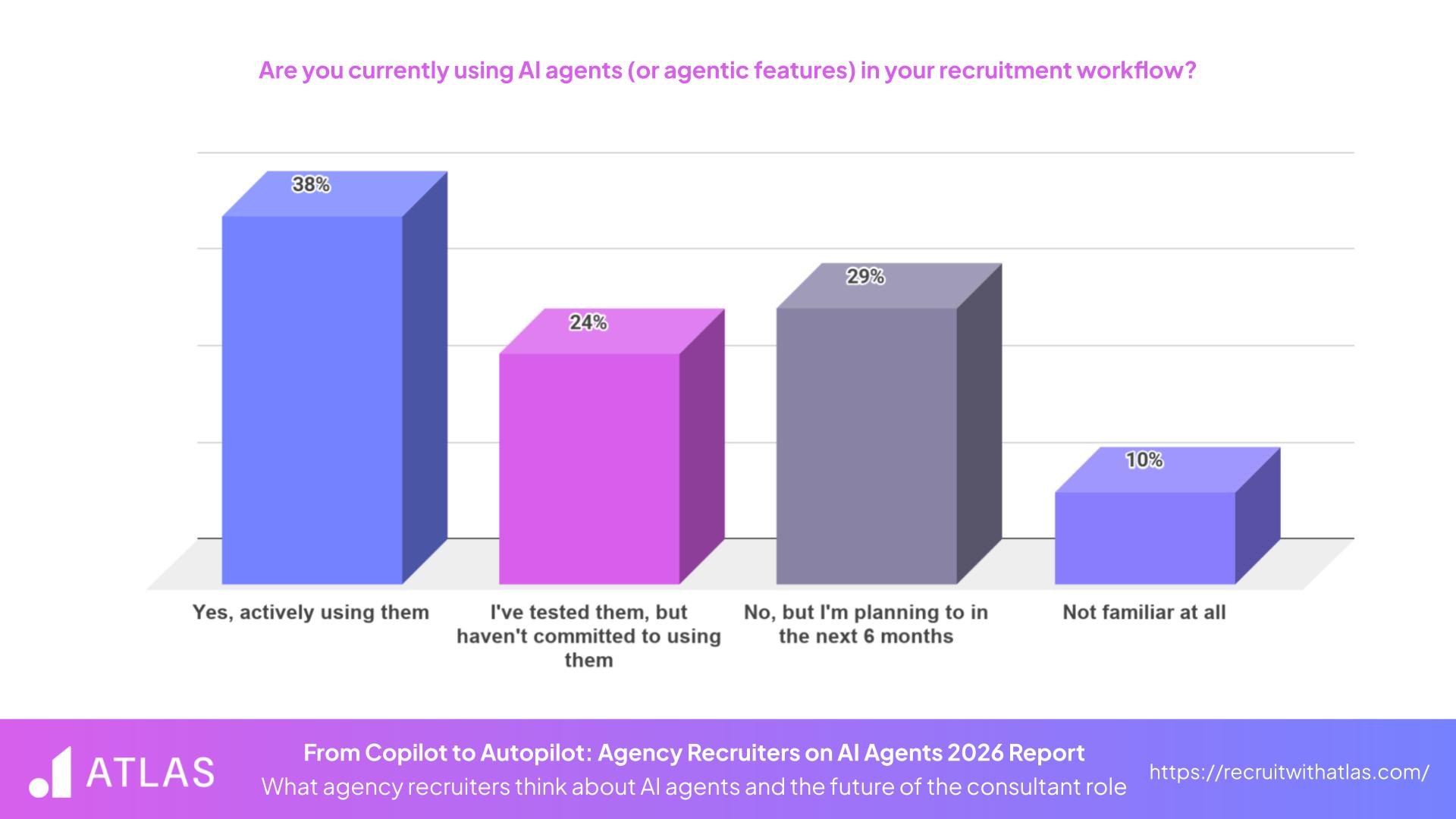
Adoption is further along than the cautious reputation of the industry suggests. 38% of agency recruiters said they are actively using AI agents or agentic features in their workflow today. Another 24% have tested them without committing, 29% are not using them yet but plan to within six months, and 10% are not familiar with them at all.
Read those middle two groups together, and the real picture appears. More than half of the market sits in motion but undecided, having tried agents or lined up to try them, without yet folding them into daily work.
That is the gap between curiosity and commitment, and it usually comes down to trust and proof rather than awareness. For you, it means the window to move from testing to genuine advantage is open now, while a large share of competitors are still circling.
The takeaway is that active use is no longer an edge case at 38%, and a sizable group of recruiters is poised to follow. Where your agency lands on that curve is becoming a competitive question, not a technical one.
3. 50% of agency recruiters use AI agents mainly for outreach and follow-up
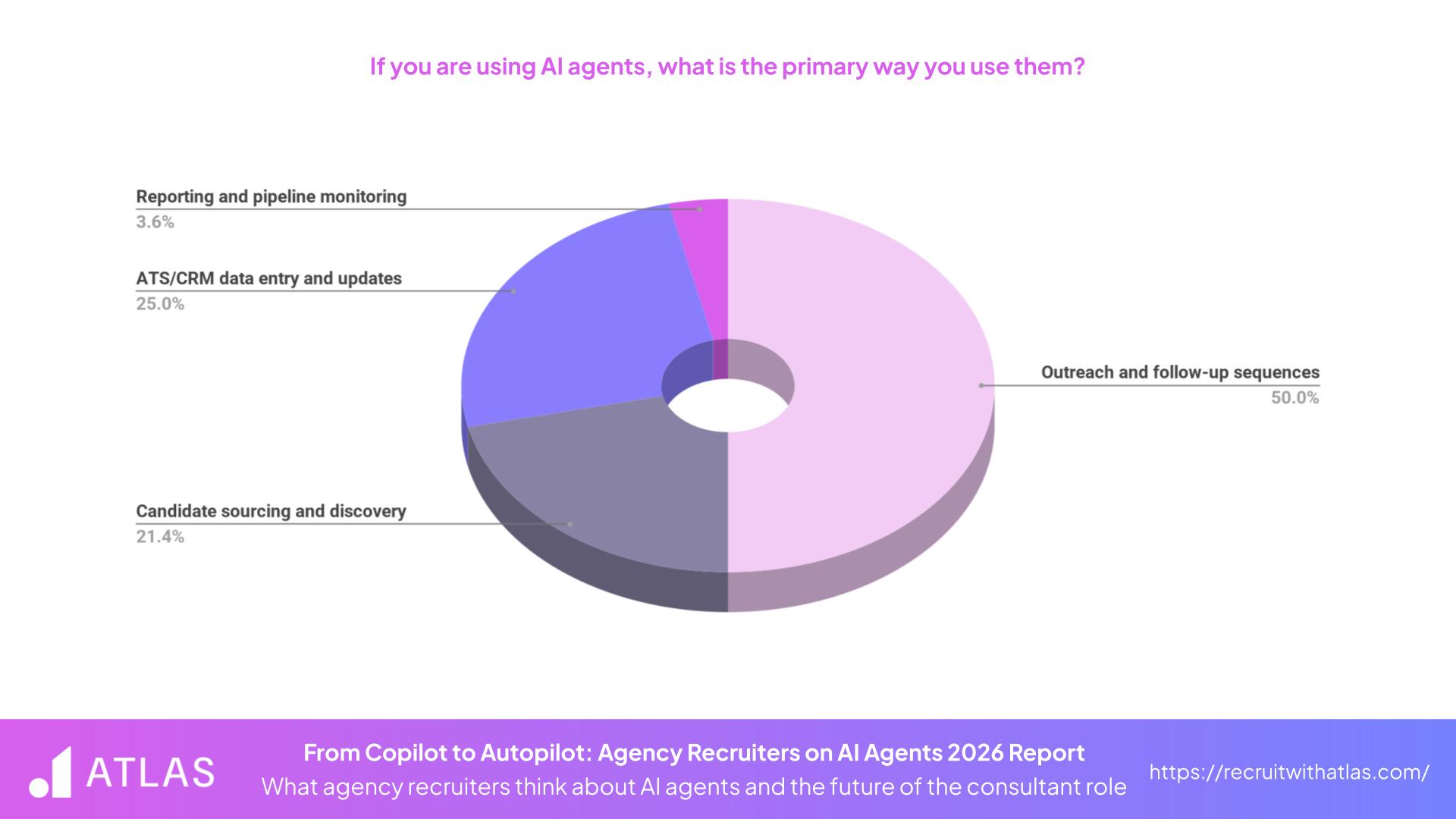
Among recruiters already using AI agents, the work they hand over clusters around communication and admin. 50% said outreach and follow-up sequences are their primary use, making it the single biggest application by a wide margin. 25% use agents mainly for ATS and CRM data entry and updates, 21.4% for candidate sourcing and discovery, and 3.6% for reporting and pipeline monitoring.
There is a clear logic to where the trust is going. The top three uses share a trait: they are high-volume, rules-friendly, and repetitive, the kind of work that drains hours without drawing on a recruiter’s judgment.
Outreach especially rewards consistency and follow-through, which is why running multi-step outreach is the first place so many agencies feel comfortable letting an agent take the wheel. Reporting sits at the bottom, not because it is hard, but because it tends to be lower volume and easier to glance at by hand.
4. Only 21% of agency recruiters want to approve every AI agent action
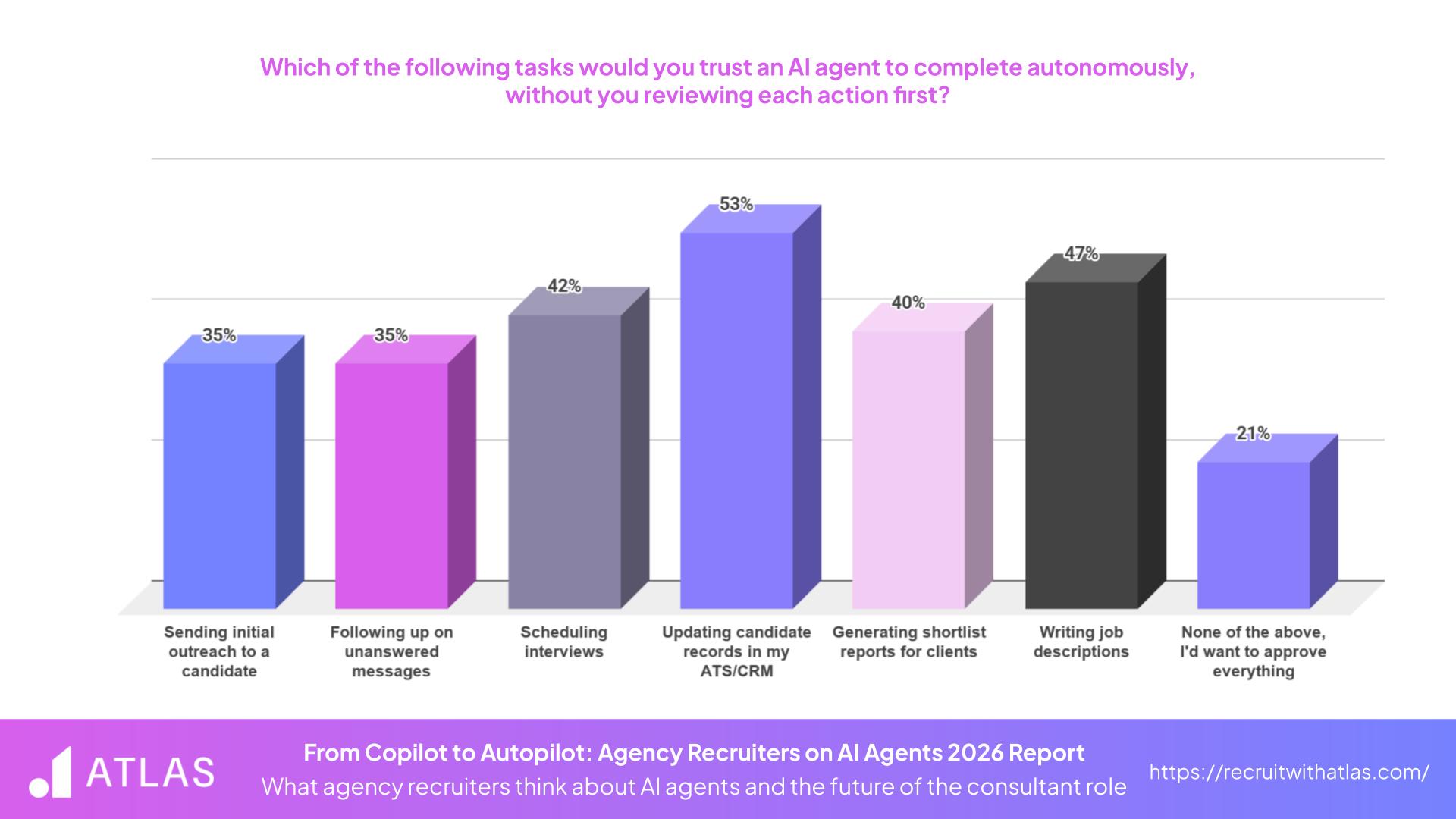
When the question turns to fully autonomous work, recruiters draw a revealing line. The task they most trust an AI agent to complete without reviewing each action is updating candidate records in the ATS or CRM, at 53%.
Writing job descriptions follows at 47%, then scheduling interviews at 42%, and generating shortlist reports for clients at 40%. The two communication tasks sit lowest, with sending initial outreach and following up on unanswered messages both at 35%. Only 21% said they would want to approve everything.
The pattern is the interesting part. Recruiters extend the most autonomy to internal, structured work where a mistake is easy to catch and cheap to fix, which is why keeping records current in an AI-powered CRM is the first thing they are willing to leave running.
They hold the tightest grip on candidate-facing messages, where tone and timing carry the agency’s reputation. Notice the tension with how agents are used today: outreach is the most common job people give an agent, yet it is the task they least want running unsupervised. That tells you recruiters are happy to let an agent draft and queue the human touch, but they still want a hand on it before it sends.
5. 81% of agency recruiters want AI agents to draft outreach for review
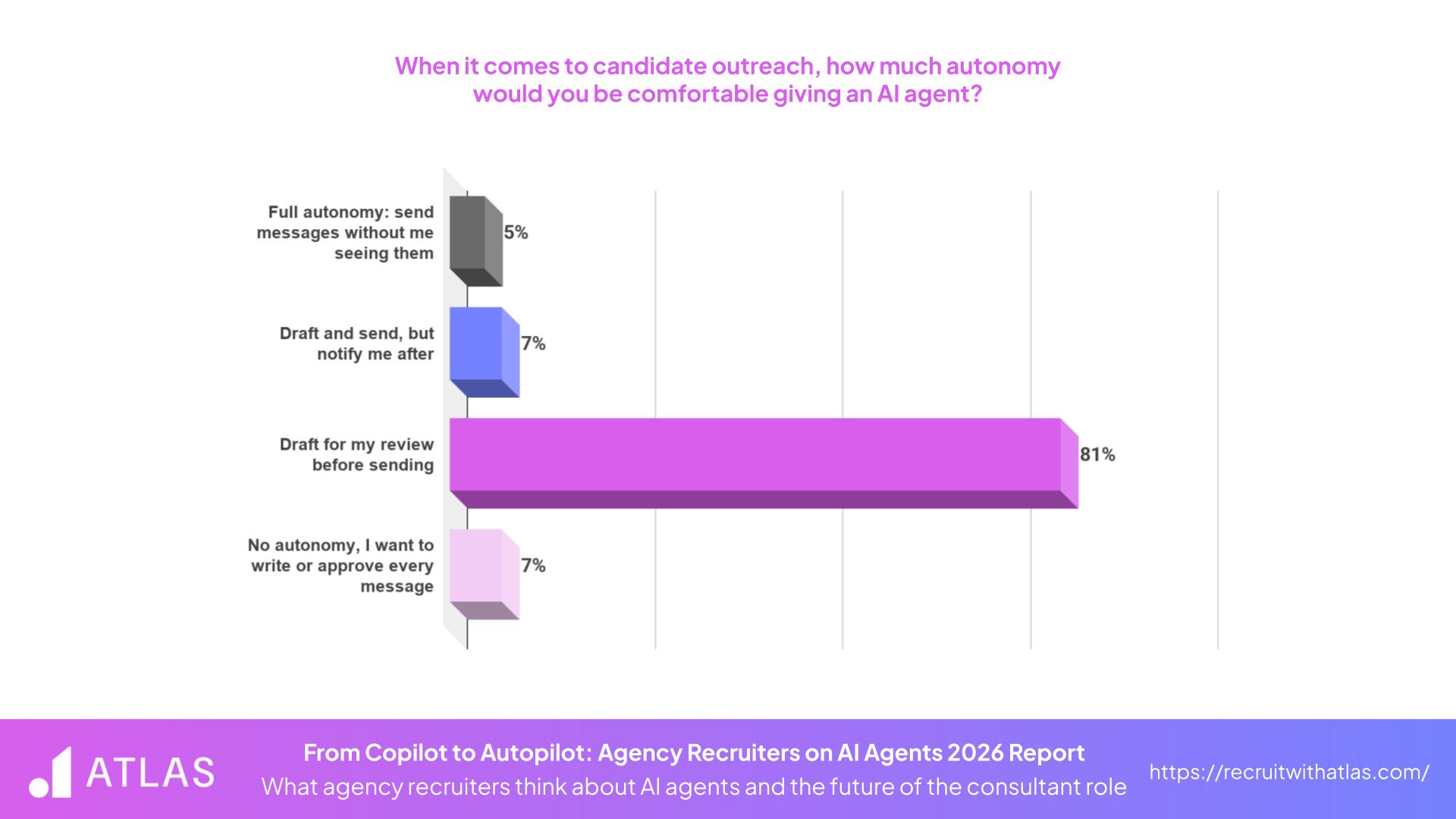
Asked how much autonomy they would hand an AI agent for candidate outreach specifically, recruiters land on one answer almost in unison. 81% said they want the agent to draft messages for their review before anything sends.
Everything else is a rounding error by comparison: 7% would let the agent draft and send with a notification afterward, another 7% want to write or approve every message themselves, and 5% would let an agent send freely without seeing the messages at all.
This is the sharpest signal the research has produced. Outreach is the work recruiters most often give an agent, yet it is the work they least want running unattended, and this chart shows where they settle that tension. They want the speed of automated drafting and the safety of a human checkpoint at the moment of contact.
For a business built on relationships, that instinct is sound, since one poorly judged message to a passive candidate can undo a placement or close a door for next time. An agent that powers fast multi-touch outreach while leaving the send button with the recruiter fits exactly what the market is asking for.
6. 90% of agency recruiters edit AI-generated output before using it
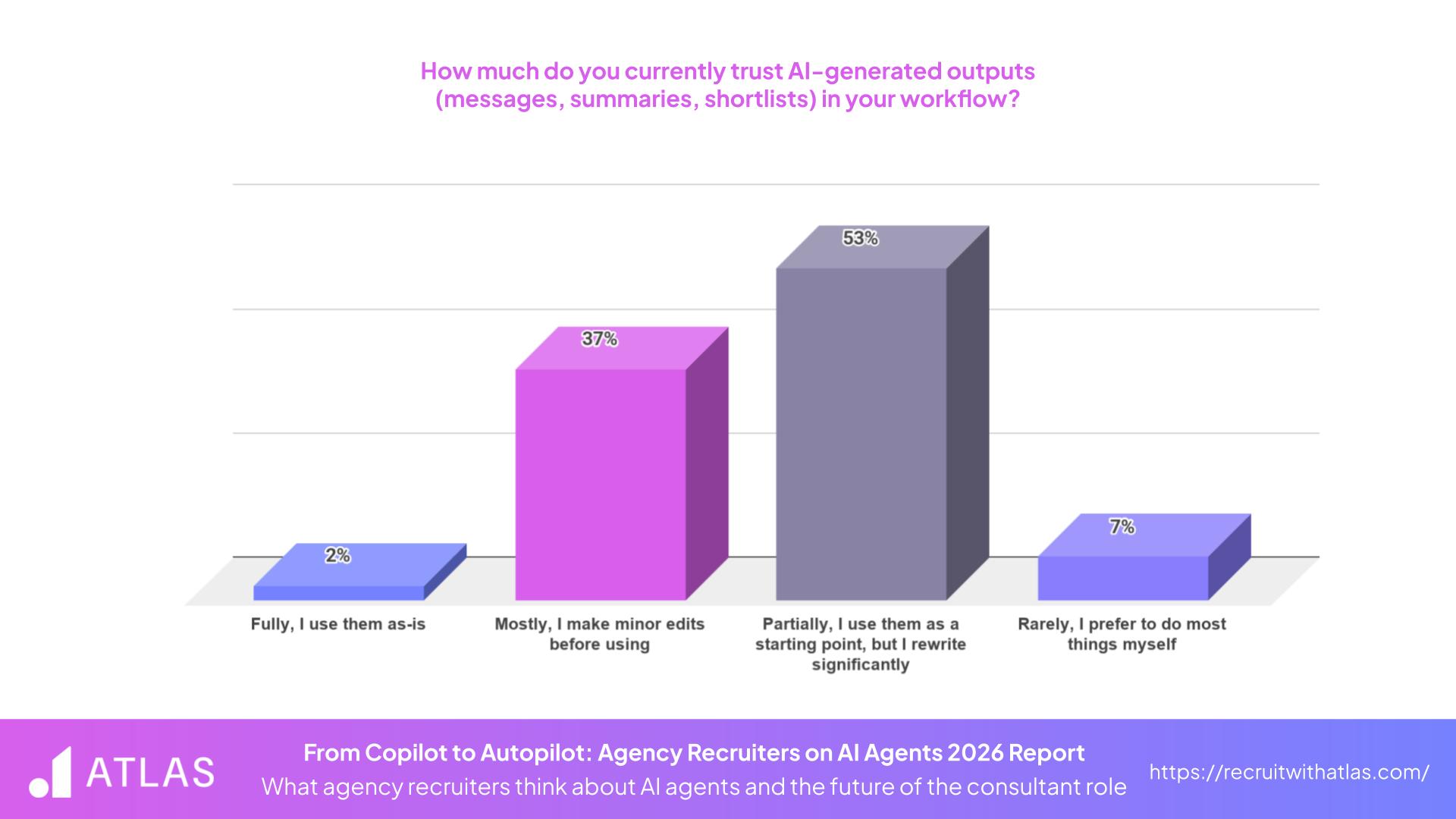
Trust in what an agent produces is real but conditional. The largest group, at 53%, said they partially trust AI-generated outputs like messages, summaries, and shortlists, using them as a starting point before rewriting significantly. Another 37% trust them mostly and make minor edits before using. At the edges, 7% rarely trust the output and prefer to do most things themselves, while only 2% use AI-generated work fully, as-is.
Stack the two middle groups and a practical truth emerges: 90% of recruiters are putting AI output to work, but almost none of them ship it untouched. The disagreement is only about how much editing each piece needs.
That distinction matters for how you measure the value of an agent. The win is not a finished artifact that bypasses the recruiter, it is a strong first draft that collapses the blank-page problem and shortens the time from nothing to client-ready. A reliable AI note taker or summary tool earns its place by getting a recruiter to 80% in seconds, even when the final 20% stays human.
7. 72% of agency recruiters think AI agents will reshape agency hiring
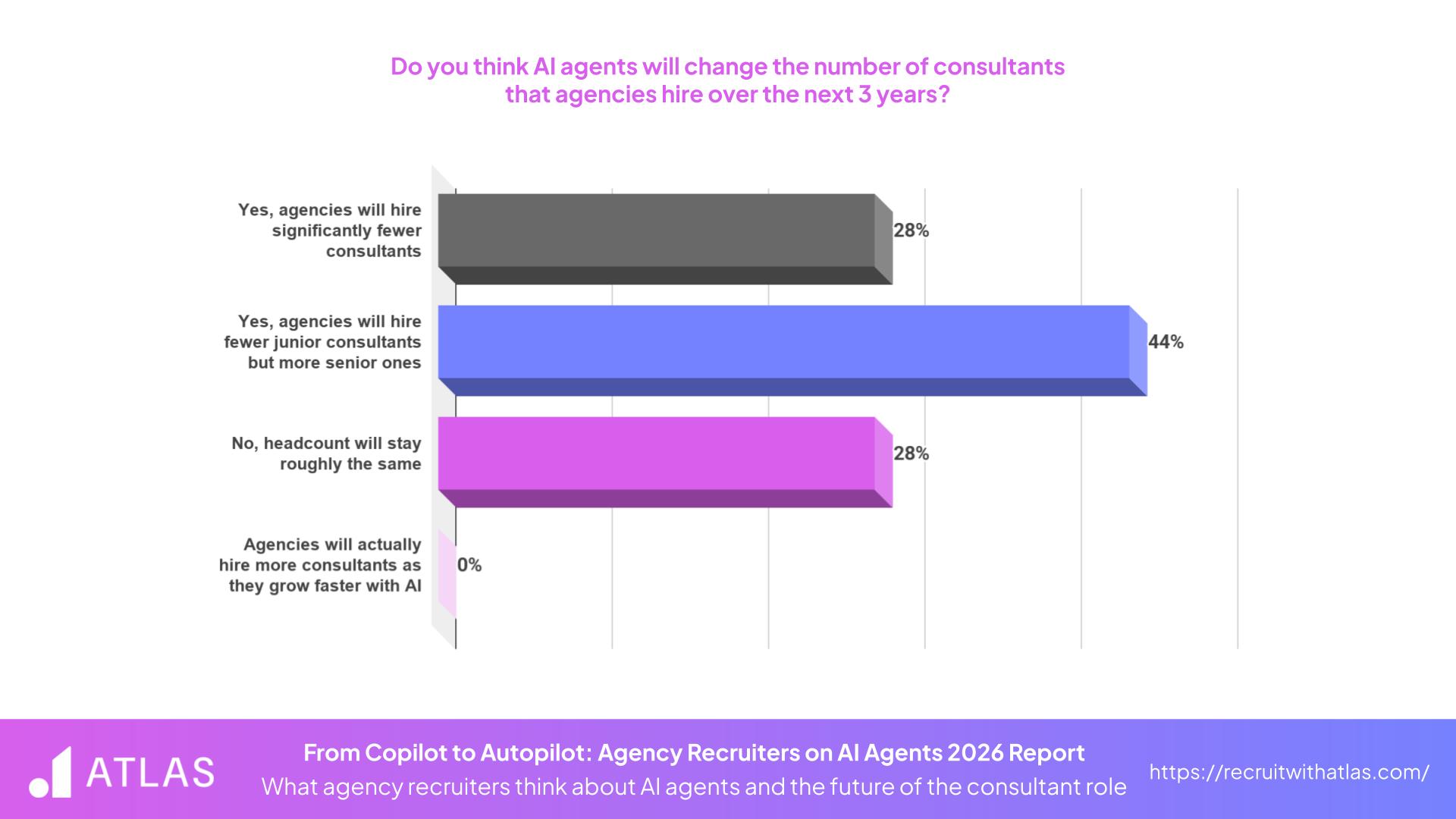
Asked whether AI agents will change how many consultants agencies hire over the coming years, recruiters point to a shift in shape rather than a simple cut. The leading view, at 44%, is that agencies will hire fewer junior consultants but more senior ones. Beyond that, opinion splits evenly: 28% expect agencies to hire significantly fewer consultants overall, and another 28% believe headcount will stay roughly the same. Not a single respondent, 0%, thought agencies would hire more consultants as they grow faster with AI.
The plurality answer is the one worth sitting with. Much of the entry-level work that traditionally justified a junior hire, the sourcing, the data entry, the first-pass outreach, is exactly what agents are absorbing first, as the earlier findings showed.
When that work thins out, the apprentice rung of the career ladder gets shorter, and demand tilts toward people who can do what agents cannot: win clients, advise on hard searches, and carry relationships. The flip side is a real question for agency leaders about where the next generation of senior consultants comes from once the junior path narrows.
8. 28% of agency recruiters expect AI agents to take scheduling and admin first
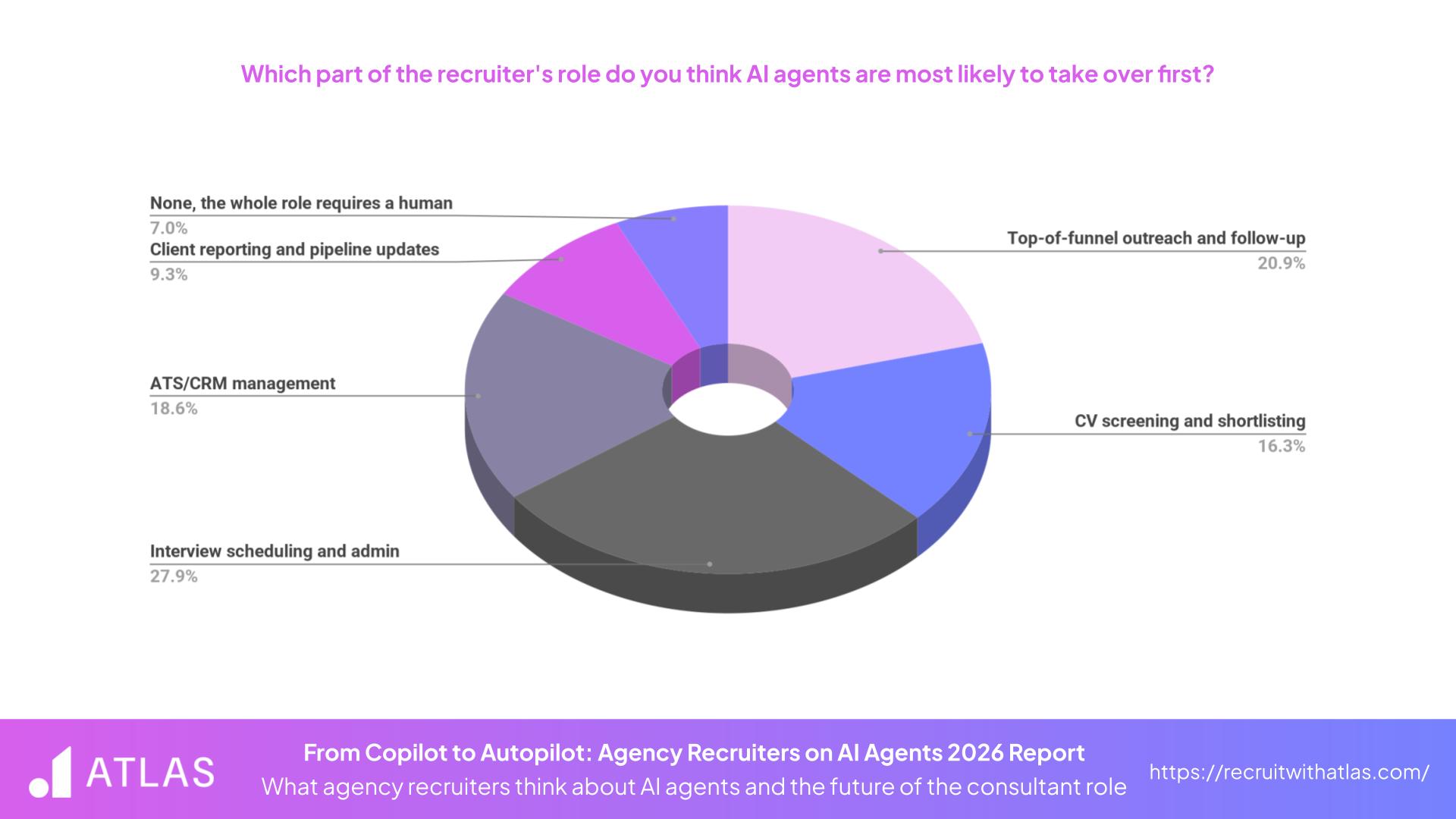
When recruiters predict which part of their role AI agents will take over first, they point firmly at the operational core. Interview scheduling and admin leads at 27.9%, followed by top-of-funnel outreach and follow-up at 20.9% and ATS/CRM management at 18.6%. CV screening and shortlisting sits at 16.3%, client reporting and pipeline updates at 9.3%, and only 7.0% said no part of the role can be taken over because the whole thing requires a human.
The shape of this answer is telling. The work recruiters expect to go first is the coordination and data layer, the connective tissue that holds a desk together without being the reason clients pay. Notably, the deeper relationship work does not appear as an option recruiters expect to lose, and the 7% holding out for a fully human role are a small minority.
Most see specific, bounded tasks moving to agents while the consultant keeps the parts that need a human read. Scheduling is a clean example, which is why automated meeting scheduling tends to be one of the earliest pieces agencies are willing to let an agent own end-to-end.
9. 86% of agency recruiters feel positive about AI agents on their desk
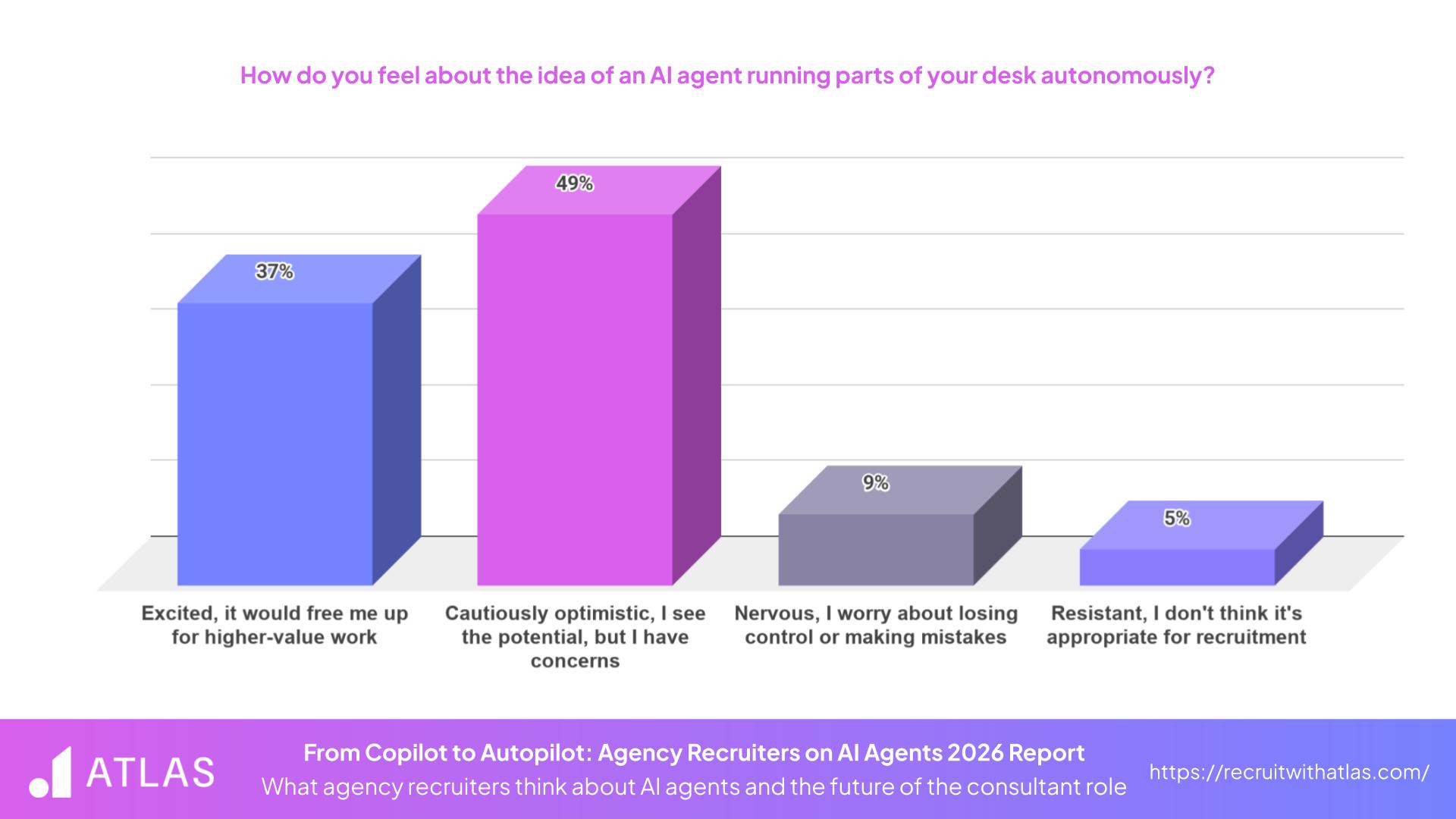
Sentiment toward letting an AI agent run parts of the desk autonomously is warm but clear-eyed. Nearly half, at 49%, described themselves as cautiously optimistic, seeing the potential while still holding concerns. Another 37% went further and said they feel excited, expecting it to free them up for higher-value work. Only 9% feel nervous about losing control or making mistakes, and a small 5% are resistant, saying they do not think autonomy is appropriate for recruitment.
Put the two positive groups together, and 86% lean favorable, but the split between them is the real story. The largest group is not unreservedly excited, it is optimistic with conditions attached, and that tempered stance lines up neatly with everything the data has shown: recruiters want agents that draft, queue, and handle the repeatable load, with a human checkpoint where reputation and judgment are on the line.
The outright resisters are a fraction of the market, which tells you the debate has largely moved past whether autonomy belongs in recruitment and on to how it should be governed. That is a far more constructive question, and one a well-designed AI agent can answer by keeping recruiters in control of the moments that matter.
10. Relationship damage is the top AI agent concern for agency recruiters
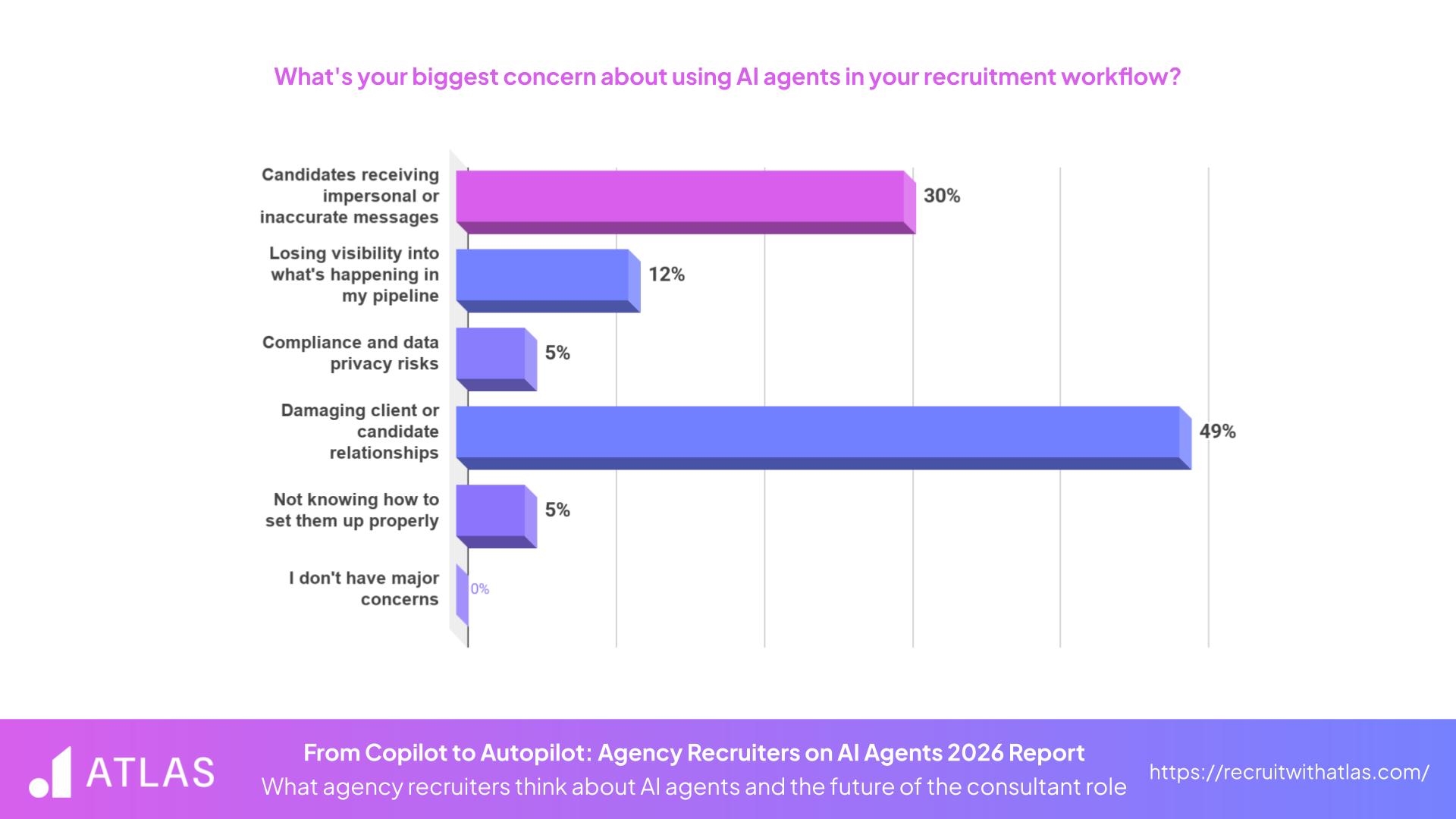
When recruiters name what worries them most about using AI agents, the answer reflects what they value most. Damaging client or candidate relationships tops the list at 49%, with candidates receiving impersonal or inaccurate messages close behind at 30%. The more operational worries trail well behind: 12% fear losing visibility into their pipeline, 5% point to compliance and data privacy risks, another 5% worry about not knowing how to set agents up properly, and 0% said they have no major concerns at all.
Read the top two together, and 79% of the concern lives in the same place: the human connection that defines agency work. Recruiters are not afraid that the technology will fail at the mechanics. They are afraid it will succeed at the mechanics while quietly eroding the relationships those mechanics are supposed to serve.
That fear explains every guardrail the earlier findings revealed, from the demand to review outreach before it sends to the reluctance to hand candidate messages full autonomy. It also points to what separates a trusted agent from a risky one: context. An agent working from complete history and total recall of every interaction is far less likely to send the impersonal, off-key message recruiters dread than one operating from thin data.
11. 58.1% of agency recruiters say more control would build their confidence
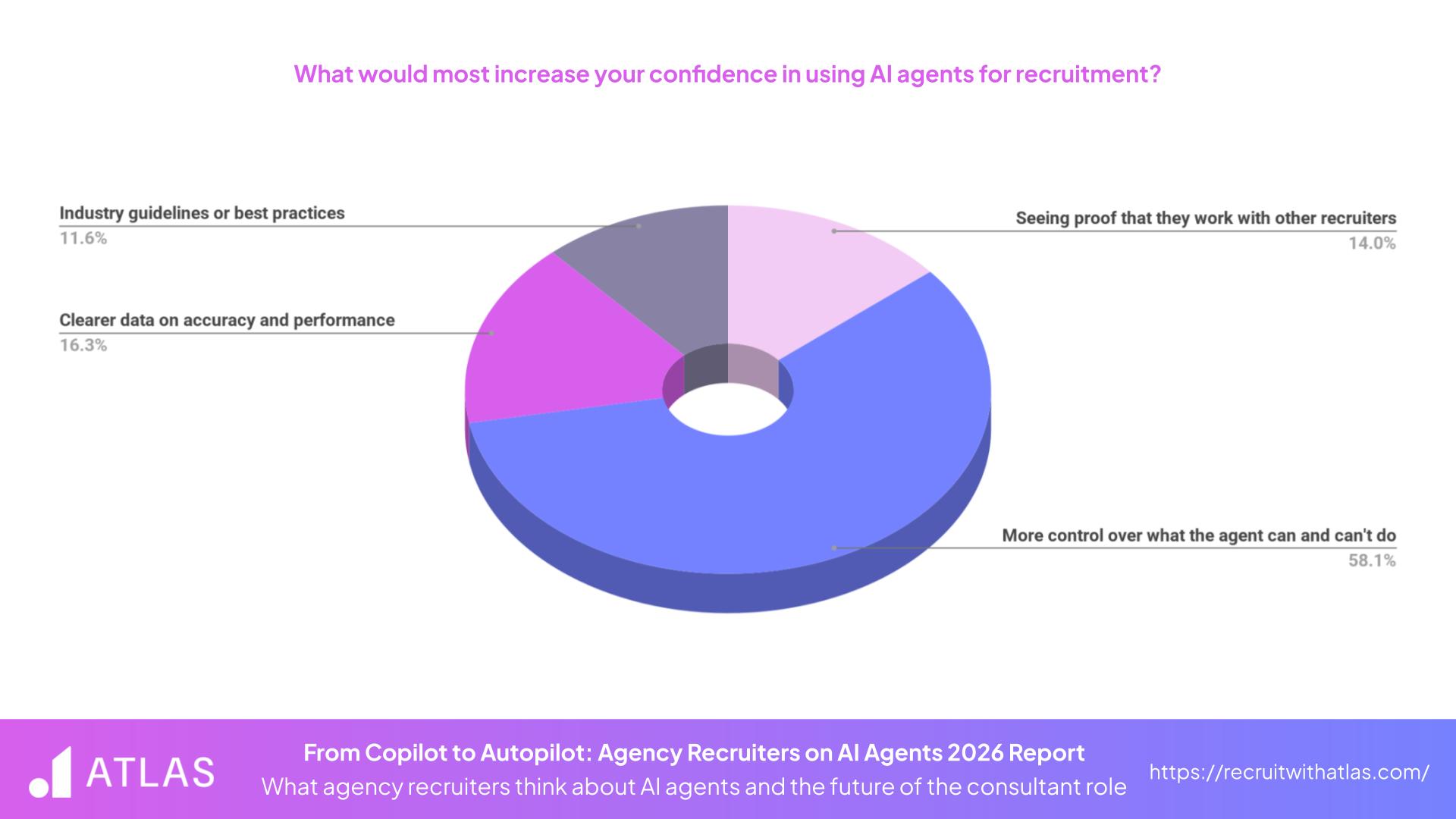
When recruiters consider what would most increase their confidence in using AI agents, one answer towers over the rest. 58.1% said more control over what the agent can and cannot do, far ahead of every other option. Clearer data on accuracy and performance follows at 16.3%, seeing proof that agents work for other recruiters at 14.0%, and industry guidelines or best practices at 11.6%.
The size of that lead resolves the whole report into a single requirement. Recruiters are not waiting for better benchmarks, peer validation, or a published code of practice, useful as those are. They want the controls: the ability to set boundaries, define what an agent may do on its own, and decide where a human steps in.
That is the prerequisite that unlocks all the cautious optimism the research surfaced. An agent perceived as a black box triggers the relationship fears from the previous finding, while one with visible, configurable guardrails turns autonomy into something a recruiter grants on purpose rather than something that happens to them. The agencies that adopt agents with granular, controllable permissions are working with the grain of what their people are asking for.
12. 70% of agencies will deepen their AI agent use over the next year
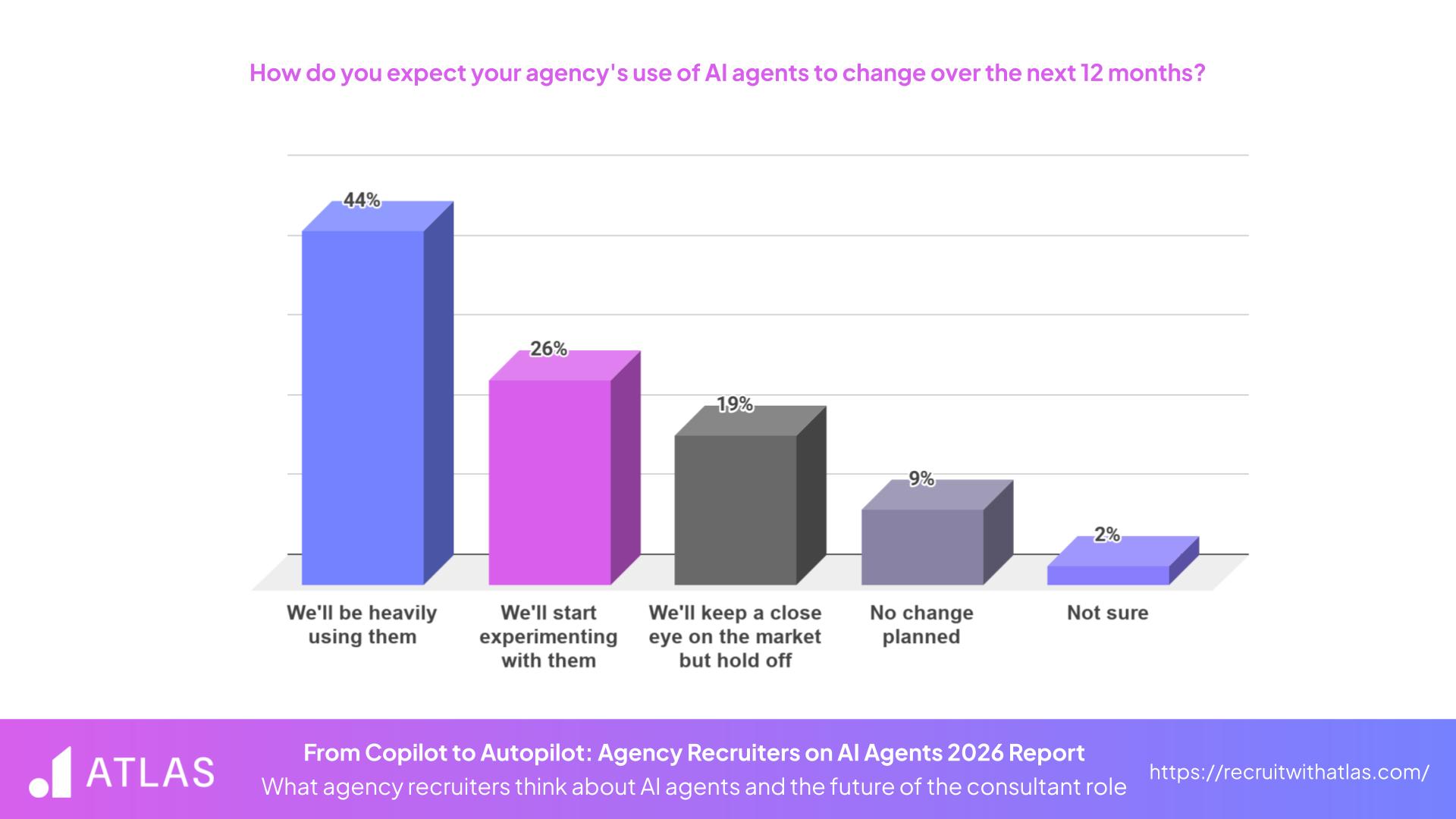
Looking ahead, the direction of travel is decisive. 44% of recruiters expect their agency to be heavily using AI agents within the next year, the single largest group. Another 26% plan to start experimenting with them, while 19% intend to keep a close eye on the market but hold off for now. Only 9% have no change planned, and a slim 2% are not sure.
Combine the first two groups, and 70% of agencies expect to deepen their use of agents over the coming year, whether by scaling up or stepping in for the first time. Set against the 9% planning no change, the gap is stark, and it reframes the choice facing agency leaders.
The question is no longer whether to engage with agents but how quickly, and the 19% watching from the sidelines are betting they can wait without falling behind. Given how concentrated the momentum is, that is an increasingly expensive bet. The agencies moving now are the ones learning where agents fit, building the controls their teams want, and compounding the time savings, while later adopters are still deciding.
13. What recruiters would hand to an AI agent tomorrow?
Numbers map the shape of a shift, but they rarely capture the texture of it. To hear how recruiters are thinking in their own words, we asked an open question: what is one recruitment task you would love an AI agent to handle end-to-end, and why?
“Autonomously adding relevant companies and contacts to the CRM with all contact information, with initial outreach in my own tone.”
“Deep market research to spot trends and opportunities before they arise.”
“Proactively find the right candidates in the market.”
“Read my entire CRM/ATS weekly on schedule so I don’t have to prompt it and join the dots between who I’ve added, put notes on, and link to opportunities.”
“Reading my emails/calls – going between the two parties and setting up interviews – it would have to be openly an AI feature, I wouldn’t want anyone mistaking it for me.”
14. Advice from recruiters on getting started with AI agents
We closed the survey with a question aimed at the recruiter standing where many were a year ago, curious about AI agents but unsure of the first move. We asked what advice they would give to another recruiter who is interested but does not know where to start.
“There are tools out there that increase efficiency, but it’s not an easy button yet. AI is not a magic bullet, and we may never want it to be.”
“Train your agent before cutting it loose. You have to make sure it understands what you are looking for in candidates, or your writing style, or whatever you are using it for in your process. The more time you spend on training your agent, the better the outcome.”
“Start slowly and with a business need in mind to solve instead of using AI for the sake of AI.”
“Ask the AI that you will be using if it can do the task you want it to complete. Then let it help you write the instructions. Make it an interactive process, start small, and expect problems to pop up as you go.”
“Think workflow first, AI second.”
From copilot to autopilot, on the recruiter’s terms
Our research shows an industry that has settled on the destination and is negotiating the route. Awareness of AI agents is near universal, adoption has moved past the early adopters, and 70% of agencies expect to deepen their use over the next year. The open question is no longer whether to let agents into the workflow, but how much of the desk to let them run.
The answer recruiters keep returning to is consistent. Agents are welcome to absorb the repeatable load, the scheduling, data entry, and first-pass outreach, but not to run unattended through the moments that carry a relationship.
That is why 81% want outreach drafted for review, why relationship damage is the top concern at 49%, and why 58.1% say more control over what an agent can and cannot do would most build their confidence. This reshapes the consultant role rather than retiring it, tilting hiring toward the senior judgment that agents cannot replicate.
Capturing that upside depends on the two things recruiters value most, and that is where a platform like Atlas fits.
Built as an AI-powered CRM that uses agentic AI to remove admin, it pairs deep memory of every interaction with agents you can govern precisely, so the repeatable work runs on autopilot while recruiters keep the final say where it matters. Wherever your agency sits on this curve today, the recruiters in this study have drawn a clear map of where the profession is heading.