








// Software Comparisons
10 Best Enterprise Recruitment Software Platforms for 2026 | Top Systems Ranked
12/02/2026
20 MIN
As recruitment agencies grow, complexity tends to grow faster than headcount. What once worked for a small, high-performing team can quickly become a bottleneck when you are managing multiple recruiters, clients, roles, and workflows all at once. Spreadsheets multiply, and recruiters spend more time on admin than on candidate and client relationships.
For larger agencies operating at an enterprise level, this creates a real tension. You need systems that bring structure, visibility, and consistency across teams. But not at the expense of the service quality and speed that made your agency successful in the first place. Manual processes, disconnected platforms, and rigid ATS setups make it harder to scale without losing control.
It’s where choosing the best enterprise recruitment software for your firm comes in. Built to support multi-team environments, complex workflows, and higher volumes, these platforms aim to centralize recruiting operations, automate repetitive tasks, and give leadership better insight into performance across the agency.
We assembled the following list to help agency decision-makers like yourself evaluate platforms to switch to based on how well they support scale, collaboration, and operational efficiency. Each tool takes a slightly different approach, which is why understanding the strengths and trade-offs matters before committing to a new system.
Top 10 best enterprise recruitment software for 2026
1. Atlas – the Recruitment Platform
2. Ceipal
3. Greenhouse
4. Pinpoint
5. Manatal
6. Bullhorn
7. Teamtailor
8. Lever
9. JobAdder
10. JobDiva
1. Atlas – the Recruitment Platform
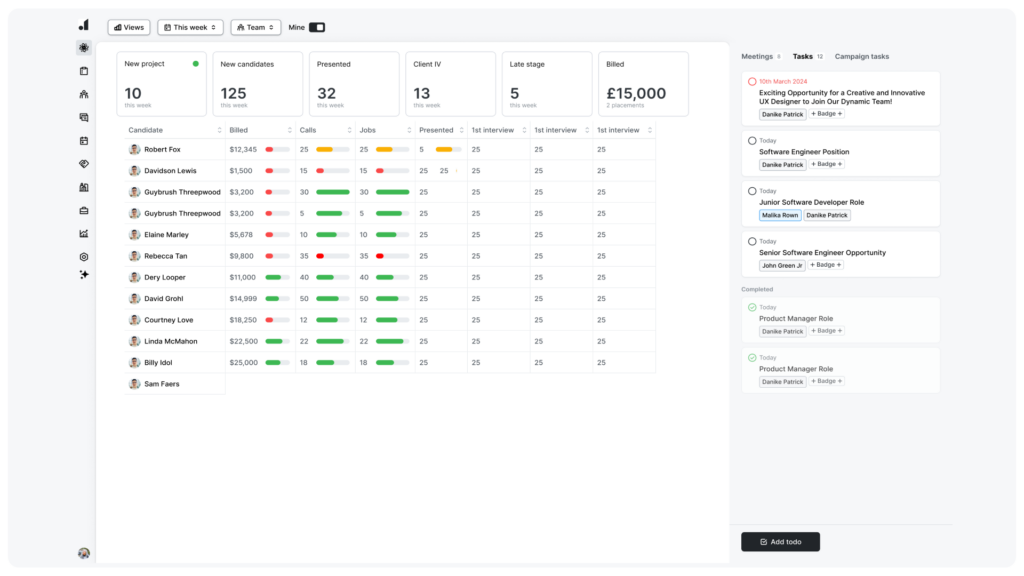
Atlas – the Recruitment Platform is built for enterprise recruitment agencies that need more than a traditional ATS or CRM. Designed specifically for agency recruiters operating at scale, Atlas combines intelligent CRM functionality with agentic AI features to eliminate manual data entry, reduce administrative work, and centralize operations across multiple teams. The interface is clean and structured, helping large agencies maintain consistent recruiter productivity without adding unnecessary complexity.
At the core of Atlas is its AI-powered agent framework. These agents continuously learn from your recruitment data to support decision-making, maintain data hygiene, and surface revenue opportunities across the agency. Opportunities, Atlas’s advanced business development engine, enables teams to identify, prioritize, and act on high-potential deals using real-time insights pulled directly from the platform. For enterprise agencies managing large pipelines, this creates a proactive, data-driven approach to growth and forecasting.
Customizable enterprise dashboards provide granular visibility into outreach, pipeline health, team performance, and deal value across offices or business units. With embedded automation, centralized communication tools, and search-ready data that connects your ATS and CRM into one unified system, Atlas is built to support admin-free recruiting at scale. For agencies preparing for 2026 and beyond, it’s the best enterprise recruitment software for structured, efficient growth.
Key features of Atlas – the Recruitment Platform:
- Agentic artificial intelligence (AI)
- Advanced business development features
- Enterprise-level customizable dashboards
- Intelligent candidate search and scoring (Magic Search)
- Centralized outreach campaigns with playbooks
- Built-in calendar and meeting scheduling
- White-label executive search reports
- Career page and job posting integration
- AI note-taker with in-person interview mobile app
- Enterprise performance analytics and insights
- Browser extension
- Integrations
- Open API
Best for: Enterprise agency recruitment, scaling executive search firms
Not ideal for: In-house recruitment
Pricing: Free trial available, book your demo below
2. Ceipal
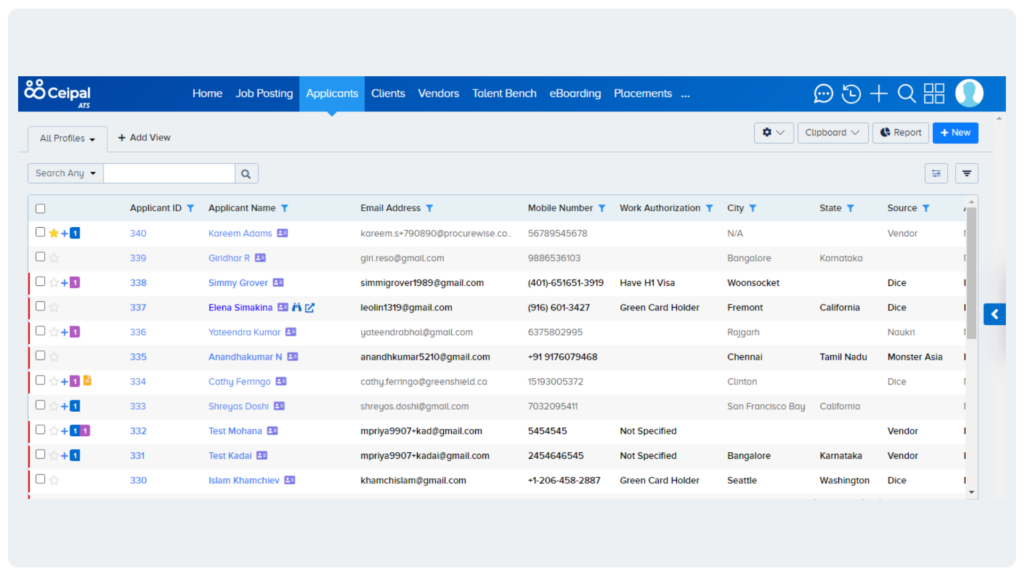
Ceipal is a talent acquisition platform that combines ATS, CRM, and workforce management capabilities to support enterprise-level recruiting operations. For larger agencies and staffing firms managing multiple teams and high hiring volumes, it centralizes candidate sourcing, client engagement, and recruitment workflows in one system.
Ceipal’s CRM functionality enables agencies to manage contacts, track communications, and nurture client and candidate relationships at scale. The platform also extends into vendor management and workforce management, making it useful for agencies that work with external partners or manage contingent workers. With customizable dashboards, automated workflows, and reporting tools, Ceipal helps enterprise teams stay coordinated across offices and functions.
Key features of Ceipal:
- AI candidate sourcing
- Outreach campaigns
- Job boards integration
- Candidate analytics
- Dashboards
- Onboarding and eSignatures
- Career portal
- Integrations
Best for: Agencies managing complex pipelines and vendor relationships
Not ideal for: Teams looking for lightweight, minimal-setup recruitment tools
Pricing: Free trial available, contact the vendor for pricing details
3. Greenhouse
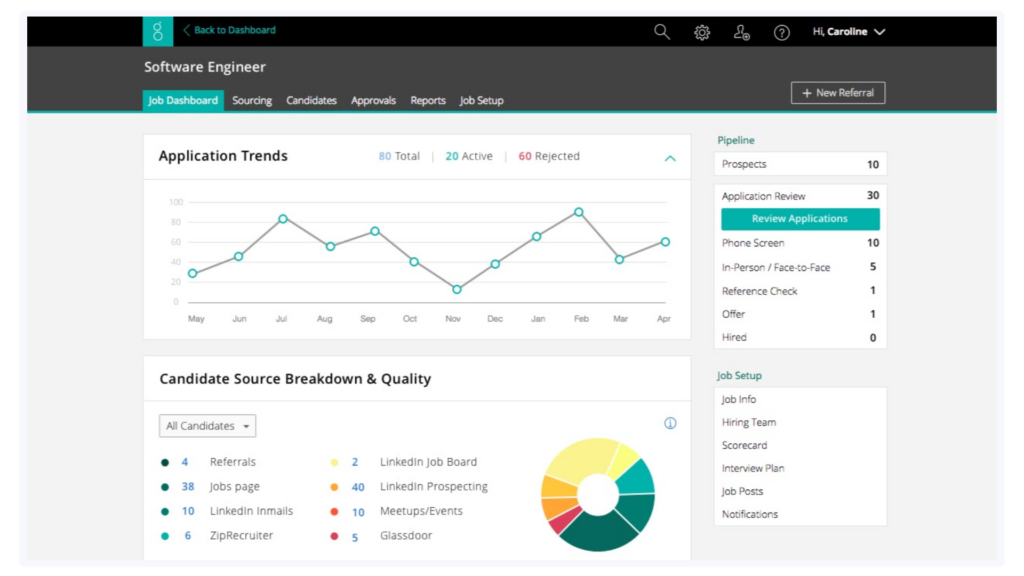
Greenhouse is a recruiting platform that combines ATS and CRM functionality to support structured, process-driven hiring environments. For enterprise agencies managing multiple recruiters and high client expectations, it provides a centralized system to coordinate candidate sourcing, interview workflows, and stakeholder collaboration within a single platform. Its structured approach helps teams maintain consistency across offices or business units.
The platform enables recruiters to track contact history, build segmented talent pools, and configure custom workflows for different roles or client requirements. With built-in dashboards and reporting tools, agency leaders can monitor pipeline activity, measure performance, and identify operational bottlenecks across teams. For larger agencies that prioritize standardized recruitment processes and visibility into hiring metrics, Greenhouse offers a framework designed to support scale and accountability.
Key features of Greenhouse:
- Pipeline management
- Interview scorecards
- Candidate segmentation and tagging
- Outreach tools
- Candidate sourcing
- Analytics dashboards
- Collaborative tools
- Open API
- Integrations
Best for: Agencies with large existing tech stacks
Not ideal for: Teams in need of highly customizable dashboards or automation
Pricing: No free trial available, contact the vendor for pricing details
4. Pinpoint
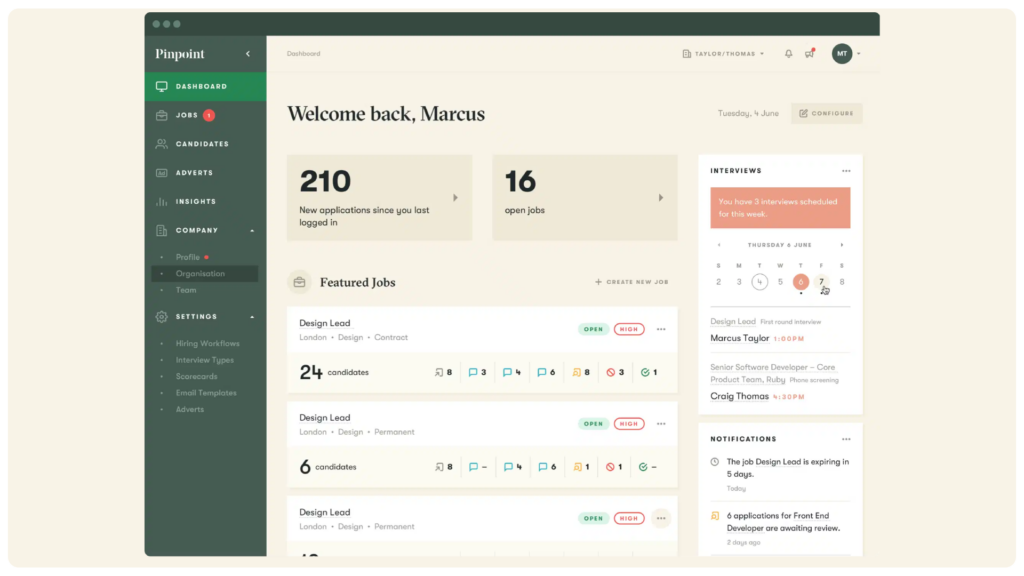
Pinpoint is a modern applicant tracking system (ATS) designed to help organizations centralize and streamline hiring workflows. For enterprise recruitment agencies managing large volumes of roles and multiple hiring streams, it provides a structured platform to manage job requisitions, candidate pipelines, interview processes, and hiring outcomes in one place. With automation at its core and a focus on configurability, Pinpoint supports multi-team coordination and visibility across complex recruitment operations.
Recruiters can use Pinpoint to standardize screening, schedule interviews, and capture structured feedback while maintaining consistency across roles, locations, or brands. Its collaboration tools and real-time dashboards give teams insight into pipeline health and bottlenecks, helping larger agencies stay aligned on performance metrics and strategic priorities.
Key features of Pinpoint:
- Customizable automations
- Candidate outreach management
- AI candidate selection and matching
- Interview scheduling
- Recruitment agency portals
- Collaborative features
- Candidate experience surveys
- Branded career website
- Browser extension
Best for: Enterprise agencies working across different regions and time zones
Not ideal for: Teams looking for all-in-one solutions (lacking in CRM features)
Pricing: No free trial available, contact the vendor for pricing details
5. Manatal
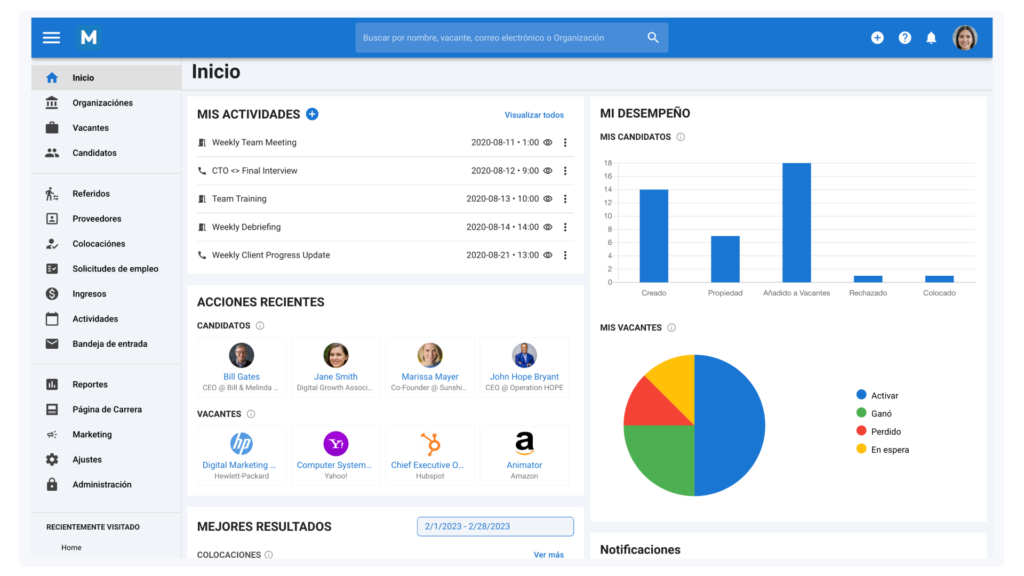
Manatal is an ATS and CRM platform designed for agencies seeking an all-in-one recruitment system with a straightforward setup. For enterprise agencies managing multiple recruiters and client accounts, it offers a centralized environment to oversee job orders, candidate pipelines, and client relationships within a clean, accessible interface.
The platform focuses on simplifying day-to-day recruiting operations while keeping core hiring and business development workflows connected. Its CRM functionality supports structured client and contact management, deal pipeline tracking, and team collaboration across offices or business units.
Recruiters can automatically enrich contact records, monitor deal stages, and configure workflows to reflect their agency’s sales process. With built-in analytics, branded client portals, and permission controls, Manatal provides a scalable option for agencies that want visibility and coordination across teams without adopting an overly complex system.
Key features of Manatal:
- Client and contact management
- Workflow pipelines
- AI-powered candidate scoring
- Job posting integration
- Client portals
- Dashboards
- Reports and analytics
- Collaboration tools
- Integrations
Best for: Solo and small-scale agencies, recruiters looking for basic automation
Not ideal for: Enterprise teams looking for a scaling recruitment platform
Pricing: Free trial available, pricing starts at $15 per user/month
6. Bullhorn
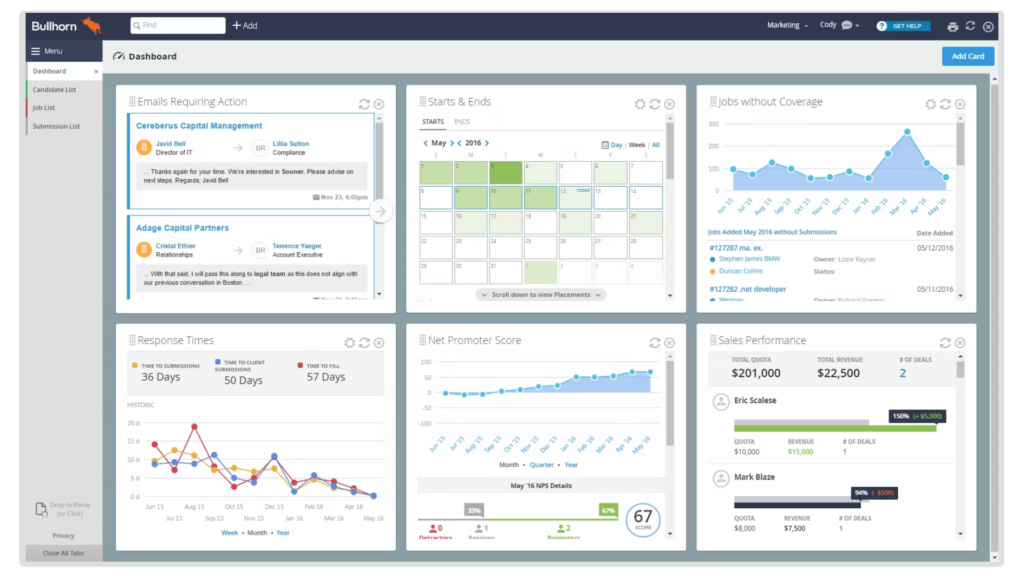
Bullhorn is an enterprise-focused recruitment CRM and ATS designed to support staffing agencies with end-to-end workflow management. For larger agencies operating across multiple teams or locations, it brings candidate sourcing, client relationship management, sales activity, and recruitment operations into a single cloud-based system.
This centralized structure makes it easier to coordinate activity at scale while maintaining oversight across the organization. Within its CRM functionality, recruiters can manage contacts, log communication, and track job orders and client activity in one place. Automation tools help streamline outreach, follow-ups, and task triggers, reducing manual effort across high-volume workflows.
Bullhorn also includes reporting capabilities and a mobile app to support distributed teams and recruiters working remotely. While it is built to handle complex recruitment environments, implementation and onboarding may require more time and internal resources than more modern platforms.
Key features of Bullhorn:
- Client lifecycle management
- Workflow automation
- Resume screening and parsing
- Job and candidate tracking
- Reports and analytics
- Integrations
- Invoicing
- Open API
Best for: Large organizations looking for traditional agency workflows
Not ideal for: Teams looking for a lightweight tool with a modern interface
Pricing: No free trial available, contact the vendor for pricing details
7. Teamtailor
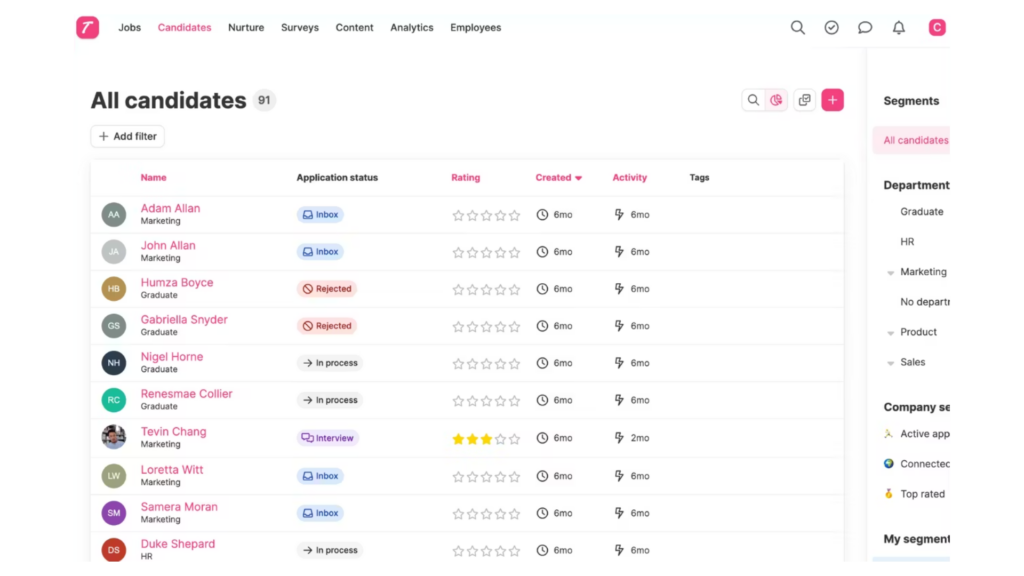
Teamtailor is an applicant tracking system designed with usability, collaboration, and employer branding in mind. While it is widely adopted by in-house hiring teams, some recruitment agencies use Teamtailor to manage candidate pipelines, job postings, and communication within a structured, user-friendly environment.
For enterprise agencies evaluating ATS options, it offers a streamlined approach to organizing hiring workflows across multiple roles and recruiters. The platform focuses on core ATS functionality, including candidate profiles, job management, team collaboration, and structured communication.
Its interface is built for clarity, which can support consistent processes across teams, particularly in agencies that value a strong candidate experience and branded career pages. Teamtailor also integrates with job boards and third-party tools to expand its capabilities within a broader recruitment tech stack.
Key features of Teamtailor:
- Customizable automations
- Candidate profile management
- Workflow and pipeline management
- Candidate outreach tools
- Interview kits
- Reports and analytics
- Career site and branding tools
- Mobile app
- Integrations
Best for: Teams prioritizing branding and candidate experience
Not ideal for: Agencies in need of deeply connected ATS and CRM features
Pricing: Free trial available, contact the vendor for pricing details
8. Lever
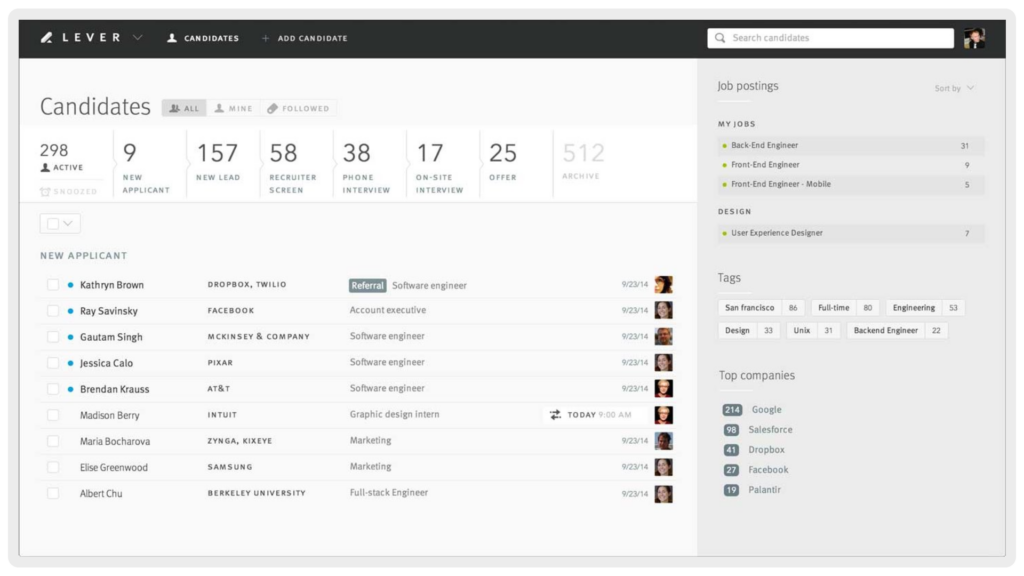
Lever is a talent acquisition platform that combines ATS and CRM functionality under its LeverTRM offering. Designed to support structured hiring and relationship-driven recruiting, it provides enterprise teams with tools to manage candidate pipelines, nurture talent pools, and maintain visibility across the hiring lifecycle.
For larger agencies evaluating enterprise recruitment software, Lever offers a centralized system for coordinating sourcing, communication, and collaboration across multiple recruiters and stakeholders.
The platform emphasizes pipeline management, automation, and candidate engagement, allowing teams to track touchpoints, build long-term talent communities, and standardize workflows. With reporting dashboards and integrations across HR and productivity tools, Lever supports organizations that want a unified view of recruiting performance while maintaining consistent processes across business units.
Key features of Lever:
- Customizable automations
- Pipeline management
- AI-powered candidate screening
- Interview scheduling and feedback
- DEI hiring dashboards
- High-volume hiring tools
- Reports and analytics
- Integrations
Best for: Teams prioritizing candidate engagement and talent nurturing
Not ideal for: Enterprise agencies seeking deep BD workflows or those looking for a lightweight user interface
Pricing: No free trial available, contact the vendor for pricing details
9. JobAdder
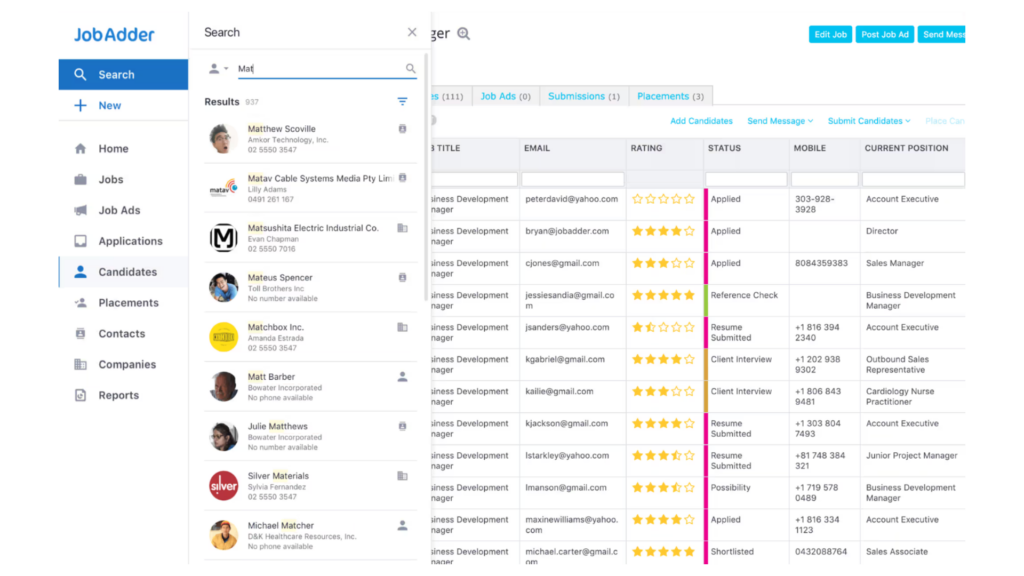
JobAdder is a recruitment system that supports staffing agencies looking to centralize candidate and client management within a single system. For enterprise agencies operating across multiple teams or regions, it provides a structured environment to oversee job postings, candidate pipelines, and client relationships without relying on disconnected tools.
Its emphasis on usability makes it accessible for recruiters while still offering the functionality required for larger-scale operations. The platform supports business development workflows by enabling teams to track leads, manage contact records, and convert opportunities into active job orders within the same system.
Configurable pipelines and task management tools help maintain visibility across teams, while integrations with email and productivity tools ensure communication history is logged and accessible. For enterprise agencies seeking an organized, end-to-end platform for full-cycle recruitment, JobAdder offers a flexible and centralized approach.
Key features of JobAdder:
- Candidate, client, and job tracking
- Record management
- Client history management
- Lead generation
- Custom workflows and pipelines
- Candidate search and filtering
- Dashboards
- Reports and analytics
- Integrations
Best for: Agencies looking for workflow customization and third-party integrations
Not ideal for: Enterprise-level reporting and complex analytics
Pricing: No free trial available, contact the vendor for pricing details
10. JobDiva
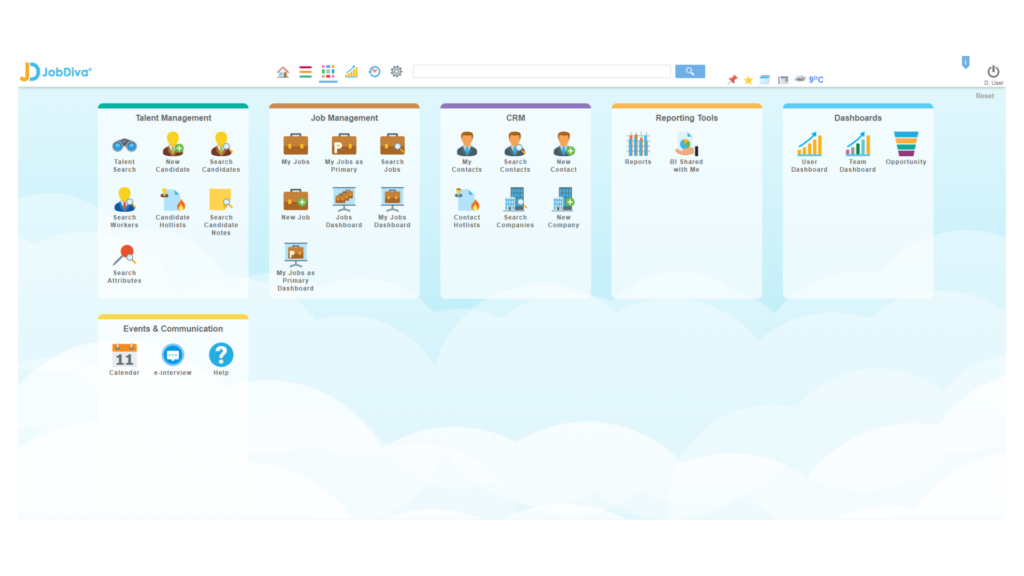
JobDiva is a recruitment platform that combines ATS, CRM, vendor management system integration, and back-office tools into a single system tailored to staffing agencies and large teams. For enterprise agencies handling high volumes of placements and complex client requirements, it centralizes candidate sourcing, job order tracking, communication, financial workflows, and analytics under one unified platform.
JobDiva’s automation and data-driven tools help larger teams coordinate activity across offices and functions without relying on disparate systems. The platform’s ATS capabilities include advanced search and resume harvesting that surface strong candidate matches quickly, while the CRM component supports contact and communication tracking across clients and candidates.
Key features of JobDiva:
- Candidate and client tracking
- AI candidate matching
- Interview scheduling
- Back-office workflows
- Resume harvesting
- Communication logging
- Ready-made report templates
- Integrations
Best for: Teams handling high-volume hiring and complex workflows
Not ideal for: Agencies looking for a quick and seamless platform adoption
Pricing: No free trial available, contact the vendor for pricing details
What is enterprise recruitment software?
Enterprise recruitment software is a recruiting platform designed to support large, complex hiring operations. For recruitment agencies, this usually means managing multiple teams, clients, and high volumes of candidates while maintaining consistent processes and visibility across the organization.
The best enterprise recruitment software typically combines core ATS functionality with CRM capabilities in a single system. On the ATS side, these tools help agencies track candidates through every stage of the hiring process, from application and screening to placement and onboarding. On the CRM side, they support long-term relationship management with candidates and clients, making it easier for recruiters to nurture talent pools, manage pipelines, and respond quickly to new hiring needs.
Unlike basic recruiting tools, enterprise-grade platforms are built to handle scale. They enable agencies to centralize candidate and client data, standardize workflows across teams, and reduce reliance on manual tasks and disconnected systems. Automation plays a key role here, whether it is resume parsing, candidate matching, outreach, or status updates, helping recruiters spend more time on high-value work.
How does enterprise recruitment software support multiple teams and clients at scale?
As agencies grow, the challenge is no longer finding a tool that works for one team or one client. The best enterprise recruitment software is built to support many recruiters, teams, and client accounts at the same time, without creating data silos or process gaps. This is where enterprise-grade ATS and CRM platforms stand apart from smaller recruiting tools.
For recruitment teams operating at scale, enterprise recruitment software helps by:
Centralizing candidate and client data
A single ATS and CRM environment allows teams to work from the same source of truth, reducing duplicate records and improving talent management collaboration across desks, offices, and regions.
Supporting structured workflows across teams
Enterprise recruitment software makes it possible to define and maintain consistent recruiting workflows while still allowing flexibility for different clients, job types, or business units.
Managing permissions and access by role or team
Role-based access ensures recruiters, managers, and operations teams see what they need to see, helping agencies protect sensitive client data while maintaining oversight at scale.
Improving visibility and reporting across the agency
The best enterprise recruitment software provides reporting at both the team and agency level, making it easier for leadership to track performance, capacity, and client delivery without relying on manual reports.
What features should enterprise recruitment software include for large agencies?
Agentic AI for admin-free recruitment
Administrative work tends to scale faster than placements. The best enterprise recruitment software uses agentic AI to remove that burden by running tailored AI agents in the background of the ATS and CRM, automatically managing workflows, updates, and data hygiene.
Instead of asking recruiters to constantly maintain the system, these AI agents handle routine tasks without manual input, keeping pipelines accurate and moving. This allows recruitment teams to spend less time managing software and more time focused on candidates, clients, and successful placements.
Enterprise hiring dashboards for granular analytics
Visibility across teams is essential to staying aligned on performance. The best enterprise recruitment software includes customizable dashboards within the ATS and CRM that allow agency leaders and operations teams to drill into interviews, placements, pipeline health, and team targets in real time.
By configuring dashboards to match how different teams work, enterprise platforms ensure everyone is looking at the same data, in the right level of detail, which supports clearer decision-making and more consistent delivery across the agency.
Advanced business development (BD) for opportunity identification
Growth depends on spotting the right opportunities before competitors do. The top enterprise recruitment software supports advanced business development by embedding intelligent systems into the ATS and CRM that continuously analyze candidate and client data.
With agentic AI scanning the recruitment database in the background, these platforms can surface high-intent candidates, highlight which prospects to prioritize, and identify where revenue potential is strongest, helping teams focus their BD efforts on opportunities most likely to convert.
Outreach campaigns for centralized candidate sourcing
For large agencies with many consultants running outreach in parallel, fragmented communication quickly becomes a risk. Enterprise recruitment platforms bring all outreach campaigns into a centralized ATS and CRM, giving teams shared visibility into emails, messages, responses, and follow-ups across the entire agency.
This makes it easier for recruiters to collaborate, step in when needed, and maintain continuity with candidates and clients, while leadership retains a clear view of pipeline activity and engagement at scale.
Customizable recruiter playbook for consistent messaging
Maintaining a consistent voice becomes harder as agency teams grow. The best enterprise recruitment software allows agencies to define a customizable recruiter playbook that guides how AI agents write across the ATS and CRM, from outreach campaigns to internal reports.
By aligning AI-generated content with the agency’s tone of voice and messaging standards, enterprise platforms help ensure communication stays consistent and professional across teams, even as the number of recruiters and clients continues to scale.
Intelligent scoring for spotting best-fit candidates early
At enterprise scale, manually reviewing every profile is not realistic. Intelligent candidate scoring within modern ATS and CRM platforms allows recruiters to define granular criteria based on role requirements, client preferences, and historical placement data.
By analyzing information across resumes, emails, interview notes, and transcripts, the system can surface a prioritized shortlist of best-fit candidates with clear explanations behind each recommendation, helping recruiters cut sourcing time significantly while maintaining confidence in candidate quality.
Client reports for clean, white-label reporting
For agencies managing multiple clients across several recruitment teams, reporting needs to be fast, accurate, and client-ready. The best enterprise recruitment software enables recruiters to generate polished client reports directly from the ATS and CRM, using real-time data and customizable templates.
With white-label options such as client logos, brand colors, and tailored layouts, enterprise platforms help agencies deliver professional reports in minutes, reinforcing credibility and making recruitment performance feel like a seamless extension of the client’s own operations.
AI note-taking with a mobile app for in-person interviews
During in-person interviews, recruiters need to stay present in the conversation rather than focus on capturing every detail. Enterprise recruitment platforms with native AI note-taking support this by recording, transcribing, and structuring interview notes automatically.
When paired with a mobile app, in-person interviews can be captured seamlessly, with transcripts pulled directly into the ATS and CRM and linked to the correct candidates or clients, reducing follow-up admin while preserving accurate, searchable records.
Integrations and open API for a seamless tech stack
As agency tech stacks grow more complex, flexibility becomes a requirement rather than a bonus. The best enterprise recruitment software offers a strong set of native integrations alongside an open API, allowing agencies to connect their ATS and CRM with the rest of their tools without forcing workarounds.
This open approach ensures critical systems can stay in sync, data flows end to end, and recruitment teams can scale their operations without being limited by a closed or rigid platform.
When is it a good time to switch to enterprise recruitment software?
For enterprise recruitment agencies, switching platforms is often triggered by operational friction rather than feature gaps. It may be time to evaluate a new system if:
Recruiters are spending too much time on admin
When your ATS or CRM requires constant manual updates, duplicate data entry, or workarounds, productivity drops quickly across large teams.
Leadership lacks clear visibility into performance
If reporting on interviews, placements, or revenue relies on spreadsheets or disconnected tools, it becomes harder to align teams and make confident decisions.
The platform no longer scales with high-volume hiring
As teams, clients, and regions expand, rigid workflows, limited permissions, or poor multi-team support can turn software into a bottleneck.
Your tech stack feels fragmented
When key tools do not integrate well with your recruitment software, data silos emerge, and recruiters lose trust in the system.
As these challenges start affecting recruiter efficiency or client experience, switching enterprise recruitment software becomes a strategic move rather than a technical one.
How do you choose the right enterprise recruitment software?
Choosing a new platform at the enterprise level is a strategic decision that affects every recruiter, client, and placement. Instead of focusing only on feature lists, agency leaders like yourself should ask the right operational questions:
- Will this recruiting software significantly reduce administrative work across all recruiting teams?
- Can it support multiple teams, clients, and business units without creating data silos?
- Does it offer the level of customization we need for workflows, dashboards, and permissions?
- Will it provide real-time visibility into interviews, placements, and revenue performance?
- Does it integrate with our tech stack through native integrations or an open API?
- Is the system built to scale with our agency over the next several years?
- Will recruiters adopt it easily, or will it introduce additional complexity?
- Does it strengthen the quality and consistency of service we deliver to clients?
- Can we try it for free without committing to a multi-year contract upfront?
Scale your staffing firm with the best enterprise recruitment software in 2026
For enterprise recruitment agencies, growth brings opportunity and operational pressure at the same time. As new consultants join, client portfolios expand, and teams spread across regions or specializations, disconnected systems and manual processes quickly become a liability.
The right enterprise recruitment software centralizes your ATS and CRM, reduces administrative overhead, and creates shared visibility across the entire agency, allowing recruiters to focus on placements while leadership retains control over performance and quality. This translates into a real competitive edge for recruiting agencies looking to one-up their hiring strategies.
Leave your admin behind with Atlas – the Recruitment Platform
Recruitment automation software that streamlines admin, automates workflows, and unifies communication across teams gives enterprise agencies the foundation they need to grow confidently and sustainably. Atlas is built with that reality in mind.
Designed around agentic AI and admin-free recruitment practices, it supports enterprise recruitment firms that want to eliminate repetitive tasks, centralize their data, and empower consultants to focus on revenue-generating work. For growing agencies looking to future-proof their operations, Atlas – the Recruitment Platform is the best recruiting software for 2026 and beyond.

Related news

// Software Comparisons
How Easily Do You Trust New AI Recruitment Software?
Explore what influences trust in new AI recruitment tools and how to assess their accuracy and fairness when choosing a new ATS or CRM.
12/10/2025
7 MIN

// Software Comparisons
How can you improve in-person recruiting interviews with the Atlas mobile app?
Learn how to improve in-person interviews using the Atlas mobile app to evaluate candidates better, reduce bias, and hire smarter.
01/13/2026
9 MIN

// Software Comparisons
5 Struggles That Recruiters Are Facing and How an AI Applicant Tracking System Can Help
Discover 5 key challenges recruiters face in documentation and candidate evaluation and how AI-powered solutions can help.
12/18/2025
9 MIN