









// Recruitment Technology
Auto-Capture Without the Junk: Syncing Your Inbox Without Filling the CRM With Landlords
Published: 17 November 2026,
8 min to read
The bottom line
Automatic capture is worth having, and the fear agencies attach to it is well founded. Connect an inbox with no rules and the database fills with suppliers, landlords, internal colleagues and strangers who emailed once. Every forwarded resume becomes a record nobody owns.
The fix sits at the point of ingestion rather than in a cleanup project months later. Scope rules, folder limits, matching logic and an approval queue let a team keep the capture and skip the cleanup.
Why agencies switch off the inbox sync they paid for
Most agencies connect the inbox once. The second attempt is a negotiation.
What happens in between is familiar to anyone running a mid-to-large desk. A consultant searches for a finance candidate and finds the commercial landlord who handles the Leeds office lease. The record comes complete with an activity history and an enriched company profile. Somewhere nearby sits the rec2rec agency that has been pitching the team for two years.
That is the point where CRM data hygiene stops being a governance slide and starts costing billings. The database your team searches every morning absorbed everything else along the way. Supplier threads, internal messages about holiday cover, job board alerts, and resumes forwarded between consultants.
Nobody serious is arguing against capture. The alternative is recruiters typing notes into fields after a call. That is how legacy systems ended up with records three lines long. The argument has always been about scope, and scope is a setting rather than a philosophy.
What actually lands in your CRM when you sync an entire inbox?
Four kinds of record arrive, and only one of them belongs to a candidate or a client. An unfiltered connection reads the mailbox as one undifferentiated stream. A background check vendor and a retained client are treated as equals.
Each category carries its own cost once it is inside:
Single bad records are survivable. Dilution is what hurts. A recruiter searching for a treasury controller now sorts through contacts who were never candidates. Duplicate records multiply as the same person appears under a personal address and again under a work address.
The commercial weight of this is well documented outside recruitment. MIT Sloan Management Review put the cost of bad data at 15% to 25% of revenue for most companies. That cost is the time people spend correcting errors and confirming figures elsewhere.
On a recruitment desk it shows up as manual research on a record the system already held.
- Suppliers and vendors. Job boards, background check providers, the landlord, the IT contractor, the coffee company
- Internal colleagues. Every consultant on your own team, filed as contacts with threads about annual leave attached
- One-touch strangers. Someone who emailed once about a role filled in 2023, now a permanent record with outdated job titles
- Forwarded resumes. A CV attached to an internal thread, creating a candidate with no source, no owner and no consent trail
Where does CRM data hygiene actually break on a busy desk?
At capture, every time. Rules applied afterwards become a cleanup project. Cleanup never wins against volume on a desk sending hundreds of emails a day.
The sequence is predictable. Capture goes on, the database swells, and someone volunteers to run a dedupe pass. The pass ends when the quarter gets busy. Six months later the agency pays for a system its own consultants have stopped trusting.
Then the workarounds appear. A shadow spreadsheet, owned by one person, deleted by nobody.
This is the structural problem behind the numbers Atlas found in its own research. 56.16% of agency recruiters describe their technology setup as functional but fragmented. Another 36.99% name too much manual work as their biggest operational challenge. Fragmentation and admin feed each other here. A database nobody trusts gets supplemented with private tools. Those tools guarantee the main system stays incomplete.
An all-or-nothing switch forces a bad choice on an operations director. Turn capture off and lose the history that makes the system useful. Leave it on and accept that candidate search returns the office furniture supplier.
Which filters keep automatic capture useful without the cleanup?
Rules that decide scope before anything is written, rather than audits that find problems after. Four settings do most of the work, and they are the practical core of any data hygiene process worth running:
Matching deserves the most attention, because it is where silent errors come from. A message that could belong to two records should stop and ask rather than guess. Merging duplicate records later is slower than preventing one now.
Stale records are a separate problem from junk records, and data decay deserves its own schedule. Access controls belong in the same conversation. A synced email about a client’s restructure belongs to the team working the account, not the whole business.
None of this makes capture less automatic. It makes it selective, which is the difference between data enrichment and data accumulation.
- Domain rules. Your own domain and known supplier domains never create contacts, however often they appear
- Folder scope. Name the folders that are read and the folders that are never touched, then write it down
- Relationship thresholds. A single inbound message rarely signals a relationship, while a two-way thread usually does
- Matching logic. A message that matches two records routes to a person instead of creating a third
How should an approval queue handle every emailed resume?
By holding the applicant outside the database until a person accepts them. A resume that arrives by email is a claim on your time. Whether it becomes a record is a decision, and the system should treat it that way.
That separation is what makes high volume survivable. Applications land, they get graded, and nothing enters the searchable database until a consultant approves it.
Built around exactly that principle, Atlas is an AI-powered CRM and recruitment platform. Agentic AI lifts the admin off an agency desk. It connects to Gmail and Outlook and parses every resume on arrival. Work history, skills, employers and contact details get structured without anyone touching a field. The email sync detects resumes as they hit the inbox, then appends them to the right candidate or creates an applicant.
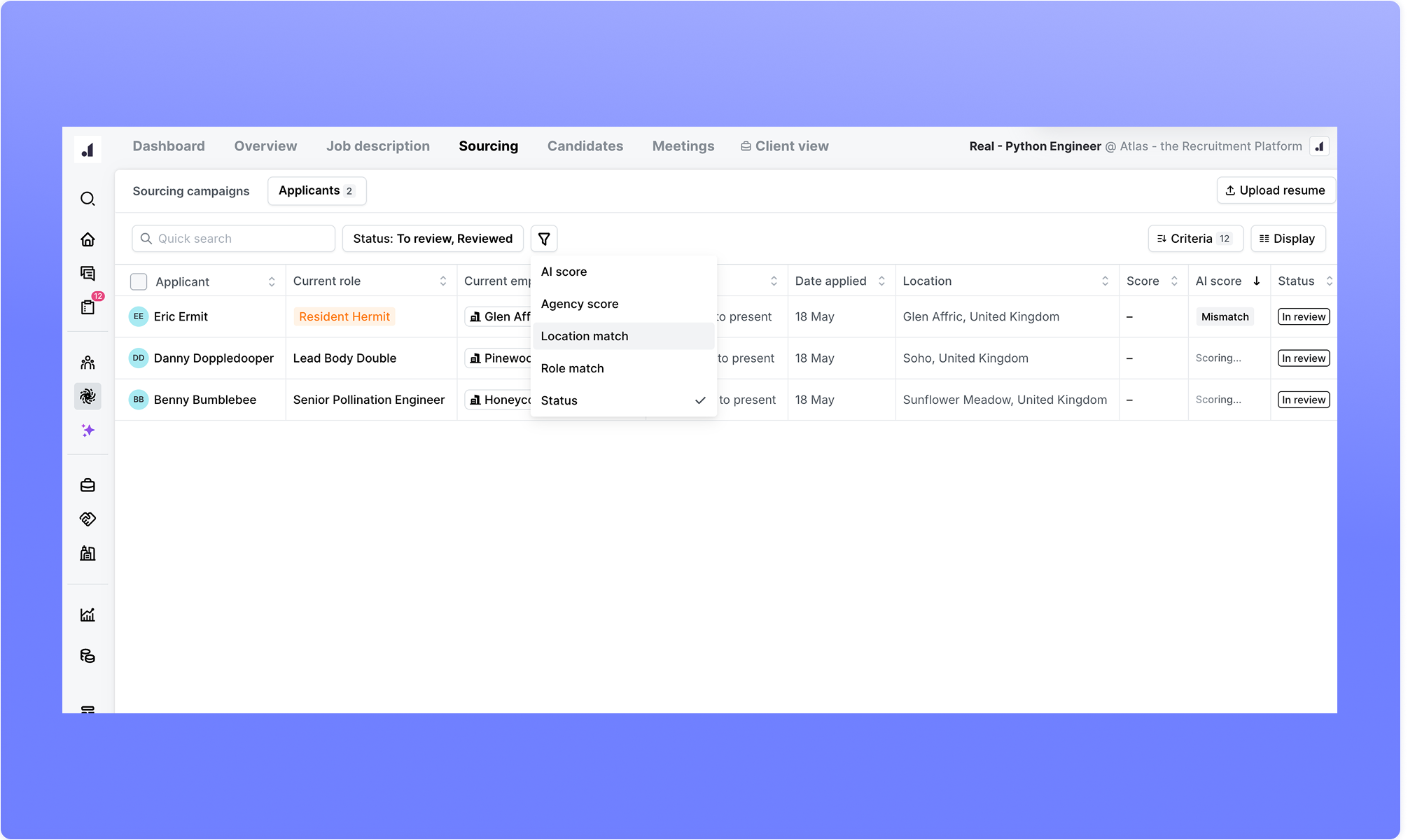
The queue is where control lives. In applicant screening, Atlas grades each applicant against criteria generated from the job description. Every score shows its evidence, and applicants stay completely separate from the database until you accept them. Approve or reject takes one click, and the platform records who made the call and when.
The noise stays out while the capture stays on. Everything approved feeds the wider record. Total memory across emails, calls, interviews and meeting notes then attaches only to people your team works with.
For agency leaders the benefit is accountability as much as cleanliness. When a decision on an applicant is questioned weeks later, the trail is already there.
Frequently asked questions (FAQs) on CRM data hygiene and inbox capture
It means the records in your system are accurate and limited to people your team has a reason to hold. In an agency that means candidate and client records, along with contact details, job titles, consent status and conversation history. Hygiene is an ongoing process tied to how data enters the system, rather than a one-off cleansing project.
Only if the connection has no scope rules. Domain exclusions, folder limits, matching rules and relationship thresholds stop vendors, landlords and internal colleagues from becoming records. Ask any vendor which folders will never be read. Ask how a single inbound email is stopped from becoming a contact.
Through matching rules that run before a record is created. Strong systems check incoming addresses against existing records and recognize the same person across personal and work addresses. Near matches route to a human instead of creating a third record. That is far cheaper than a duplicate contacts cleanup once thousands of records have accumulated.
They should be parsed automatically and held separately until someone approves them. Atlas grades them against your role criteria while keeping them outside the main database. The database grows only when a consultant accepts someone. Volume then has no effect on data quality.
Quarterly is a reasonable rhythm for fields that decay fast, such as job titles and phone numbers. Regular data audits matter far less once capture is controlled, because most bad records never enter the system. Audits should confirm the rules are working rather than carry the whole hygiene burden.
No. Filtering decides what becomes a record, and nothing gets deleted from the mailbox. Threads with suppliers or colleagues stay where they belong, searchable by the person who owns them. The CRM holds the relationships your agency bills against, which is what makes it worth searching.
The capture decision that keeps your database worth searching
Automatic capture and a clean database are not in conflict. The conflict comes from an all-or-nothing switch that treats a landlord and a retained client alike. The way out is control over what gets ingested.
Controlled capture is the capability to insist on. Atlas parses and grades what arrives, then holds every applicant outside your records until a consultant approves them. Strong CRM data hygiene becomes a product of the workflow rather than a repair job afterwards.
Worth a look if your team has already turned the inbox sync off once.