










// Reports
The State of Agency Recruitment: 2026 Benchmark Report
16/03/2026
15 MIN
Agency recruitment is evolving faster than ever. New AI-powered tools, automation platforms, and data-driven workflows are reshaping how agencies manage sourcing, outreach, and operations. At the same time, client expectations in agency recruitment are increasing, with firms under pressure to move faster, deliver stronger candidate pipelines, and provide clearer performance insights.
For many recruitment leaders, the challenge is how to scale agency recruitment without overwhelming recruiters with administrative work, disconnected workforce solutions, and growing operational complexity.
To better understand how agencies are adapting, Atlas conducted original research with 1,000+ agency recruiters participating. We asked how they manage workload, which parts of the recruitment workflow they automate, and how AI is influencing productivity, placement speed, and day-to-day operations in 2026.
The result is the first edition of an annual research initiative from Atlas. This report provides a data-driven snapshot of how agency recruitment teams are adapting to new technology and rising expectations, offering agency owners and recruitment managers a benchmark for where the industry stands today.
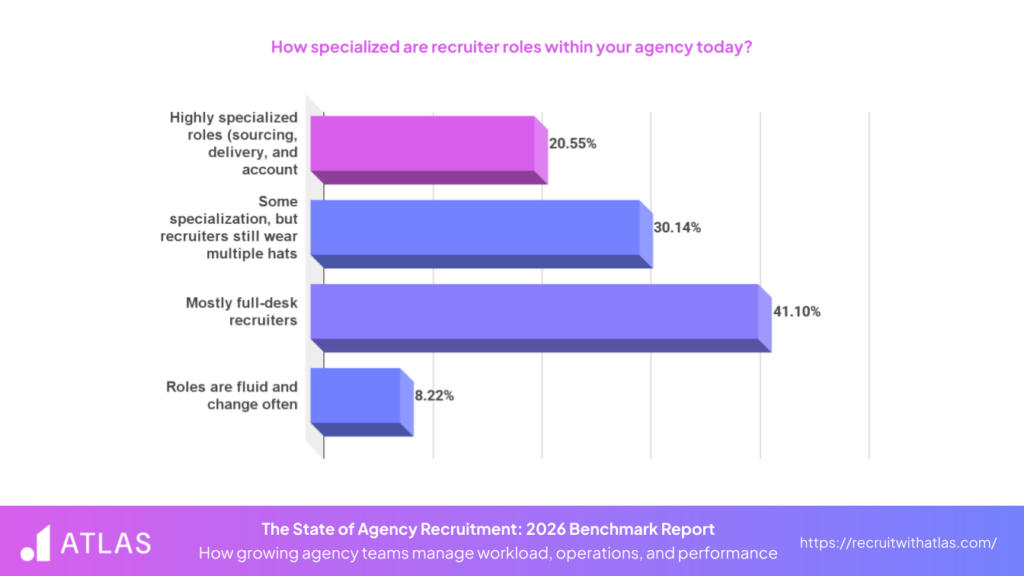
1. 41.10% of agency recruiters work in full-desk roles
Despite new technology and evolving operating models, many agencies still rely on the traditional full-desk structure. In our survey, 41.10% of respondents said their agency primarily employs full-desk recruiters, in which one person manages the entire recruitment cycle for staffing services, from client development to job seekers’ placement.
At the same time, the data shows a gradual movement toward specialization. Another 30.14% of agencies report some role specialization, though recruiters still handle multiple responsibilities. Meanwhile, 20.55% operate with highly specialized roles such as sourcing, delivery, and account management.
This suggests agency recruitment is in a state of flux. While the full-desk model remains dominant, more agencies are experimenting with specialized roles as they look for ways to scale recruiter productivity and manage growing workloads.
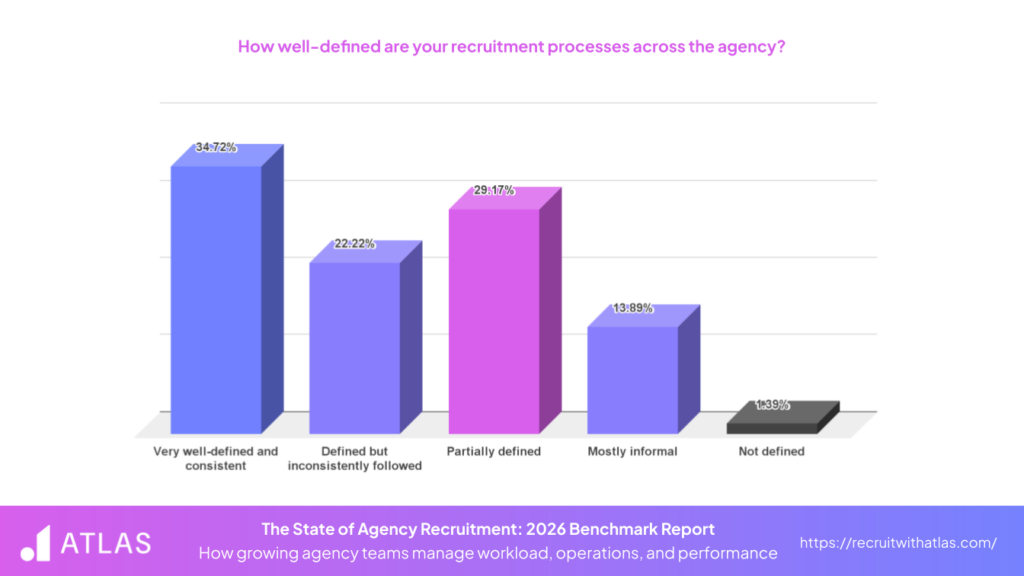
2. 34.72% of recruitment agencies report very well-defined and consistent processes
Process maturity plays a major role in how effectively agencies scale their recruitment operations and human resources. 34.72% of respondents said their staffing agency has very well-defined and consistently followed recruitment processes across the business to deliver workforce solutions to their clients.
However, the data also shows that consistency remains a challenge for many teams. Another 29.17% said their processes are partially defined, while 22.22% reported having defined processes that are followed inconsistently. This indicates that while many agencies have frameworks in place, execution can still vary across recruiters or teams.
A smaller portion of agencies operates with a more flexible staffing approach. 13.89% said their recruitment processes are mostly informal, and 1.39% reported having no defined processes at all. Overall, the findings suggest that agency recruitment is becoming more operationally structured, but many agencies are still refining how consistently those processes are applied.
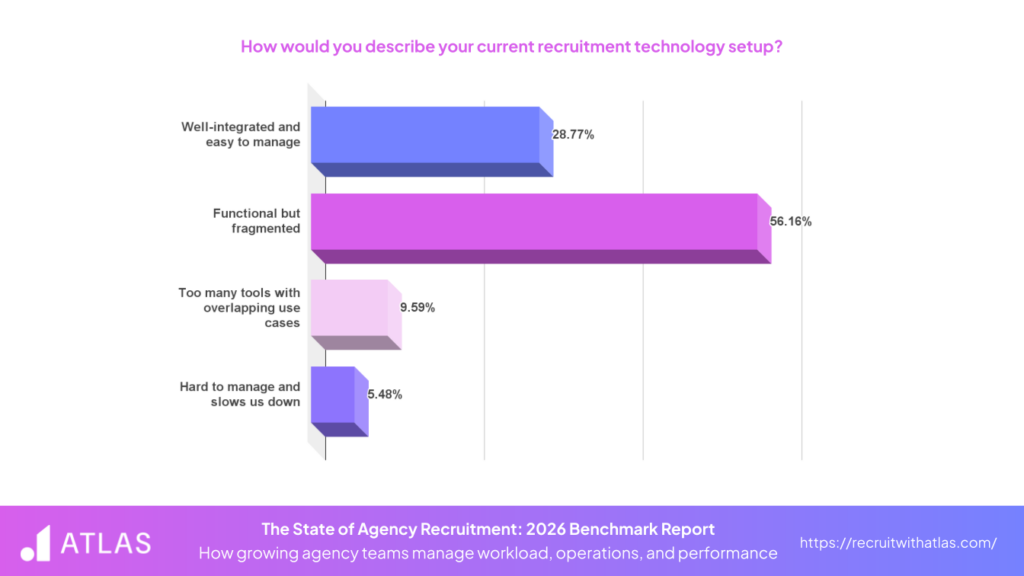
3. 56.16% of agency recruiters report a functional but fragmented tech stack
Technology adoption in agency recruitment has accelerated rapidly, especially with the rise of AI-powered tools. But many agencies are still figuring out how to make these systems work together. 56.16% of respondents said their current recruitment technology setup is functional but fragmented.
This suggests that most agencies have assembled a collection of tools that support sourcing, outreach, CRM management, and automation, but these systems often operate in silos. While the tools themselves may work well individually, recruiters frequently have to move between platforms to complete everyday tasks.
28.77% of agencies reported having a well-integrated and easy-to-manage technology stack. This highlights how rare fully streamlined recruitment systems still are, even as agencies continue investing in new technology.
The data reflects a broader shift happening across agency recruitment. As AI tools become more widely adopted, recruiters are experimenting with different platforms and workflows to find what actually improves productivity.
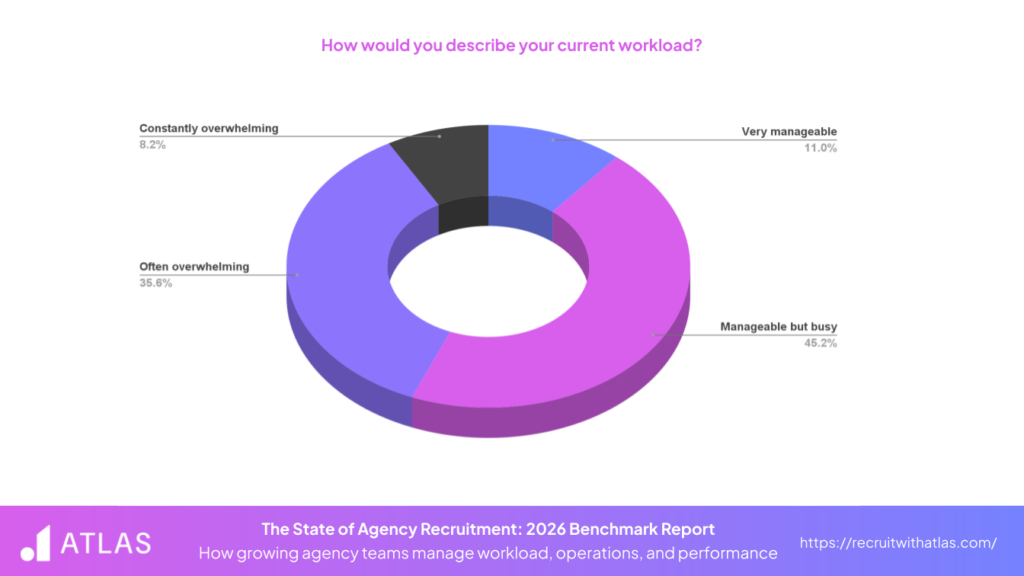
4. 45.2% of recruiters describe their workload as manageable but busy
Agency recruiters today are operating in an environment of rising expectations. Clients want faster shortlists, stronger candidate pipelines, and greater visibility into hiring progress. The result is a pace of work that many recruiters describe as sustainable but intense.
In our survey, 45.2% of respondents said their workload is manageable but busy. Another 35.6% reported that their workload is often overwhelming, highlighting the pressure many recruiters face as agencies try to deliver more placements without proportionally increasing headcount.
This pressure is one of the key drivers behind the rapid adoption of automation and AI tools in agency recruitment. As workloads grow, recruiters are looking for ways to offload time-consuming tasks such as sourcing, outreach, scheduling, and CRM updates. Automating these operational activities allows recruiters to focus more on relationship-building and closing placements.
Only 11.0% of recruiters described their workload as very manageable, while 8.2% said they feel constantly overwhelmed. Most recruiters are navigating a middle ground, balancing increasing client demands with new technology that helps them manage their day-to-day workload more efficiently.
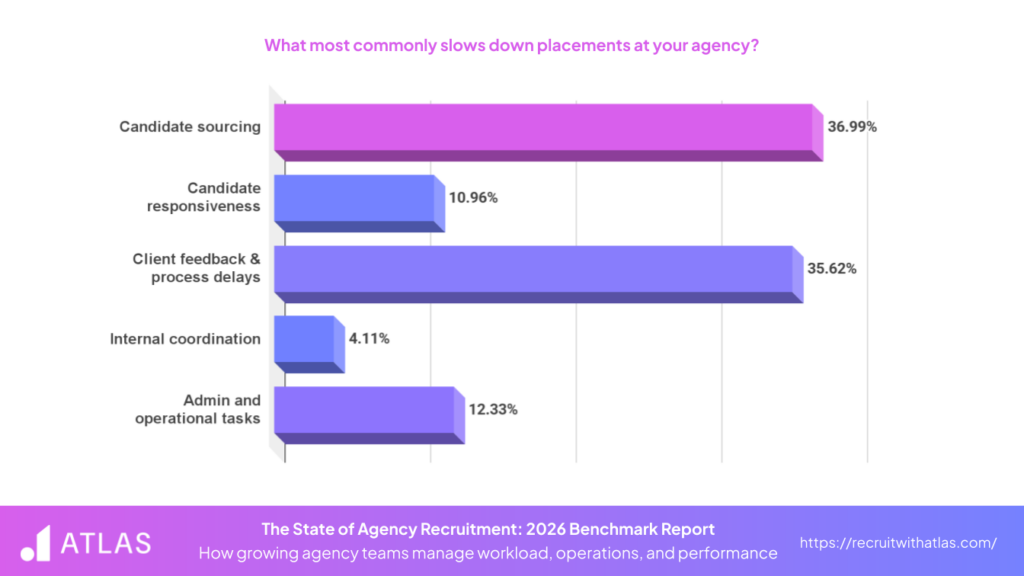
5. 36.99% of agencies say candidate sourcing is the biggest factor slowing placements
When placements stall, the issue often starts at the top of the funnel. In our survey, 36.99% of agency recruiters said candidate sourcing is the biggest factor slowing down placements, making it the most common bottleneck in the recruitment process.
Close behind, 35.62% of respondents pointed to delays in client feedback and hiring processes. Together, these two factors highlight how both sides of the recruitment equation, candidate discovery and client decision-making, can impact how quickly agencies move from job search brief to placement.
To address these challenges with greater success, many recruiters are turning to AI-powered sourcing tools and automation platforms to accelerate the discovery of high-quality candidates. By using technology to surface relevant candidates faster, automate outreach, and prioritize the strongest matches, recruiters are finding ways to reduce the time spent on manual sourcing while keeping pipelines full.
Other operational factors still play a role. 12.33% of recruiters said admin and operational tasks slow down placements, while 10.96% cited candidate responsiveness. However, the data suggests that improving how agencies identify and engage candidates earlier in the process can have the biggest impact on overall placement speed.
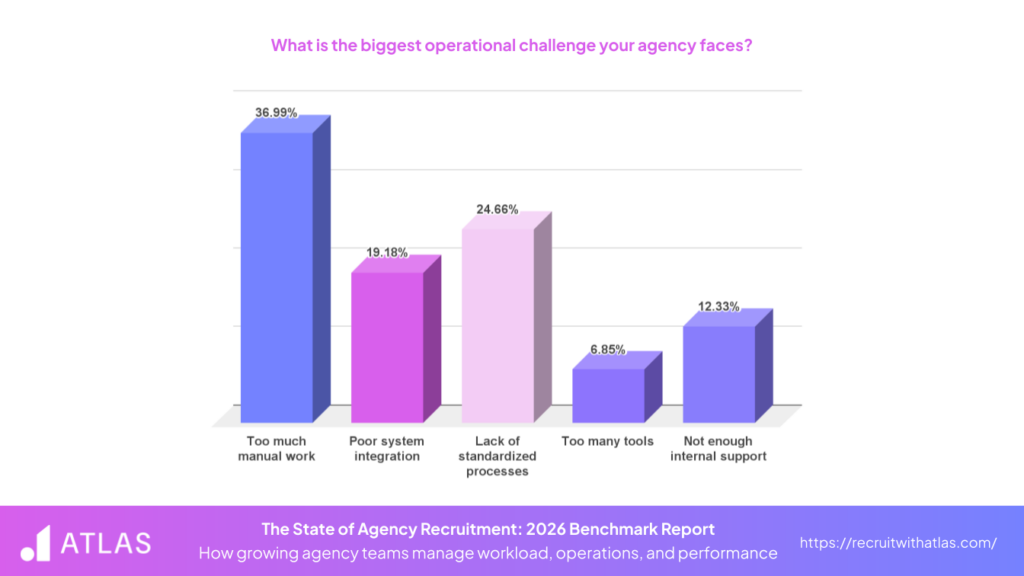
6. 36.99% of agency recruiters say admin is their biggest operational challenge
Despite the rapid growth of recruitment technology, manual work remains the biggest operational challenge for many agencies. In our survey, 36.99% of respondents said too much manual work is the primary barrier to running their recruitment operations efficiently.
Many recruiters still spend significant time updating CRM records, managing candidate notes, scheduling interviews, and coordinating communication between clients and candidates. While these tasks are essential to the recruitment process, they can quickly consume hours that could otherwise be spent sourcing candidates or closing new job placements.
Other operational challenges also highlight structural issues within agency workflows. 24.66% of respondents said a lack of standardized processes slows their teams down, while 19.18% pointed to poor system integration across their technology stack. Smaller groups cited not having enough internal support (12.33%) or managing too many tools (6.85%).
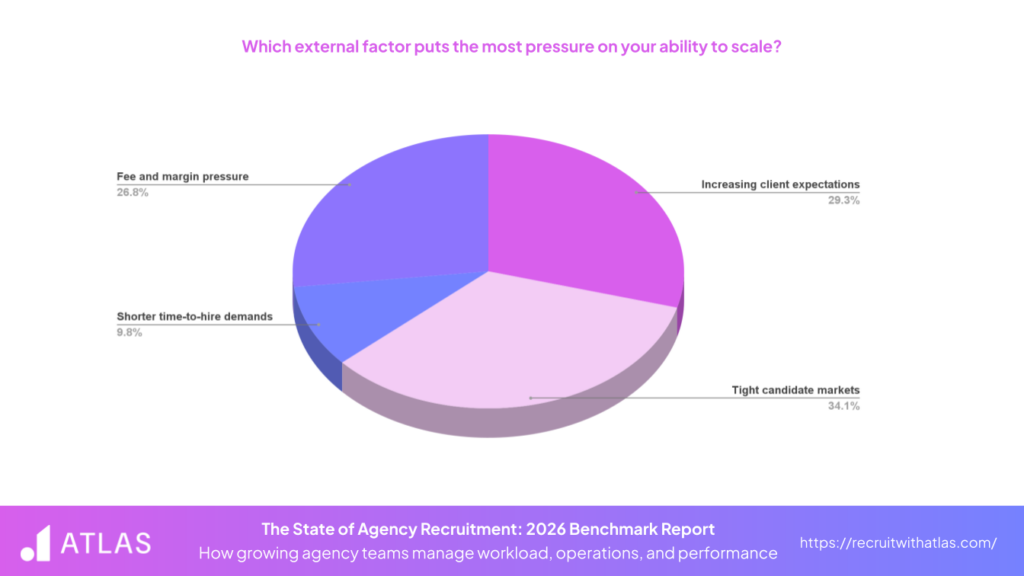
7. 34.1% of agencies say tight candidate markets put the most pressure on scaling
For many agencies, the biggest barriers to growth are not internal. They come from the market itself. In our survey, 34.1% of respondents said tight candidate markets represent the latest trends to put the most pressure on their ability to scale agency recruitment.
When qualified candidates are scarce, recruiters must spend more time sourcing, nurturing, and re-engaging talent pipelines. This makes it harder to consistently deliver strong shortlists to employers and maintain placement speed, especially as agencies try to handle more client demand.
Other external pressures are closely tied to this dynamic. 29.3% of respondents pointed to increasing client expectations as the biggest scaling challenge, while 26.8% cited fee and margin pressure. Together, these trends show how agencies are being asked to deliver better results, faster, often in highly competitive talent markets.
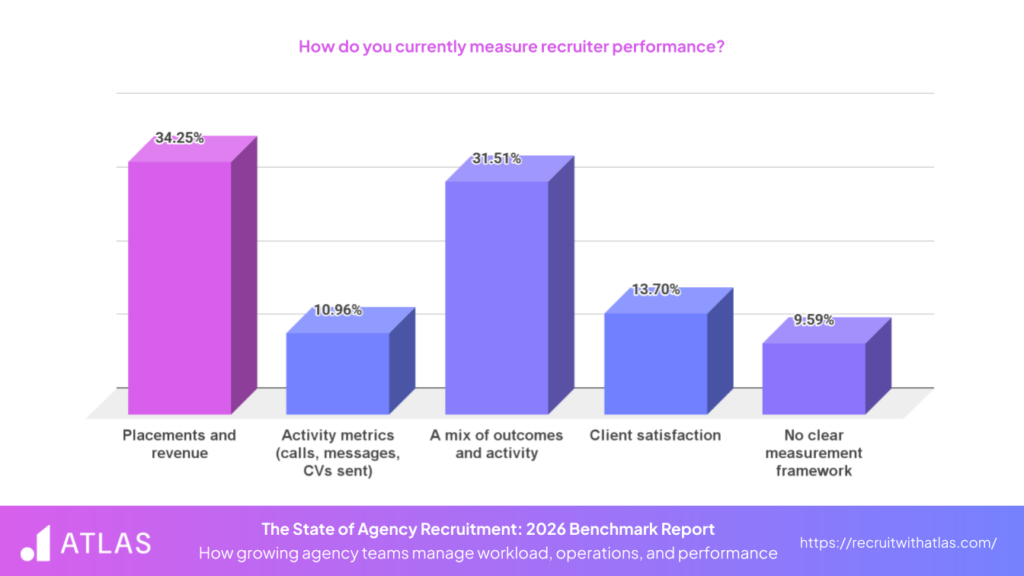
8. 34.25% of agencies measure recruiter performance primarily by placements and revenue
In agency recruitment, performance is still largely tied to results. Our survey found that 34.25% of agencies measure recruiter performance primarily through placements and revenue, reinforcing the industry’s long-standing focus on outcomes and billings.
However, many agencies are beginning to take a more balanced approach. Another 31.51% of respondents said they evaluate recruiters using a mix of outcomes and activity metrics, reflecting a growing interest in understanding the behaviors that lead to direct hires.
Other measurement frameworks are less common. 13.70% of agencies track client satisfaction as a key performance indicator, while 10.96% focus primarily on activity metrics such as calls, messages, or CVs sent. Meanwhile, 9.59% of respondents reported having no clear measurement framework in place.
9. 50%+ of agencies use AI regularly for specific recruitment tasks
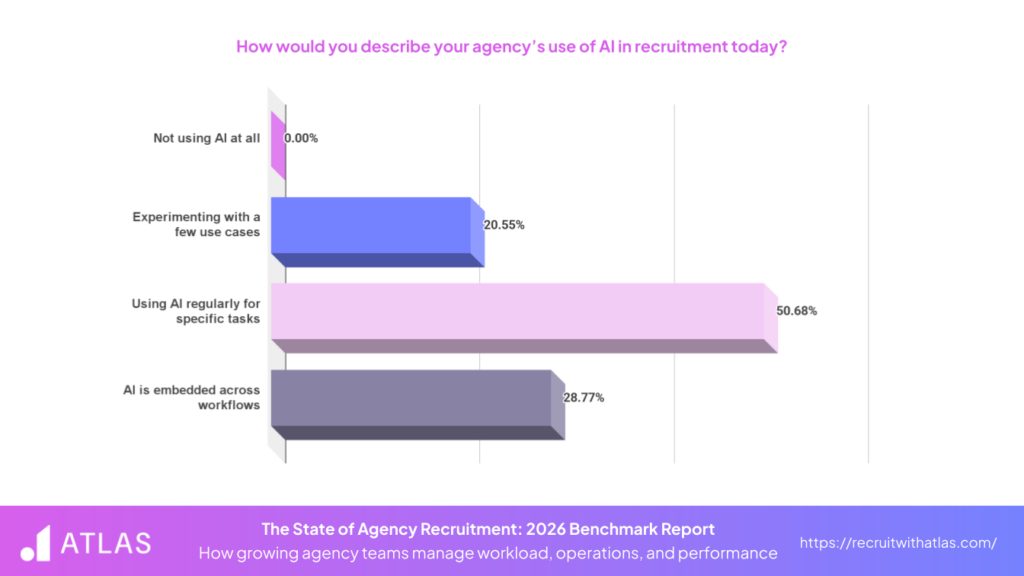
AI is quickly becoming part of the daily toolkit for agency recruiters. In our survey, 50.68% of respondents said their agencies use AI regularly for specific tasks within the recruitment workflow.
Rather than replacing recruiters, AI is most often used to handle operational work that previously consumed hours of manual effort. Recruiters are increasingly using AI tools to capture meeting notes, generate task lists, summarize candidate conversations, and automate follow-ups or outreach campaigns. Agencies are also experimenting with intelligent agents that help manage communication or surface relevant candidates automatically.
Another 28.77% of agencies reported that AI is already embedded across their workflows, suggesting a growing group of teams that are moving beyond experimentation and integrating AI deeply into their operations. Meanwhile, 20.55% are still experimenting with a few use cases as they evaluate where the technology adds the most value.
Together, these findings show that AI adoption in recruitment companies is moving from curiosity to practical application. By automating admin-heavy tasks and supporting routine communication, AI allows recruiters to spend more time on the human side of recruitment.
10. 80%+ of agency recruiters use AI to handle admin and data entry
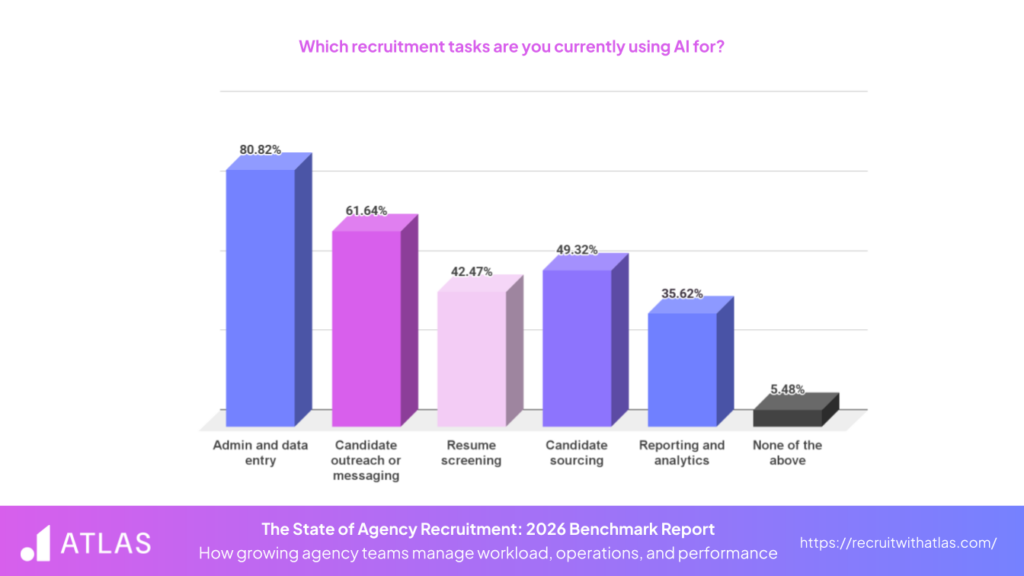
The most common use of AI in agency recruitment today is removing administrative work from recruiters’ daily workload. In our survey, 80.82% of respondents said they currently use AI for admin and data entry tasks, making it by far the most widespread application of the technology.
Administrative work has long been one of the biggest time drains for recruiters. Updating CRM records, logging candidate notes, preparing candidate summaries, and organizing recruitment data can take hours each week. AI tools are increasingly being used to automate these tasks by capturing call notes, generating summaries, updating systems automatically, and creating task lists for recruiters.
Other use cases are also gaining traction. 61.64% of agencies use AI for candidate outreach or messaging, while 49.32% apply it to candidate sourcing. Meanwhile, 42.47% use AI for resume screening and 35.62% leverage it for reporting and analytics. By automating backend processes and routine communication, recruiters focus more on candidate relationships, client advisory, and human interactions.
11. 60%+ of agencies say time savings is the biggest benefit of AI
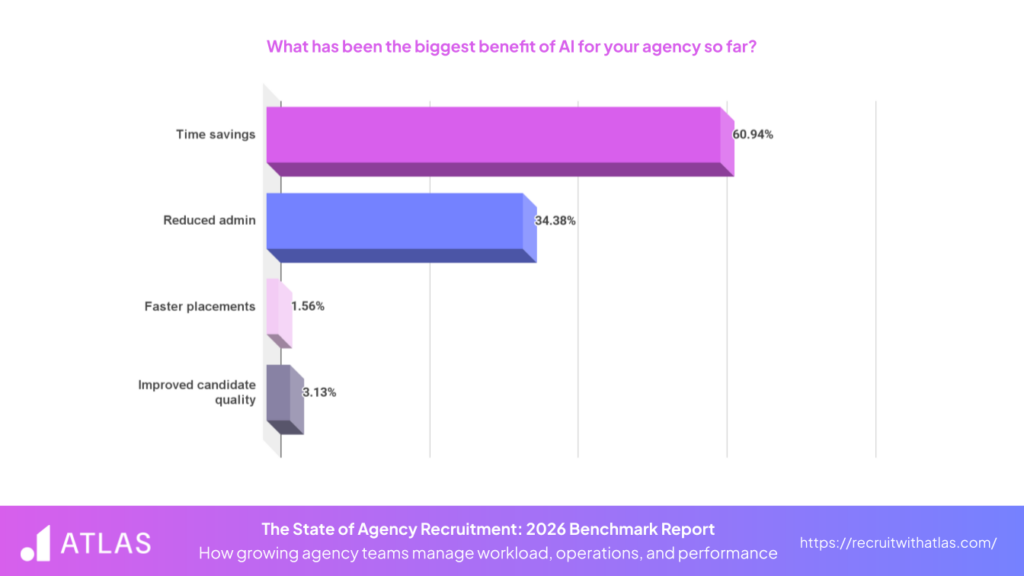
For most agencies, the value of AI shows up in one clear way: time. In our survey, 60.94% of respondents said the biggest benefit of AI in their recruitment operations so far is time savings.
Recruitment workflows are filled with repetitive operational tasks that can quickly consume a recruiter’s day. From updating CRM records and writing candidate summaries to scheduling interviews and organizing communication threads, these tasks are necessary but rarely drive revenue directly. AI tools are increasingly being used to automate these steps, allowing recruiters to move through their workflows faster.
Another 34.38% of agencies pointed to reduced admin as the biggest benefit, reinforcing the idea that AI’s most immediate impact is operational efficiency. By removing administrative work from recruiters’ daily workload, agencies can free up more time for candidate conversations, client advisory, and deal-making.
While smaller groups cited faster placements (1.56%) and improved candidate quality (3.13%), the overall trend is clear. AI’s first major impact in agency recruitment is not replacing recruiters, but giving them back time.
12. 50%+ of recruitment agencies say AI usage will increase significantly during 2026
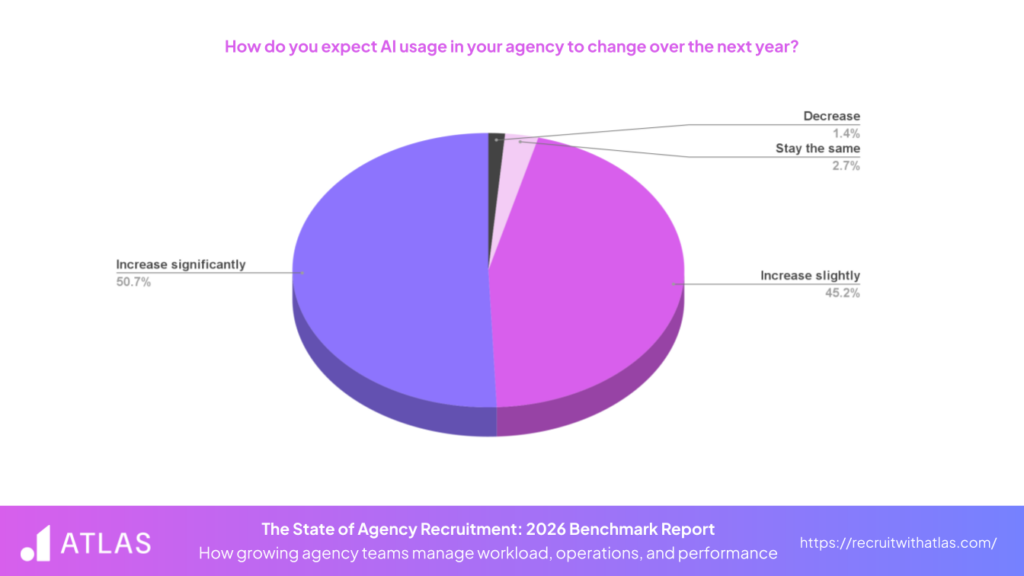
AI adoption in agency recruitment is not slowing down. In our survey, 50.7% of respondents said they expect their agency’s use of AI to increase significantly over the next year, while another 45.2% anticipate usage increasing slightly.
Together, these numbers show that nearly every company expects AI to play a larger role in their recruitment operations moving forward. As agencies look for ways to scale without dramatically increasing headcount, AI tools are becoming an important part of the solution.
Recruiters are increasingly embracing AI to streamline workflows, automate operational tasks, and support candidate engagement. Tools that capture notes, generate task lists, manage outreach, and surface relevant candidates allow recruiters to move faster through the recruitment process while maintaining strong candidate and client relationships.
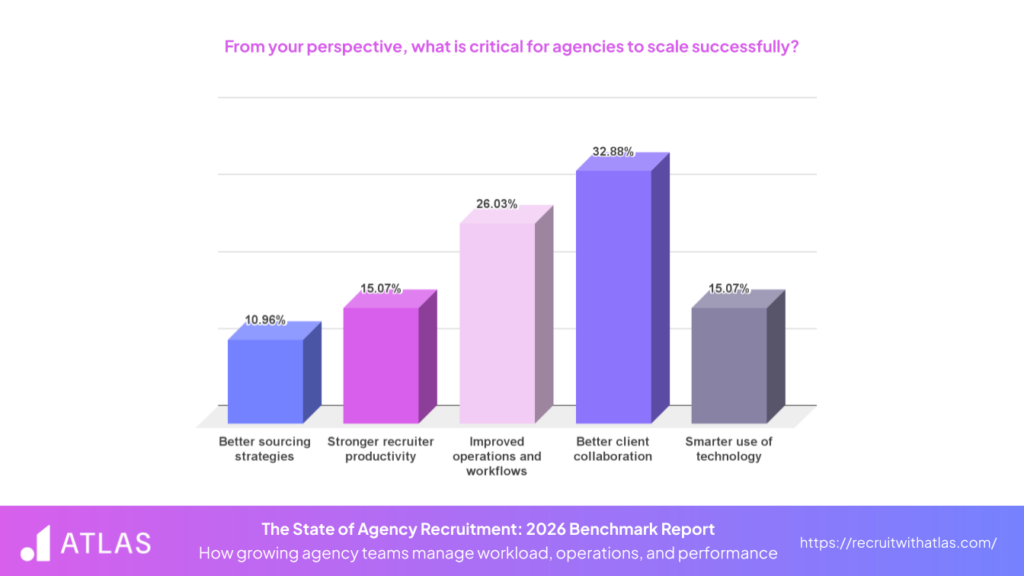
13. 32.88% of recruitment agencies say stronger client collaboration is key to scaling
Successfully scaling an agency is not only about internal efficiency because it also depends on how well recruiters and clients work together throughout the hiring process. In our survey, 32.88% of respondents said better client collaboration is the most critical factor for agencies looking to scale successfully.
When communication with clients is clear and consistent, recruiters can move faster from brief to shortlist and avoid delays in feedback or decision-making. Strong collaboration also helps agencies align expectations earlier in the process, reducing friction and improving placement outcomes.
Internal operations also play a major role. 26.03% of respondents highlighted improved operations and workflows as a key factor in scaling agency recruitment. As agencies grow, having structured processes and clear workflows becomes essential for maintaining consistency across teams.
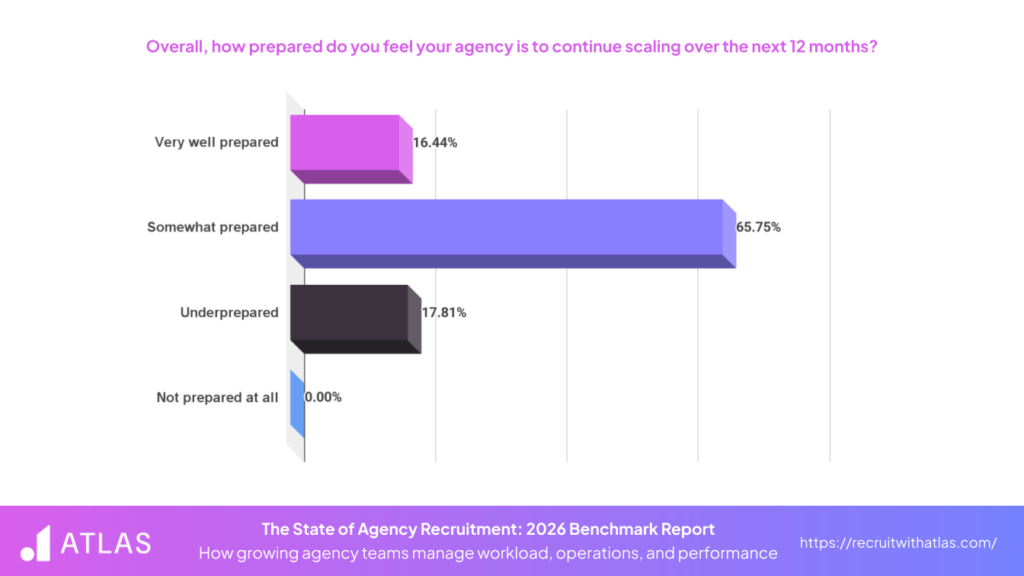
14. 65.75% of agency recruiters feel somewhat prepared for the next phase of growth
Most agencies believe they are on the path to growth, but many acknowledge there is still work to do. In our survey, 65.75% of respondents said they feel somewhat prepared to continue scaling their agency over the next 12 months.
This suggests a level of cautious optimism across the industry. Many agencies have already begun investing in better workflows, stronger processes, and new recruitment technologies, but they are still refining how these pieces fit together as they grow.
At the same time, 16.44% of respondents said their agencies feel very well prepared for the next stage of scaling, while 17.81% feel underprepared. This distribution highlights how the ability to scale successfully often depends on operational maturity, technology adoption, and how effectively recruiters can manage increasing workloads.
As agencies continue evolving their processes and integrating AI-powered recruitment into their workflows, many are building the operational foundations needed to handle higher placement volumes without significantly increasing recruiter workload.
15. What advice would you give to other recruitment agencies in 2026?
Lastly, we turned the microphone to the recruiters and asked them a single question. If there was one piece of advice they would give to other agencies going through the same operational and scaling challenges, what would that be? Below is a small sample of their responses:
“Embrace how AI can help make the day-to-day administrative tasks easier, but don’t lose the human side of recruitment. Look for tools that enable your team and address their true problems rather than plugging in AI for AI’s sake.”
“With many AI tools out there, it can be overwhelming and thus disruptive to your workflow. Make your systems lean, don’t forget your personal input, and use AI strategically.”
“AI will not replace recruiters; however, recruiters who don’t use AI will be replaced by those using it.”
“Recruitment will always be about relationships. Use technology to improve systems and processes that don’t require a human touch.”
Smarter hiring processes define the future of agency recruitment
The findings in this report show an industry in transition, with unique demands and complex talent solution needs. Agency recruiters are navigating rising client expectations, tighter candidate markets, and growing operational requirements. At the same time, AI and automation tools are beginning to reshape how recruitment teams manage sourcing, communication, and administrative work. Placing the perfect match in your client’s next opportunity has become more demanding than ever before.
Across our research report, one theme stands out: agencies are focused on scaling operations without increasing recruiter workload at the same pace. Whether through better workflows, stronger client collaboration, or smarter use of information technology, recruitment leaders are looking for ways to help their teams move faster while maintaining quality and consistency.
Staffing services in an era of automation and scalable operations
This is where a recruitment intelligence platform like Atlas plays an increasingly important role. Built specifically for agency recruiters, it eliminates manual tasks such as data entry, note-taking, workflow management, and operational coordination. By automating recruitment admin, agencies can allow recruiters to focus on building relationships, delivering placements, and driving growth based on the latest data and intelligent insights.
As the recruitment landscape continues to evolve, we will revisit these benchmarks next year in a new edition of The State of Scaling Agency Recruitment. By tracking how agencies adapt to new technologies, market conditions, and client expectations, this annual report will continue to provide a clear view of how agency recruitment is changing over time. For even more on the recruitment industry, read our report on AI and automation to learn how agencies are adapting for 2026.

Related news

// Reports
AI & Automation in Agency Recruitment Statistics: How Recruiters are Adapting for 2026
Explore how agency recruiters are adopting AI and automation tools in 2026. Get key insights, usage patterns, and expectations, backed by original research and compelling takeaways.
10/23/2025
12 MIN

// Reports
10 Best Enterprise Recruitment Software Platforms for 2026 | Top Systems Ranked
A practical look at the best enterprise recruitment software for agencies managing multiple teams, clients, and high-volume workflows.
02/12/2026
20 MIN
// Reports
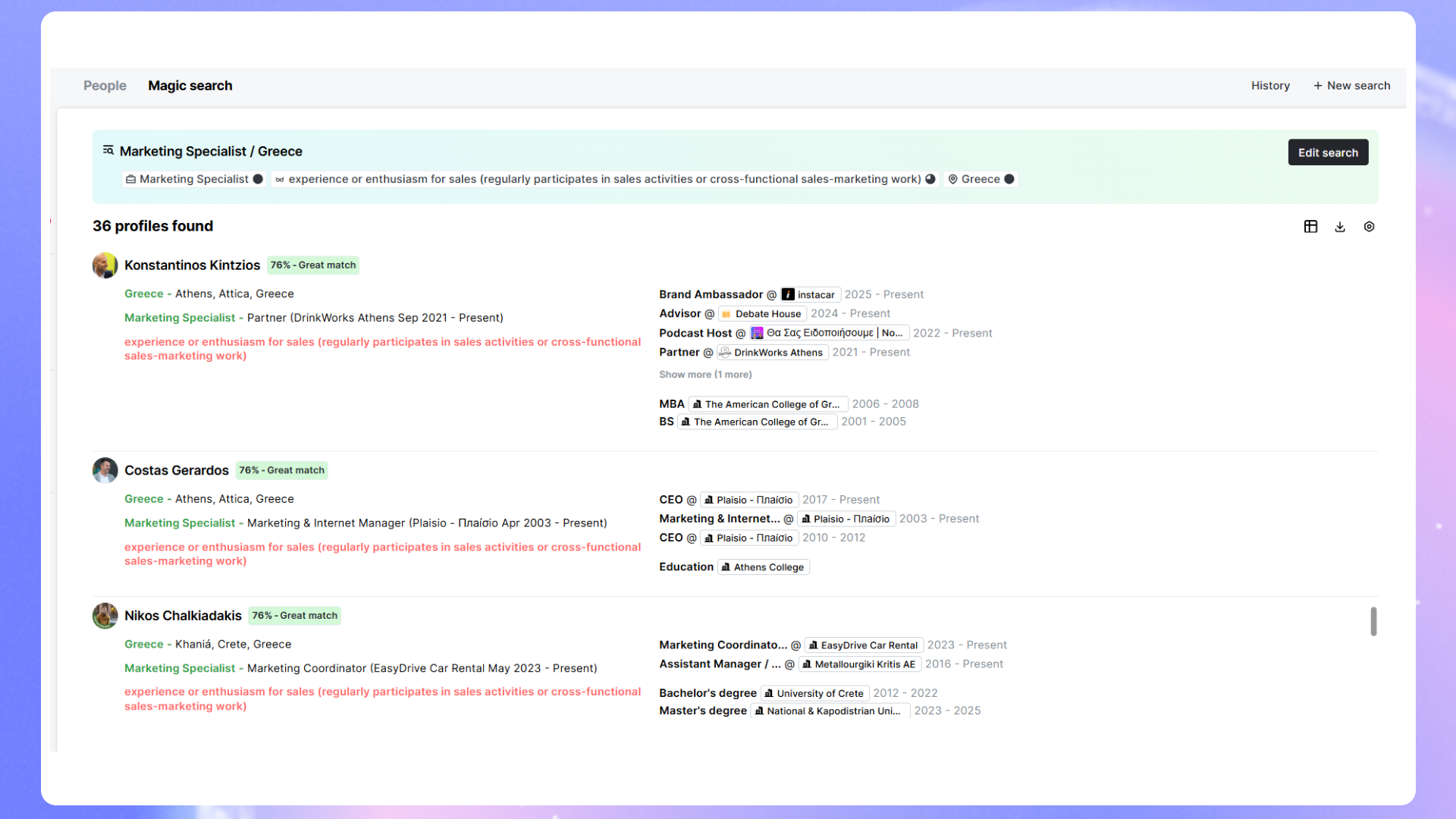
Magic Search: Enterprise AI Candidate Search for Large Staffing Agencies
Magic Search by Atlas delivers an enterprise AI candidate search built for large staffing agencies. Standardize sourcing, improve visibility, and scale recruiting performance.
02/16/2026
9 MIN