









// Recruitment Strategies, Executive Search Best Practices
What Are Hiring Managers Really Looking For In a Candidate?
21/01/2026
8 MIN
There are many aspects and must have skills to consider when identifying the right candidate. The evaluation process usually begins with a review of the candidate’s CV or public professional profile, such as those on social media. Hiring managers often review these materials alongside recruiters to form an initial impression.
Depending on whether you are a recruiter or a hiring manager, the focus during candidate evaluation can differ. Recruiters and human resources usually lead the initial interviews and assess candidates against specific role requirements. When interviewing candidates, they primarily focus on attitude, communication style, motivation, and soft skill set.
Hiring managers, on the other hand, lead the most technical interviews, evaluating in depth the candidate’s hard skills, domain expertise, OKRs, and role-specific competencies.
The role of strong recruiters is especially important, as they are responsible for crafting inclusive job descriptions, sourcing and identifying potential applicants, and conducting initial screenings based on professional profiles and CVs. Through this prescreening process, recruiters ensure that only relevant and qualified candidates move forward in the pipeline. This makes the interview process and the final decision more efficient for hiring managers.
Clear role requirements and effective communication between recruiters and hiring managers also streamline hiring managers’ work, helping to ensure faster hiring decisions.
3 Important Skills that Hiring Teams See in Candidates During the Hiring Process
As potential candidates advance through the hiring process, interviews and assessments become more specific and challenging at each hiring stage. This enables both recruiters and hiring managers to gain deeper insights into technical capabilities, cultural fit, and overall suitability, allowing them to confidently select the best candidate for the role.
Based on the current job market, there are 3 main aspects that hiring managers pay attention to when they select and test job seekers.
1) Educational Requirements and Certifications
If you are part of a recruiting agency, during the kickoff call for a new position, it’s important to understand the clients by asking the right questions. This helps you know where to focus your search and interviews. One important question to ask is whether they value any specific certifications for the job position.
For example, in Accounting and Finance, certifications such as ACCA or CFA may be preferred. In Governance, Risk, and Compliance (GRC) or security-focused roles, certifications like ISO, CISA, or similar credentials can be highly relevant.
Many roles require specific certifications because continuous learning is essential in today’s job market. As technology advances, professionals must constantly update their knowledge, develop new skills, and stay current with industry standards and best practices.
In addition to certifications, most roles also require at least a bachelor’s degree. Education plays a crucial role in building a strong foundation before entering or practicing in a profession, something hiring managers often see as a baseline requirement rather than a differentiator. It equips candidates with the theoretical knowledge and critical thinking skills needed to perform effectively and grow within their roles.
2) Work Experience and Specific Tools
Almost every new position requires a specific number of years of experience, whether that open position is junior or senior. In most job descriptions, experience requirements are clearly outlined in a dedicated section.
However, hiring managers differ in how strictly they interpret these requirements; some insist on meeting them precisely, while others are more flexible, believing that many skills can be learned and developed on the job.
Learning a skill is only the first step; true competence comes from practicing and applying that knowledge in real-world scenarios. From a hiring manager’s perspective, practical experience demonstrates a candidate’s ability to understand the role, navigate real challenges, and contribute effectively.
Over time, experience helps professionals develop judgment, problem-solving abilities, and confidence that hiring managers value highly.
Every role, whether it’s a consultant, software engineer, or marketing assistant, requires familiarity with specific tools, technologies, and workflows. Hiring managers look for this hands-on experience by asking targeted interview questions or assigning practical assessments.
That’s why it’s essential to continuously build practical skills and stay informed about current market trends. Doing so not only strengthens your profile but also ensures you remain relevant in an ever-evolving job market.
3) Attitude and Cultural Fit
Attitude and soft skills are often inherent traits and core competencies. While many job descriptions list specific soft skills, such as ownership, teamwork, and a willingness to help, these qualities cannot truly be assessed on paper.
Instead, they are closely observed by hiring managers during live interactions. They become evident only through direct interaction with a candidate. In these moments, their values, clear communication style, manners, and openness to learning new skills or tools can be observed in real time.
This is why one of the earliest stages in the hiring process is often a cultural interview. During this conversation, recruiters or hiring managers assess whether candidates are polite and enthusiastic about the role and the company.
They also evaluate whether candidates are aligned with the organization’s values. It also helps reveal aspects of their personality, such as whether they are more introverted or extroverted, and how they engage with others.
Attitude plays a critical role in long-term success because it is difficult to change over time. In contrast, hard skills can be developed and strengthened through training and experience. For many hiring managers, a positive attitude and strong cultural fit are just as important, if not more, than technical expertise.
Which Factor Matters Most to Hiring Managers When Making a Hiring Decision?
After conducting some initial research, we ran a poll to better understand what hiring managers value most when evaluating promising candidates. The results clearly showed that work experience and technical expertise are top priorities.
We asked the question, “What are hiring managers really looking for most in a candidate?” and provided 4 possible answers: education, work experience, attitude and cultural fit, and other.
The majority of respondents (46%) indicated that work experience is the most important factor in their decision-making process. Attitude and cultural fit ranked second, while education received the fewest votes.
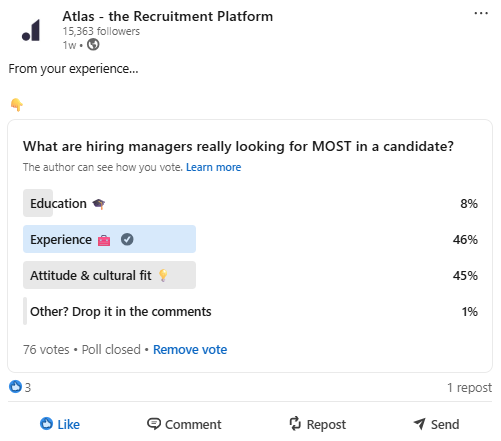
That said, this doesn’t mean education isn’t important. Many roles allow for on-the-job training, and quality candidates can also pursue certifications while working. Additionally, not all positions require specific certifications, which is why some hiring managers are flexible and don’t always prioritize formal credentials.
Finally, attitude and soft skills remain critical. Hiring managers want top candidates who will integrate well with the existing team and company culture and while technical skills can often be taught, soft skills and attitude are much harder to train.
These findings highlight a strong preference for practical, hands-on experience, while still recognizing the importance of soft skills, adaptability, and cultural alignment.
What Are the Benefits of the Right Hires?
When a company’s hiring process is successful, and candidates possess all of the above, while hiring managers and recruiters use the right applicant tracking systems, the overall candidate experience improves significantly.
As a result, new hires are more likely to stay with the company, transition smoothly into their employment contract, and grow alongside it. This also helps build a team of trusted employees who truly fit the company environment, reducing the likelihood of early turnover.
As a result, organizations can reduce the cost and time associated with replacing or letting go of employees, since hiring and onboarding someone new requires significant resources.
Last but not least, well-structured processes and hiring practices, supported by effective communication throughout the hiring journey, increase productivity across team members and the organization as a whole. By hiring new employees who align well with one another and fostering a positive experience from the very beginning, companies create a strong and supportive work environment.
In this environment, employees can enjoy working together while remaining engaged, motivated, and successful.
What Truly Matters to Hiring Managers and Recruiters
To conclude, many factors hiring managers, recruiters, and the HR department pay attention to throughout the entire recruitment and talent acquisition process. These factors span from the very first message or phone call to the final impression at the last stage, whether the interview is in person or online. This is especially important as they evaluate top talent within an increasingly competitive talent pool.
The ideal combination includes strong work experience with the required tools, relevant education paired with a willingness to keep learning, and a positive attitude. Being a team player, showing initiative, and taking ownership are also highly valued traits.
It’s important to remember that soft-skill expectations can vary depending on the company. For example, larger organizations often prioritize professionalism and teamwork. Startups, on the other hand, tend to value ownership, adaptability, and the ability to build or start things from scratch.
Ultimately, when technical skills and soft skills align with team culture and goals, they play a crucial role in the final hiring decision. This alignment leads to stronger teams, better performance, and long-term success for both the employee and the organization.

Related news

// Recruitment Strategies, Executive Search Best Practices
How Do You Present Your Top Candidates During the Interview Process?
Learn key ways to present candidates effectively and discover how the client view feature streamlines sharing profiles with clients.
12/12/2025
7 MIN
// Recruitment Strategies, Executive Search Best Practices
How Do You Present Your Top Candidates During the Interview Process?
Learn key ways to present candidates effectively and discover how the client view feature streamlines sharing profiles with clients.
12/12/2025
7 MIN

// Recruitment Strategies, Executive Search Best Practices
5 Ways an AI Interview Transcript Transforms Your Recruitment
Discover how AI note-taking and interview transcripts save time, improve focus, and make every interview smarter.
11/06/2025
5 MIN