









// Recruitment Technology, Recruitment Strategies
The Case for a Holding Area Before the CRM
Published: 17 November 2026,
8 min to read
The bottom line
High inbound volume has made automatic push into the CRM a liability. Agencies switch it off, then lose the strong applicants along with the noise. A gated holding area solves both halves of that. Every applicant is graded against the role first, and only approved people cross into the database.
Decide deliberately where filtering happens. Getting it wrong does not cost you storage. It costs you placements you never knew were in the pile.
What 1,500 responses to one advert does to your candidate database
Three hundred responses to a single advert was a talking point five years ago. On a volume desk it is now a quiet Tuesday, and 1,500 barely registers. Almost none of that pile gets read closely. That is why AI applicant screening software has moved from curiosity to infrastructure on high volume desks.
The volume is structural rather than seasonal. LinkedIn now processes 11,000 job applications a minute, a 45% rise in a single year. Generative AI tools drive much of that increase. Applying costs a candidate close to nothing now, while reviewing still costs your team the same hour it always did.
Seventy-nine agencies have raised this with us on recorded calls, and the symptom is always the same. Somebody turned off the job board integration that pushes applicants straight into the CRM. Nobody wrote a policy. One consultant switched it off on a Tuesday afternoon, and that became the policy.
Why do agencies turn off auto-push into the CRM?
Because a database stops being an asset the moment it fills with people nobody assessed. A CRM record carries an implied claim: somebody looked at this person and judged them worth keeping. Auto-push breaks that claim at scale, and manual screening after the fact never catches up with the inflow.
The damage shows up in search rather than in storage. A consultant searches the candidate database and gets 400 hits. Nothing shows which of them a human ever qualified. Every agency has someone who does exactly that, sighs, and opens LinkedIn instead. Data decay finishes the job, because candidate data nobody has spoken to ages faster than data attached to a conversation.
The load is measurable elsewhere too. Robert Half found that 67% of US HR leaders say reviewing AI-generated applications has slowed their hiring. Another 84% report heavier workloads. Agency teams carry that same weight across more live roles and fewer people per role.
So the integration gets switched off, and one problem is traded for another. The noise stays out of the CRM. So do the six genuinely strong responses sitting in a shared inbox that nobody owns.
What should the holding area do with every applicant before a record exists?
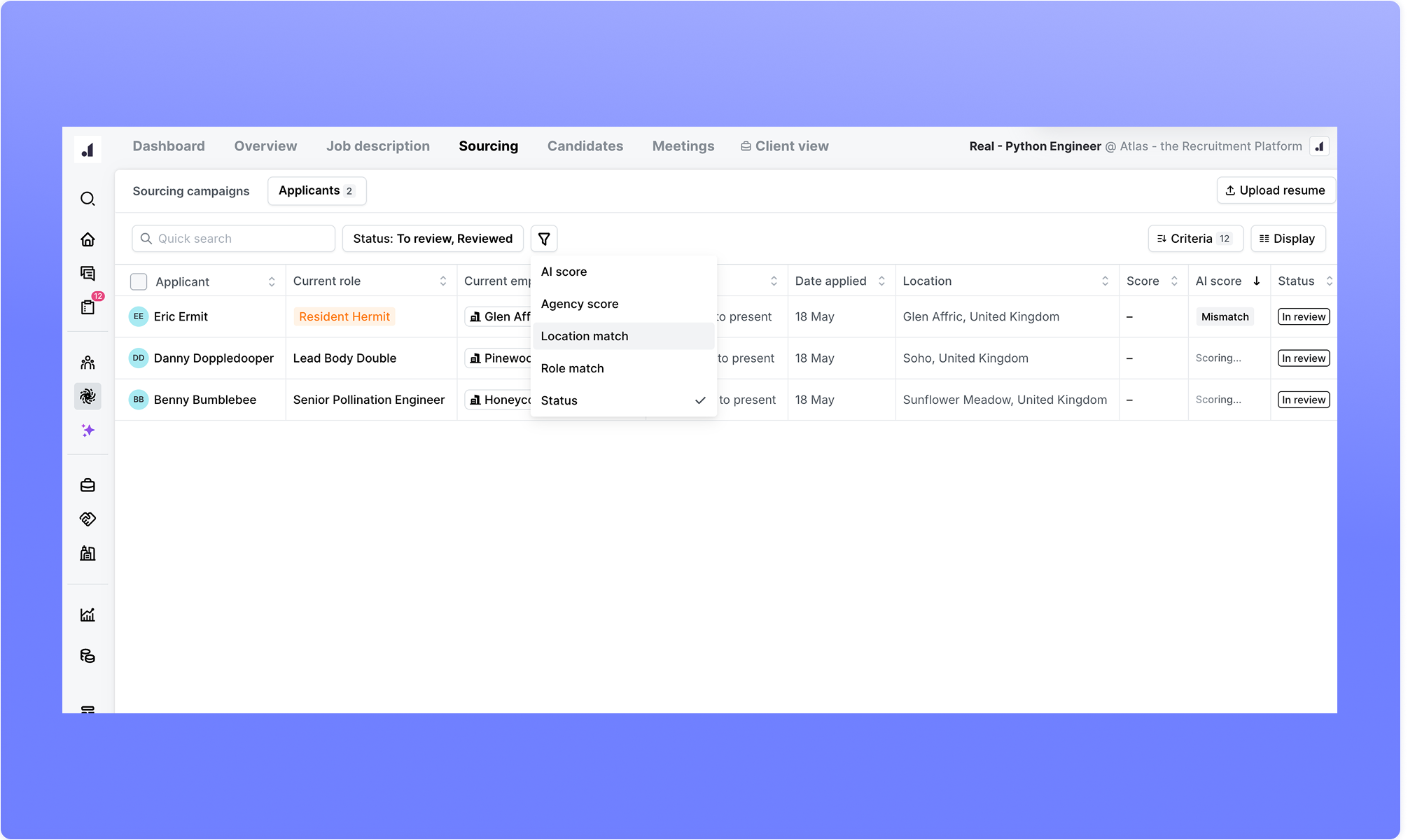
It should grade them. A gated holding area runs the whole screening process outside the database. Criteria come from the job description, ranked from hard requirements down to nice-to-have. Every applicant is then measured against the same bar.
That is what scores candidates consistently, whoever is covering the role. Two consultants working one advert apply a single standard rather than two personal ones. The score has to arrive with candidate evidence attached, drawn from the resume itself. A recruiter can then see which criteria were met and which were not.
Grading inbound before it reaches your records is the purpose of applicant screening in Atlas. The platform is an AI-powered recruitment system that uses agentic AI to remove admin from the workflow. Applicants stay fully separate from the database until someone accepts them. Rejections go out from stored templates, and every decision is logged with a name and a timestamp.
That log matters more than it first sounds. When a hiring manager asks why someone never reached the shortlist, the answer exists. Automated candidate screening turns a judgment call into something defensible, which is the difference between a process and a habit.
Where should filtering happen on a high volume desk?
In one of four places, and the choice deserves a decision rather than a default. Filtering can sit in the advert, in job board knockout questions, in the holding area, or in the CRM.
Each option costs something different. The advert filters by deterring people, which is cheap and extremely blunt. Knockout questions reject on self-reported answers. Candidate responses to those questions now come from the same AI tools that wrote the application. Filter in the CRM and you have already paid the price described above.
The holding area is the only place where a near-miss stays visible and recoverable. Someone who fails one preferred criterion is still ranked and still searchable. On a job board they are a rejection email, and nobody on your team learns what was lost.
Better filtering shows up in the ratios your managers already watch. Aym Recruitment cut its CV-to-interview ratio from 2.2 to 1.4 over eight months. A consistent check in front of every submission did most of that. Fewer sends for the same interviews, and faster hiring decisions on the client side.
How does AI applicant screening software protect the strong CVs?
By ranking instead of discarding. AI candidate screening tools that score and explain leave every applicant in view, ordered by fit. The eighth-best person is a scroll away rather than gone. Manual screening at volume works the other way round. Readers tire, and the last hundred resumes get a worse look than the first ten.
Criteria also have to be editable once the role is live. Briefs move after the intake meeting. A client softens one requirement and hardens another. A screening layer that cannot be re-scored is out of date by Wednesday. Re-running the evaluation against revised criteria pulls back the people your original bar excluded.
Adoption is well past the experimental stage. Atlas benchmark research found that 42.47% of agency recruiters now use AI for resume screening. Another 80.82% use it for admin and data entry.
Final hiring decisions stay with the recruiter. What an AI applicant tracking system contributes is candidate evaluation at speed. Human judgment then applies to a ranked list rather than an unsorted inbox. Approval rates per role belong on your live dashboards too. A desk approving 2% of inbound and a desk approving 40% are telling you different things.
Frequently asked questions (FAQs) on applicant screening before the CRM
It is a gated space where inbound applicants are graded against a role. Nobody becomes a candidate record until a recruiter approves them. Recruiters review the scored applicants, approve the ones worth pursuing, and reject the rest. Data quality then stops being a function of application volume.
No, because applicants in a holding area are not records your team maintains, tags or searches. They sit against one role, they are scored against that role, and they resolve into an approval or a rejection. Nothing lingers for someone to clean up later.
Not if it ranks rather than rejects. Scoring software should order applicants by fit and show the evidence behind each score. The accept or reject decision stays with a recruiter. The real risk of losing good people sits in blunt knockout questions on a job board.
They should receive a prompt, professional rejection sent from a stored template. That protects your brand with people who may fit a future role. Handling it inside the screening process removes the task from a recruiter’s list. At 1,500 responses per advert, that is the difference between replying to everyone and replying to nobody.
It usually improves it. A graded, ranked list means the first shortlist can be assembled within minutes of the advert going live. Nobody has to work through resumes in order of arrival. The gate adds a step on paper and removes several in practice.
What your database looks like next year is being decided this quarter
Inbound volume is not going to fall, and no agency is adding headcount to read it. The agencies handling this well treat the question as a design decision rather than a software setting. Screening belongs in front of the database, not inside it.
Most of that work does not need a person at all. Reading, scoring, evidencing, logging and replying can run in the background through agentic AI. Your consultants stay on the phone. That model is what Atlas is built on, so the AI-powered CRM your team searches every day only ever holds people a recruiter approved.
Worth a look before your next volume campaign goes live.