









// Recruitment Technology, Recruitment Strategies
Job Boards Are Off the Budget. Here's Where the Money Went
Published: 19 November 2026,
8 min to read
The bottom line
Job board response quality has fallen far enough that broad board spend no longer defends itself on a billing sheet. Agencies are keeping the one or two sources that still produce placements. The rest of the budget moves to LinkedIn slots and their own site. The gain comes from what a smaller mix allows: branded apply routes and fewer channels to manage. Applications then land against the job record rather than in a consultant’s inbox.
Where the job board money actually went
Job board contracts are being cut at agencies that renewed them without argument for a decade.
The trigger is rarely a strategy meeting. It is a quarter where someone divides the board invoice by the placements it produced. The number rarely survives the conversation. Most of those contracts had been surviving on renewal dates rather than results.
A recruitment advertising strategy written for 2019 assumed scarce applications and expensive reach.
Both halves of that assumption are gone. Applications are abundant and close to free to send. Reach costs more and buys a lower grade of response. Across more than 60 agency conversations, the same shape keeps appearing. Indeed spend cut back. One or two boards retained. LinkedIn slots and the agency website carry the rest.
Why did job board response quality collapse for agency desks?
Because applying became almost free while the number of live roles stayed flat.
LinkedIn now sees 11,000 applications submitted every minute, up 45% in a year. Generative AI tools are feeding much of that deluge. Job openings did not grow to match. Indeed’s job postings index stood at 103.8 in October 2026, under 4% above its February 2020 baseline. New postings are drifting sideways.
Same inventory. Far more paper.
On a perm desk this shows up as a response rate that looks healthy and converts like nothing. Applications arrive tailored and keyword-matched, and they read nearly identically. Four hundred applications against one live role is a reading assignment with a talent pipeline hidden somewhere inside it.
The cost moved rather than disappeared. It came off the invoice and landed on your consultants. They now start the day separating qualified candidates from job seekers who applied to everything. That is why automated candidate screening became a line item before anyone decided to cut a board.
What does a leaner recruitment advertising strategy look like in practice?
Fewer paid channels, each with a defined job, and a measured route for everything else.
Agencies that have done this tend to get there in the same order.
Step four is where the released money does the most work. A board buys access to people actively applying. That is a small and heavily contested slice of any market. Multi-touch outreach reaches passive candidates who never see your advertisement. The AI-powered CRM your team already pays for holds thousands of them.
A database you have already paid to build is the cheapest channel you own. That holds only while the records stay current enough to act on.
- Rank every board by placements across the last four quarters. Application volume flatters a bad channel, and clicks flatter it further.
- Keep the one or two sources that fill your core desks, and let broad-reach contracts lapse at renewal rather than canceling mid-term.
- Move the released budget into targeted paid advertising where your audience sits, usually a handful of LinkedIn slots per quarter, plus your own site.
- Point the remainder at outreach and your database, because the people worth placing are rarely the ones reading job listings this week.
Should applications land on your careers page or in a consultant’s inbox?
On your careers page first, and then against the job record. Neither is where most applications land today.
A branded apply route does work a board apply button cannot. It puts your agency’s name on the application process and keeps the candidate experience consistent. You also own the first-party data rather than renting someone else’s. Your job postings become an asset you hold rather than inventory you lease by the month. Job posting software that publishes roles to your website keeps the careers site producing applications between campaigns.
The inbox problem costs more than the channel problem.
When applications arrive as email, a consultant becomes the system of record. Nothing is graded and nothing is attributable. The CV that matched a different live role stays buried in a thread. 36.99% of agency recruiters name too much manual work as their biggest operational challenge. An inbox-shaped funnel at volume is one way to produce it.
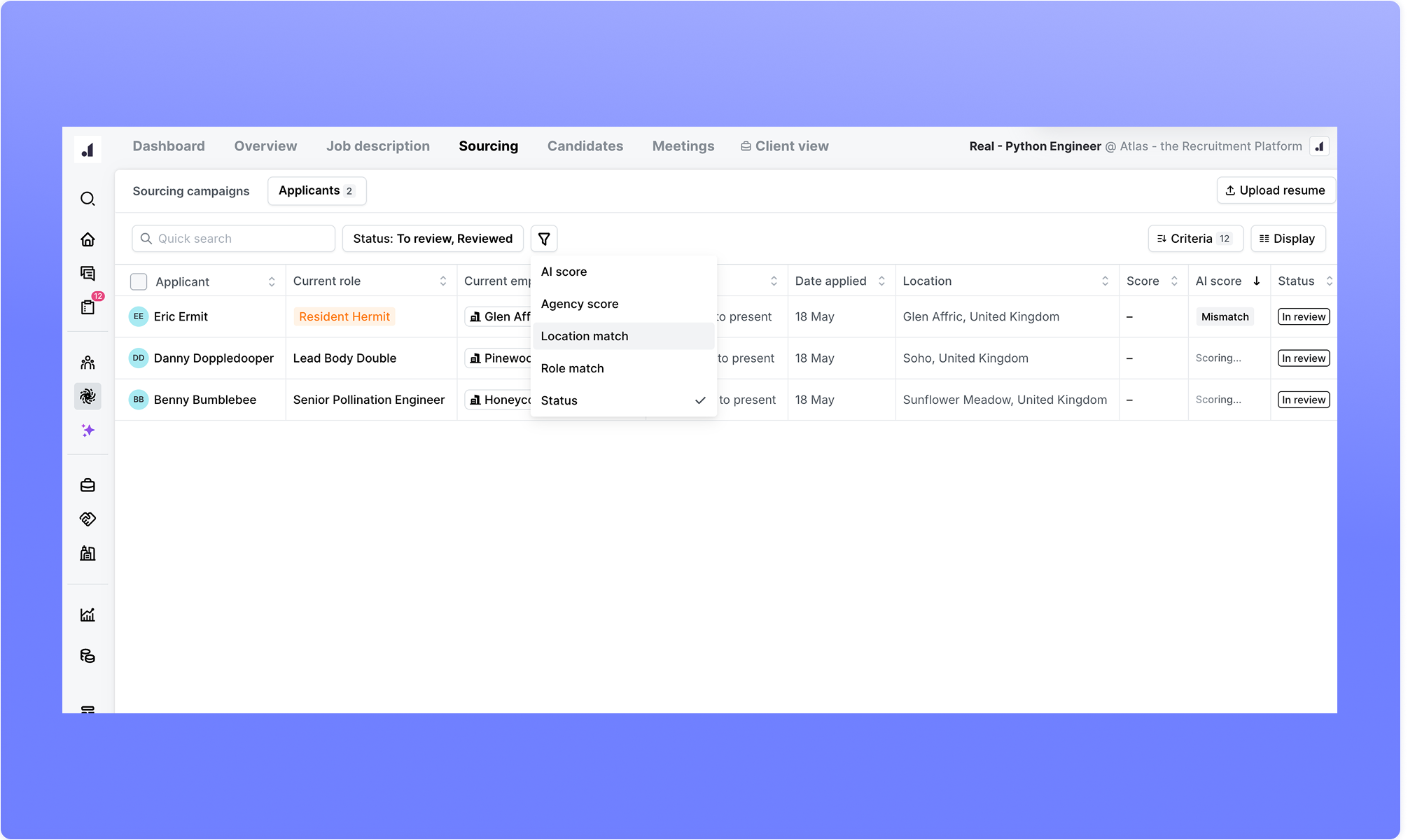
Grading applications against the brief before anyone opens them has become normal practice at agencies running a narrow channel mix. Atlas is an AI-powered CRM and recruitment platform that uses agentic AI to lift admin off the desk. It scores every applicant against criteria generated from your job description, with the reasoning attached to each score. Applicants stay separate from your database until you approve them. A poor month of board traffic cannot degrade the records your team searches. Approving someone moves them into the project inside the AI-powered ATS.
How do you prove which channel produced the placement?
Record the source on the job record at the point of application. Then read it on a dashboard, rather than asking consultants to remember at renewal time.
This is where most board decisions stall. The invoice is precise and the return is anecdotal. The contract renews by default, and the argument waits another year.
Attribution that survives that conversation needs the application, its source, its stage and its outcome on one record. Custom dashboards then make it readable by desk, consultant, client and period.
Speed is the second measure worth watching, because a leaner mix only pays if it shortens time-to-send. Novify cut shortlist delivery by 96% and saved more than 20 hours of admin a month. The gain came from consolidating its workflow onto one platform. Fill rate and placements per source tell you what to renew. Time-to-send tells you whether your team can act on what the remaining channels bring in.
Frequently asked questions (FAQs) on job board spend and recruitment advertising
Most agencies that review their spend properly end up with one or two, chosen on placements rather than application volume. The right number depends on your desks. High-volume contract work often justifies a specialist board, and senior perm roles rarely do. Rank each contract by placements over four quarters before the next renewal date.
For senior perm roles, agencies report a better return from a few LinkedIn slots than from broad board contracts. The audience there sits closer to the brief. The trade-off is cost per slot. Slots work best when held back for roles that are hard to fill. Volume desks often still need a specialist board alongside.
Two destinations absorb most of it. The first is your own site as a branded apply route. The second is outreach to passive candidates who never see an advertisement. A board contract stops producing the day it lapses, while a careers page and an enriched database keep working.
Raw application volume usually falls, and placements often hold. Much of what a broad board produces now is unqualified applicants who applied to everything. That costs screening time without improving the shortlist. Watch placements per source and your submission-to-interview ratio rather than total job applications.
Record the source on the job record at the point of application rather than reconstructing it later. When applications land against the job rather than an inbox, source, stage, owner and outcome stay on one record. A dashboard can then report placements by channel without anyone compiling it by hand.
A careers page, wherever you can route them there. It keeps the candidate experience under your control and puts your employer brand on the application process. You also get first-party data on every applicant rather than a partial feed. Board apply routes still earn their place on volume roles, provided the application reaches your system intact.
The advertising budget decision your agency is already making
Every quarter a board contract renews untested is a decision taken by default. It favors a channel whose output your team spends hours filtering. The agencies moving first still invest in candidate attraction. The money now goes where it compounds. Fewer paid channels, an apply route they own, a database worth searching, and a system that grades whatever arrives.
The commercial case gets clearer once admin is counted. Hours spent sorting board traffic are hours not spent on BD calls and candidate control. That cost grows every quarter the setup stays as it is. Putting applicant grading and channel reporting on the same job record is what Atlas does. A leaner mix becomes measurable rather than a matter of faith.
Before your next renewal date, it is worth seeing those applications land somewhere your team can act on.