











// Recruitment Strategies
All-in-One Recruitment Software: Why It Matters for Your Agency
Published: 21 April 2026,
9 min to read
Most staffing businesses don’t have a people problem. They have a data problem disrupting their entire hiring workflow.
Across the average mid-size agency, recruiters are switching between an applicant tracking system (ATS), a customer relationship management system (CRM), a sourcing tool, an email platform, a job board aggregator, and a reporting dashboard. None of which talk to each other particularly well. Every system holds a piece of the picture. No single system holds the context of their entire hiring process.
That fragmentation has a cost for scaling staffing agencies. Not in the obvious sense of paying multiple vendor invoices alone, but in the subtler, harder-to-quantify ways: time lost to manual data entry, placements that slip through because a follow-up fell between systems, and revenue forecasts built on numbers that three different tools report differently.
All-in-one recruitment software addresses this at the root with a unified solution. Here’s what that actually means for your agency’s bottom line.
The Hidden Cost of a Fragmented Rec Tool Stack
When decision-makers evaluate their recruitment software spend, they tend to look at license fees. That’s understandable, because it’s the number that shows up on the invoice. The real cost of running multiple disconnected tools, though, rarely lives on a single line item.
Consider what your recruiters do every day. A candidate is sourced in one tool, added manually to the ATS, their communication history lives in the email client, their stage in the process is tracked in a spreadsheet, and the hiring manager update goes out through a separate platform. Each of those handoffs is an opportunity for data to get stale, duplicated, or lost entirely.
There’s also the administrative recruiting software overhead to consider. Time spent reconciling data across systems, building manual reports, and troubleshooting integrations that break after a vendor update is time your team isn’t spending on revenue-generating activity. In a business that runs on relationships and responsiveness, that trade-off matters.
What a ‘All-in-One’ Recruiting Platform Actually Means
The term gets used loosely, so it’s worth being specific. True all-in-one recruitment software is a platform built from the ground up so that candidate data, client data, communication history, pipeline activity, and reporting all share the same underlying database.
That distinction matters more than it might seem. When data is genuinely centralized rather than synced between separate systems, you eliminate the latency that causes misalignment and optimize performance where it really matters. A candidate’s status updates everywhere the moment it changes. Fee agreements are visible to every recruiter working on specific accounts. A placement’s revenue contribution flows automatically into your forecasting without anyone having to enter it twice.
All-in-one also doesn’t mean you’re locked out of every external tool you rely on. The best platforms in this space are built with open APIs and native integrations. The goal is to have a single source of truth that multiple channels and external tools feed into, rather than a patchwork of systems each claiming ownership of different data.
Data Misalignment: The Quiet Recruiter Productivity Leak
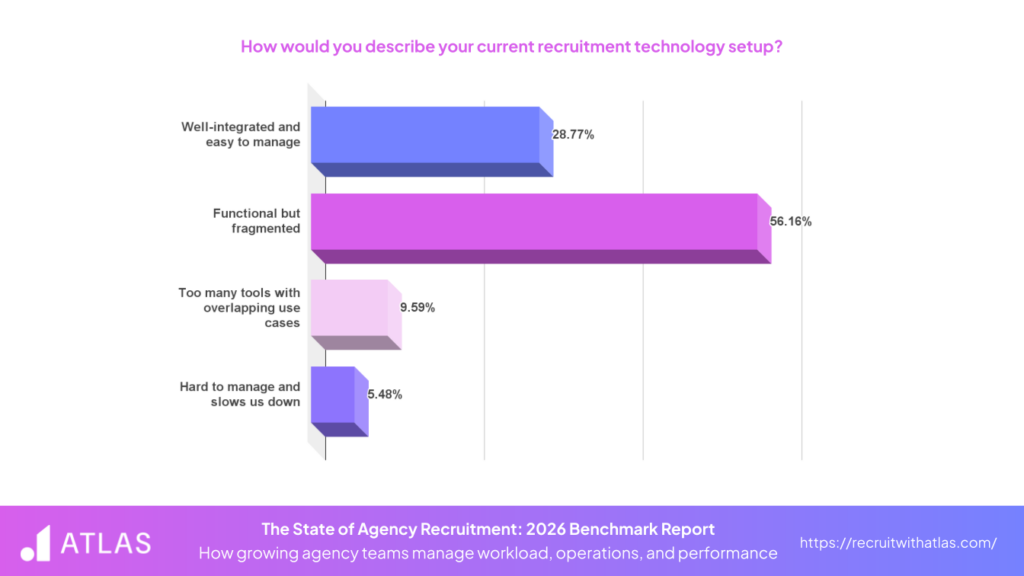
Data misalignment is one of those problems that feels manageable for staffing firms until it isn’t. It starts small: a duplicate candidate record, a follow-up email sent to the wrong stage of a process, a report that shows different headcount numbers depending on which system you pull from. None of those things are catastrophic on their own. According to Atlas research, 56.16% of agency recruiters report a functioning but fragmented tool stack.
Recruiters stop trusting the data and start maintaining their own records, usually in spreadsheets. Managers can’t make confident hiring decisions because the pipeline numbers aren’t reliable. Business development conversations with clients stall because your account data is incomplete or out of date, not to mention the data security implications.
When your entire operation runs through a unified system, this dynamic changes. There’s one version of every candidate, every client, every job order. Your recruiters spend their time working the data rather than auditing it. And your leadership team can make decisions based on numbers they actually trust.
That reliability has a direct effect on revenue. Agencies that run tighter pipelines, where every lead is tracked, every follow-up fires on time, and no top talent goes cold because they fell between systems, close more placements per recruiter. The economics are straightforward and user-friendly, even if the problem is invisible until you solve it.
How Centralizing Your Stack Reduces Operational Cost
Vendor Consolidation Under One System
Enterprise companies running separate tools for their ATS, CRM, sourcing, and analytics pay four different subscription fees, potentially at different billing cycles, with different contract terms and renewal dates to manage. Consolidating onto a single platform typically reduces that spend and eliminates the ongoing cost of managing those vendor relationships.
New Hire Onboarding and Training
When a new recruiter joins your team, the learning curve for a single integrated platform is meaningfully shorter than the learning curve for four separate tools with four separate logins, interfaces, and data models. And between learning the ins and outs of your CRM software, reporting tools, and other platforms, they spend more time on routine tasks instead of starting to place talent faster. This translates to real financial value because new hires become revenue-generating sooner.
Existing ATS/CRM Integration Overhead
Every connection between two separate systems is a maintenance liability. APIs change, vendors update their authentication methods, and integrations break. If you have an internal IT function or an MSP handling these, you’re paying for that maintenance. If you don’t, the maintenance burden falls on your most technically capable recruiter, which is an expensive use of their time.
The Revenue Upside: More Placements, Better Margins
Cost reduction is one side of the equation. The revenue upside of all-in-one recruitment software is equally significant, and arguably more compelling for growth-focused agencies. When your pipeline is clean and your follow-up is automated through a central hub, your recruiters can carry more active roles without dropping the ball on any of them.
The capacity increase that comes from eliminating manual admin, including data entry, report building, and cross-system reconciliation, frees up time that goes back into candidate outreach and client development. AI-driven outreach can automate the generation of personalized candidate emails, allowing recruiters to focus on strategic engagement rather than repetitive tasks.
Curating the Client and Candidate Experience
There’s also a compounding effect on client relationships. When your account management team has a complete, accurate view of every interaction with a client, every placement in the talent pool, every conversation, every open role and its job description, they can have more informed conversations and identify expansion opportunities they’d otherwise miss. That kind of visibility is almost impossible to maintain for recruiting agencies across fragmented systems.
Reporting is another area where the revenue impact becomes tangible. When your data is centralized, you can see which recruiters are most effective at which types of roles, which sourcing channels have the best placement rates, and which client segments generate the most margin. Those insights inform better hiring decisions, better business development targeting, and better resource allocation across your team.
What to Look for When Evaluating All-in-One Platforms
Not every platform that markets itself as all-in-one is genuinely built that way. When you’re evaluating options for your agency, a few questions cut through the noise quickly.
Ask whether the ATS and CRM share a single database or whether they’re separate modules with a sync layer between them. The latter looks the same on a demo but behaves very differently in production. Sync delays and conflicts are common, and you’re still maintaining two data models under the hood.
Ask what the reporting architecture looks like. Genuinely centralized platforms can generate cross-functional reports, including pipeline activity by client, time-to-fill by sourcing channel, and revenue per recruiter, without needing a data warehouse or manual export. If the answer involves a CSV export and a pivot table, that’s a fragmentation problem wearing a different mask.
Ask about the onboarding and migration process. Moving from multiple tools to a single platform is a significant operational change, and how a vendor handles that transition tells you a lot about how they’ll handle the relationship long-term. Platforms that offer structured data migration, dedicated onboarding support, and clear timelines are meaningfully different from those that hand you a knowledge base and wish you well.
Finally, ask about the product roadmap and how often the platform ships updates that reflect recruiter feedback. The best all-in-one platforms in this space, like Atlas, are actively developed by teams that work closely with agency recruiters, meaning the product improves in ways that are relevant to how your team actually works.
The Bottom Line for Agency Decision-Makers
Recruitment is a relationship business, and relationships depend on information. Who said what, when they said it, where they are in a process, and what comes next. When that information lives across four different systems, none of which fully agree with each other, your agency is operating with an incomplete picture of its own business.
The case for all-in-one recruitment software comes back to that fundamental problem. Data misalignment isn’t a minor inconvenience. It quietly undermines the decisions your team makes every day, from which candidates to prioritize to which clients are worth investing more time in. Fixing it at the source, by centralizing everything into a single platform, removes an entire category of risk from your operation. A centralized dashboard also allows hiring managers and recruiters to access the same up-to-date information.
The agencies that will grow fastest over the next few years won’t necessarily be the ones with the largest teams or the biggest marketing budgets. They’ll be the ones whose operations are tight enough that nothing falls through the cracks, whose recruiters spend their time on the work that actually generates revenue, and whose leadership can make clear-eyed decisions based on data they trust. All-in-one recruitment software is the infrastructure that makes that possible.
Atlas – AI-Powered CRMx Platform Built for Agency Recruiters
Atlas is a CRMx platform built specifically for agency recruiters. Where conventional all-in-one recruitment software centralizes your data, Atlas goes further by capturing context automatically across every conversation, call, email, and message, and turning it into action without your team having to lift a finger. If you’re evaluating recruitment software for your agency, it’s worth seeing what a platform built around context, rather than data entry, actually looks like in practice.